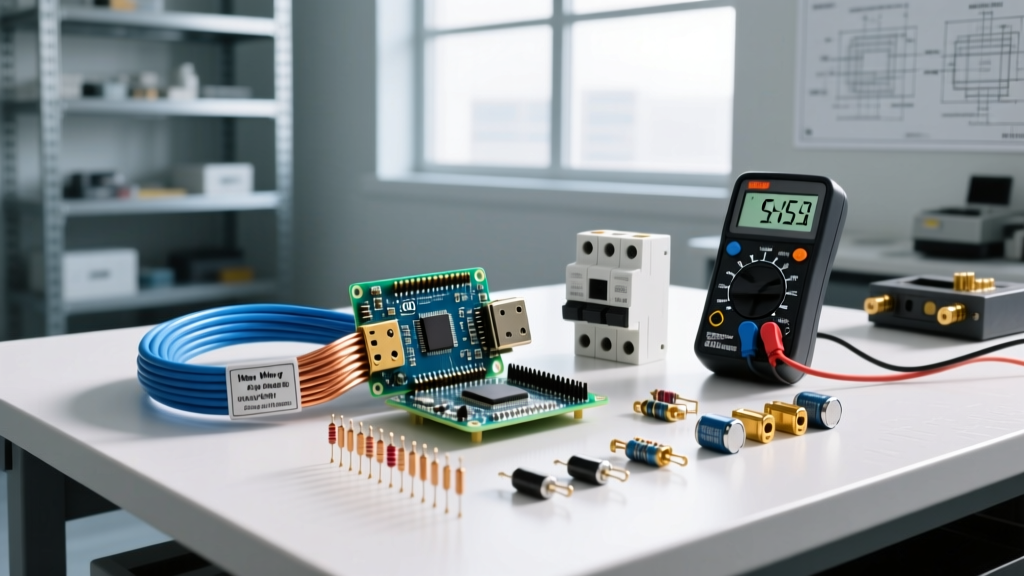
The standard volts in the US for residential power is a split-phase 240V system that delivers 120V for everyday outlets and 240V for heavy appliances. This single architectural decision dictates everything from the NEMA receptacles on your walls to the gauge of copper THHN wire you pull through your conduit, and misunderstanding it is the fastest way to trip a main breaker or start an electrical fire.
The Split-Phase Reality: How US Volts Are Delivered
When the utility company routes power to your house, the pole-mounted or pad-mounted transformer steps the distribution voltage (usually 7,200V) down to 240V. The secondary winding of this transformer has a physical wire connected to its exact electrical center. This center tap is bonded to ground at your main service panel, creating the Neutral conductor.
Because the alternating current (AC) sine wave pushes and pulls, the two outer ends of the transformer winding (Leg 1 and Leg 2) are 180 degrees out of phase with each other. When L1 is at its positive peak (+170V peak / 120V RMS), L2 is at its negative peak (-170V peak / 120V RMS). The potential difference between them is 240V RMS.
According to U.S. Energy Information Administration (EIA) guidelines and ANSI C84.1 standards, the acceptable voltage ranges at the receptacle are:
- 120V Nominal: Acceptable range is 114V to 126V.
- 240V Nominal: Acceptable range is 228V to 252V.
Worked Example: Sizing Breakers and Wire for 120V vs 240V
What does voltage actually change in a real circuit? It dictates current. For a given amount of power (Watts), higher voltage means lower current. Lower current means you can use smaller, cheaper wire and suffer fewer $I^2R$ (heat) line losses. Let us run the math on two common resistive loads to see how this changes your installation.
Load A: 1500W Portable Space Heater (120V Circuit)
- Current Draw: $I = P / V \rightarrow 1500W / 120V = 12.5A$.
- NEC Sizing: If run continuously (3+ hours), NEC 210.20 requires sizing at 125%. $12.5A \times 1.25 = 15.625A$.
- The Fix: You must use a 20A single-pole breaker and 12 AWG copper wire (NM-B or THHN). A standard 15A breaker would nuisance-trip under continuous load.
Load B: 4500W Electric Water Heater (240V Circuit)
- Current Draw: $I = P / V \rightarrow 4500W / 240V = 18.75A$.
- NEC Sizing: NEC 422.13 mandates storage water heaters be sized at 125%. $18.75A \times 1.25 = 23.43A$.
- The Fix: The next standard breaker size up is 25A, but standard practice and panel availability dictate a 30A double-pole breaker paired with 10 AWG copper wire.
If you tried to run that 4500W water heater on 120V, it would pull 37.5A (46.8A continuous). You would need massive 6 AWG wire and a 50A single-pole breaker, and the voltage drop over a 50-foot wire run would be severe. This is exactly why the US split-phase system uses 240V for heavy loads.
Where You Meet This in Practice
You will physically interact with the 120V/240V split every time you open a panel or wire a receptacle. Here is how it manifests on the jobsite:
| Component | 120V Implementation | 240V Implementation |
|---|---|---|
| Breaker Panel Bus | Single-pole breaker clips to one bus bar stab (L1 or L2). | Double-pole breaker clips to two adjacent stabs (L1 and L2) via a handle tie or internal common trip. |
| Receptacle Type | NEMA 5-15R (Standard 3-prong: Hot, Neutral, Ground). | NEMA 14-50R (EV chargers/Ranges: L1, L2, Neutral, Ground) or NEMA 6-20R (240V only, no neutral). |
| Wire Colors (NM-B) | Black (Hot), White (Neutral), Bare (Ground). | Black (L1), White or Red (L2), Bare (Ground). *Note: 240V-only circuits can use 2-wire with ground; 120/240V appliances require 3-wire with ground. |
When wiring a subpanel, this split-phase reality is critical. You must keep the Neutral bar and Ground bar strictly separated in the subpanel. The 120V return current flows on the Neutral back to the main panel, while the Ground bar only carries current during a fault. Bonding them in a subpanel will cause 120V return current to flow on your grounding paths, energizing appliance chassis and creating a lethal shock hazard.
Common Confusions: 110V/220V vs 120V/240V
The most common mistake DIYers make is using legacy terminology to buy modern components. People frequently ask for '110V outlets' or '220V breakers'.
Historically, early 20th-century systems operated at lower nominal voltages due to higher line losses and less robust utility grids. As transformer technology and grid infrastructure improved, utilities pushed the nominal voltage up to 115V, then 117V, and finally standardized at 120V/240V to align with modern NEMA WD 6 Wiring Devices Standards.
When you measure a modern US outlet with a Fluke multimeter, you should read between 118V and 122V. If you read 110V, you have a severe voltage drop issue, a loose neutral connection at the utility pole, or an overloaded transformer. Always size your wire ampacity and breaker limits based on the 120V/240V nominal figures, not the outdated 110V/220V terms.
Frequently Asked Questions About Volts in the US
Are standard volts in the US 110V or 120V?
The official nominal standard is 120V for standard branch circuits and 240V for split-phase appliances. The terms 110V, 115V, and 220V are legacy holdovers from decades ago. Modern appliances and the National Electrical Code (NFPA 70) are engineered around the 120V/240V baseline. When calculating voltage drop or wire sizing, always use 120V or 240V in your formulas.
Why are volts in the US lower than Europe's 230V?
Europe standardized on 230V single-phase (formerly 220V) because higher voltage allows for thinner, cheaper copper wire across long distribution distances and reduces $I^2R$ line losses. The US stuck with the 120V split-phase system primarily for safety and legacy infrastructure reasons. 120V is significantly less likely to cause a fatal ventricular fibrillation shock or sustain a dangerous arc flash compared to 230V. By using split-phase, the US gets the safety of 120V for everyday use, while still achieving the efficiency of 240V for heavy loads like HVAC and EV chargers.
What happens if I plug a 230V European device into US volts?
If you plug a strictly 230V appliance (like a European hair dryer or kettle) into a standard US 120V outlet using a simple plug adapter, it will receive less than half its required voltage. Because power scales with the square of the voltage ($P = V^2 / R$), the device will produce roughly 25% of its rated heat or power, and motors may stall and burn out. You must use a step-up voltage transformer rated for the appliance's wattage, not just a physical plug adapter.
Can I get 3-phase volts in a US residential home?
Standard US residential service is strictly single-phase split-phase (120V/240V). True 3-phase power (120V/208V Wye or 240V Delta) is reserved for commercial and industrial buildings. If you are a hobbyist trying to run a 3-phase mill or lathe in your home garage, you cannot pull it from your panel. You will need to buy a rotary phase converter or a Variable Frequency Drive (VFD) that accepts 240V single-phase input and synthesizes a 3-phase output for the motor.