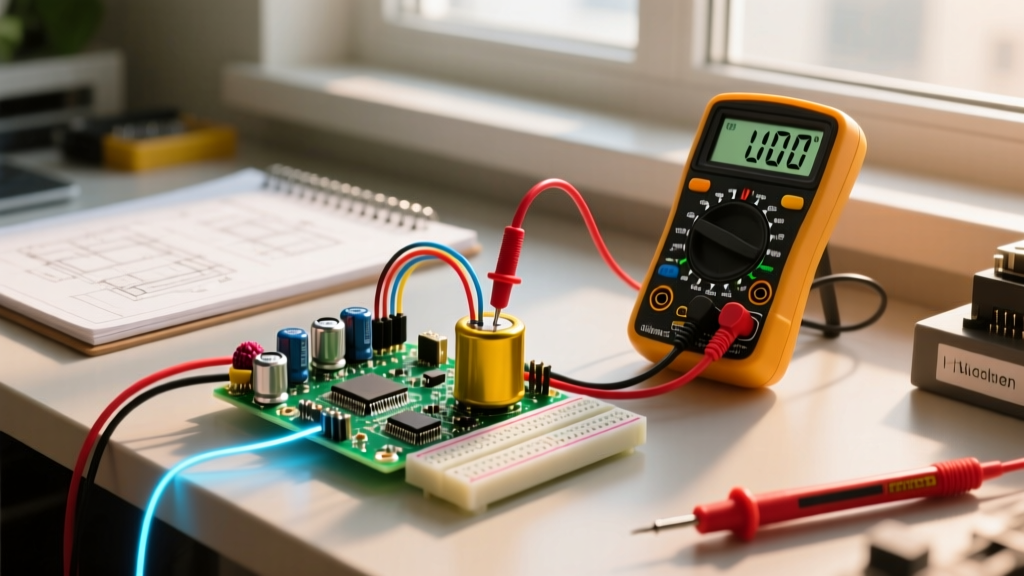
The standard values of resistors are defined by the IEC 60063 E-series (E12, E24, E96), which use a geometric progression to ensure overlapping tolerance bands. When designing, repairing, or adapting equipment for global markets, you cannot simply calculate a theoretical resistance; you must select the nearest standard values of resistors that safely accommodate regional mains voltage tolerances. For example, a voltage divider designed for a nominal 230V European mains must actually withstand 253V (+10%), while a North American 120V circuit must handle 126V (+5%). Selecting the correct E-series value ensures your bleeder networks, current-limiting stages, and sensing dividers operate reliably across borders without exceeding component power ratings.
The IEC 60063 E-Series and Global Voltage Sensing
Manufacturers do not produce resistors in every possible ohmic value. Instead, the IEC 60063 standard dictates preferred numbers based on a logarithmic scale. This ensures that the maximum and minimum tolerance limits of adjacent values overlap, eliminating gaps in available resistances.
- E12 Series (10% tolerance): 12 values per decade (1.0, 1.2, 1.5, 1.8, 2.2, 2.7, 3.3, 3.9, 4.7, 5.6, 6.8, 8.2).
- E24 Series (5% tolerance): 24 values per decade. The most common bench stock for general-purpose through-hole and SMD resistors.
- E96 Series (1% tolerance): 96 values per decade. Used for precision voltage sensing and ADC scaling.
Worked Example: You are designing an AC mains zero-cross detector for an ESP32 using an optocoupler and a current-limiting resistor. The nominal EU voltage is 230V AC, but the EN 50160 standard permits a +10% tolerance, pushing the RMS voltage to 253V. The peak voltage is therefore 253V × √2 ≈ 358V. If your optocoupler LED requires 10mA peak current, Ohm's law dictates R = 358V / 0.01A = 35,800Ω. Looking at the E24 series, the closest standard value is 36kΩ. Furthermore, you must calculate power dissipation (P = V²/R). At 253V RMS, P = (253²) / 36,000 ≈ 1.78W. A standard 2W resistor is required, or you can chain two 72kΩ (E24 standard) 1W resistors in series to distribute the heat and voltage stress.
Regional Voltage Standards and Equipment Tolerance
When importing equipment or designing for global deployment, understanding the local grid's nominal voltage, tolerance, and frequency is critical. What a device must tolerate depends entirely on its power supply architecture. Modern Switch-Mode Power Supplies (SMPS) auto-scale from 100V to 240V, making them immune to regional differences. However, purely resistive loads (heaters, incandescent lamps) and transformer-based linear supplies will overheat or underperform if plugged into the wrong regional grid.
| Region | Nominal Voltage | Statutory Tolerance | Frequency | Common Plug Types |
|---|---|---|---|---|
| North America (US/CA) | 120V / 240V | ±5% (ANSI C84.1) | 60 Hz | NEMA 1-15, NEMA 5-15 |
| Europe (EU/EEA) | 230V | +10% / -6% (EN 50160) | 50 Hz | CEE 7/7 (Schuko/French) |
| United Kingdom | 230V | +10% / -6% (BS EN 50160) | 50 Hz | BS 1363 (Type G) |
| Australia / NZ | 230V | +10% / -6% (AS/NZS 3000) | 50 Hz | AS/NZS 3112 (Type I) |
| Japan | 100V | ±5% (JIS) | 50 Hz (East) / 60 Hz (West) | JIS C 8303 (Type A/B) |
If you must run a 120V resistive heating appliance (like a travel iron) on a 230V European grid, you must use a heavy, magnetic step-down transformer. Never use a lightweight solid-state travel 'converter' (which uses a triac to chop the AC sine wave in half). Converters are only safe for simple resistive heating elements; they will instantly destroy motor loads, digital clocks, and the input rectifiers of switch-mode power supplies. Furthermore, while resistors are immune to frequency changes, AC motor loads are not. Running a 60Hz motor on a 50Hz grid reduces its RPM by 20%, which proportionally reduces the internal cooling fan speed, frequently leading to thermal failure.
Conductor Color Mapping and Mixed Installation Standards
When integrating imported machinery into a local facility, the internal wiring of the equipment often clashes with the building's fixed wiring standards. Equipment built to IEC standards uses different color codes than equipment wired to the US National Electrical Code (NEC).
| Function | IEC 60446 (EU / Global Equipment) | NEC Article 200/250 (US Premises) |
|---|---|---|
| Line 1 (Hot) | Brown | Black (or Red/Blue for multi-phase) |
| Line 2 (Hot) | Black | Red |
| Neutral (Grounded) | Blue | White or Gray |
| Protective Earth (Ground) | Green/Yellow Stripe | Green, Green/Yellow, or Bare Copper |
Which standard governs a mixed installation?
The local Authority Having Jurisdiction (AHJ) and the adopted building code (e.g., the NFPA 70 NEC in the US) always govern the fixed premises wiring. If you import a CNC machine with IEC-colored internal wiring (Brown/Blue/Green-Yellow), the machine's internal wiring is grandfathered under its original manufacturing standard (like UL or CE). However, the external feeder and branch circuit wiring connecting the machine to the building's disconnect switch must follow the local NEC color codes. The transition point must occur inside a clearly marked junction box or disconnect enclosure, and mixing IEC blue (which is 'hot' in the US for DC or sometimes switchlegs) with NEC white (neutral) in the same conduit is a severe code violation and shock hazard.
FAQ: Standard Values of Resistors in Global Designs
What are the standard values of resistors for a 5% tolerance?
For a 5% tolerance, you use the E24 series. The base values for a single decade (e.g., 10 to 100 ohms) are: 10, 11, 12, 13, 15, 16, 18, 20, 22, 24, 27, 30, 33, 36, 39, 43, 47, 51, 56, 62, 68, 75, 82, and 91. These values repeat across all decades (e.g., 4.7Ω, 47Ω, 470Ω, 4.7kΩ, 47kΩ). The 5% tolerance on a 47Ω resistor means its actual measured value will fall between 44.65Ω and 49.35Ω.
How do standard values of resistors change when scaling from 120V to 240V circuits?
The ohmic standard values (E12/E24) do not change, but the physical wattage rating and circuit topology must. Because power dissipation scales with the square of the voltage (P = V²/R), doubling the voltage from 120V to 240V across the same standard resistor value quadruples the heat generated. To maintain the same current and power dissipation in a 240V circuit, you must double the resistance value (selecting the next appropriate standard value) and ensure the new resistor's wattage rating is sufficient. In high-voltage mains applications, engineers often chain multiple standard high-value resistors in series to divide the voltage stress and prevent internal arcing.
Why do standard values of resistors follow a logarithmic scale instead of linear?
Standard values follow a geometric (logarithmic) progression so that the tolerance bands of adjacent values perfectly overlap without gaps. If the scale were linear (e.g., 10, 20, 30, 40), a 10% tolerance on 10Ω yields a range of 9Ω to 11Ω, while a 10% tolerance on 20Ω yields 18Ω to 22Ω. This leaves a massive gap between 11Ω and 18Ω where no standard resistor exists. By using the geometric formula (the 12th root of 10 for E12), the values are spaced such that the upper limit of one resistor's tolerance always slightly overlaps the lower limit of the next, ensuring every possible resistance is covered by the product line.