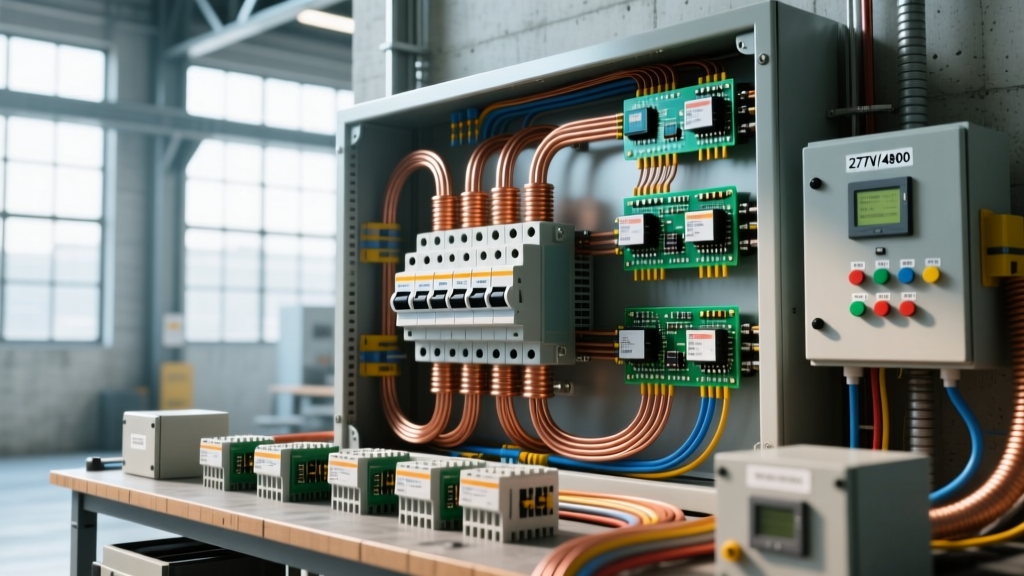

A 277 480 transformer bank is a three-phase transformer assembly, typically with a Wye-connected secondary, that provides 480 volts between any two phase lines and 277 volts between any phase line and the neutral. In commercial and industrial power distribution, this configuration changes the game by allowing a single electrical feed to simultaneously run heavy 480V three-phase machinery (like rooftop HVAC units and air compressors) and 277V single-phase lighting circuits, entirely eliminating the need for a separate, costly step-down transformer just for the lights.
While modern installations often use a single three-phase transformer enclosure, a true transformer 'bank' consists of three separate single-phase transformer cans wired together. This modular approach is still widely used by utilities and large facilities because if one phase fails, you only replace one can, and it allows for open-delta fallback configurations in a pinch.
The Core Architecture: Wye vs. Delta and What It Changes
To get 277V and 480V from the same secondary winding, the transformer bank must be wired in a Wye (Y) configuration. In a Wye setup, one end of each of the three secondary coils is tied together at a common star point. This star point becomes your neutral (the X0 terminal).
Think of a 480Y/277V system like a four-lane highway: three lanes (phases) carry heavy freight (480V machinery) between each other, while the neutral lane allows individual trucks to pull off at a lower 277V ramp for lighting. This dual-voltage capability drastically reduces copper costs and panel space in large buildings.
Sizing, Ampacity, and Real-World Load Calculations
When specifying a 277 480 transformer bank, you must size the primary feeders, the secondary feeders, and the overcurrent protection based on the bank's total kVA rating. Below is a reference table for standard three-phase 480V transformer banks, calculated using the 75°C column of NEC Table 310.16 for copper conductors.
| Bank Size (kVA) | 480V Line Current (Amps) | 277V Phase Current (Amps)* | Min. Copper Wire (75°C) | Standard Breaker Size |
|---|---|---|---|---|
| 45 kVA | 54.1 A | 54.1 A | #6 AWG | 70 A |
| 75 kVA | 90.2 A | 90.2 A | #3 AWG | 110 A |
| 112.5 kVA | 135.3 A | 135.3 A | #1 AWG | 150 A |
| 150 kVA | 180.4 A | 180.4 A | #2/0 AWG | 200 A |
| 225 kVA | 270.6 A | 270.6 A | #300 kcmil | 300 A |
*Note: 277V phase current assumes a perfectly balanced load across all three phases. In reality, lighting loads are rarely perfectly balanced, so the neutral conductor must be sized to handle the maximum unbalanced current, often requiring it to be the same size as the phase conductors in high-harmonic environments.
Worked Numeric Example: Sizing a 150 kVA Bank
Let’s say you are installing a 150 kVA, 480Y/277V transformer bank to feed a warehouse lighting panel. The formula for three-phase current is:
I = (kVA × 1000) / (V_LL × √3)
I = 150,000 / (480 × 1.732) = 180.4 Amps
However, commercial lighting is considered a continuous load (on for 3 hours or more). Per NEC Article 215, you must multiply the continuous load by 125% to size your conductors and overcurrent protection:
180.4 A × 1.25 = 225.5 Amps
Looking at the 75°C column, a #1/0 AWG copper wire is only rated for 150A. You will need to step up to #2/0 AWG copper (rated 175A, which is still too small for 225A) or jump to #4/0 AWG copper (rated 230A at 75°C) for your secondary feeders, protected by a 250A breaker. Always verify the terminal temperature ratings on your specific transformer and panelboard; if they are rated for 60°C, you must use the 60°C ampacity column, which will force you to use even larger wire.
Where You Meet This in Practice (And Common Confusions)
You will almost exclusively encounter a 277 480 transformer bank in commercial, industrial, and large retail environments. Big-box stores use 480V for their massive rooftop RTU (rooftop unit) HVAC compressors and 277V for their high-bay LED lighting. Parking garages use 480V for heavy ventilation exhaust fans and 277V for the sprawling overhead lighting grids.
Another common point of confusion is the terminology itself. Electricians and utility workers use 'bank' to refer to three individual single-phase transformers (e.g., three 50 kVA pole-mounted cans) wired together to create a 150 kVA three-phase supply. Inside a commercial building, you are more likely to see a single, integrated three-phase transformer unit. Both provide the exact same 277/480V output, but the modular bank offers redundancy and easier replacement logistics for utility-scale distribution.
Grounding, Bonding, and NEC Article 450 Nuances
When you install a 277 480 transformer bank, the secondary side is considered a Separately Derived System by the NEC. This triggers specific grounding and bonding requirements that are frequently botched by inexperienced crews.
- The System Bonding Jumper: The X0 neutral terminal on the secondary must be bonded to the transformer's metal enclosure. This bonding jumper must be sized according to NEC Table 250.122 based on the rating of the secondary overcurrent protection. For our 250A secondary breaker example, you need a minimum #4 AWG copper bonding jumper.
- Grounding Electrode Conductor (GEC): Because it is a separately derived system, the X0 neutral must also be tied to a grounding electrode (like a building's structural steel or a concrete-encased electrode). This stabilizes the 277V line-to-neutral voltage and provides a path for lightning or surge transients.
- Neutral Isolation Downstream: Once the neutral and ground are bonded at the transformer's X0 terminal (or at the first point of disconnect downstream), they must remain strictly separated. If you bond the neutral to ground again inside a downstream 277V lighting panel, you will create parallel neutral paths, causing objectionable neutral current to flow on the equipment grounding conductors.
For a deeper look into the physics of how these winding configurations manage phase shifts and harmonic currents, the All About Circuits textbook on three-phase transformers provides excellent vector diagrams. Additionally, when dealing with non-linear loads like LED drivers and VFDs that generate triplen harmonics, consider specifying a K-rated transformer bank (e.g., K-4 or K-13) to prevent the neutral from overheating and the transformer core from failing prematurely due to eddy currents.
Frequently Asked Questions
Can I use a 277 480 transformer bank to step down to 120V?
No. A 480Y/277V bank only provides 277V line-to-neutral. If you need 120V for standard receptacles, you must install a separate step-down transformer (480V Delta primary to 208Y/120V Wye secondary) or use a 480V to 120/240V single-phase transformer for specific circuits.
What happens if I lose the neutral on a 480Y/277V system?
If the X0 neutral connection fails or is severed, the system loses its voltage reference. The 277V loads will experience severe voltage imbalance based on the resistance of the connected loads. Some lighting circuits will see voltages spike well over 400V (destroying drivers and causing fires), while others will drop below 150V (causing flickering and failure to start). Always treat a lost neutral on a Wye system as an immediate emergency.


