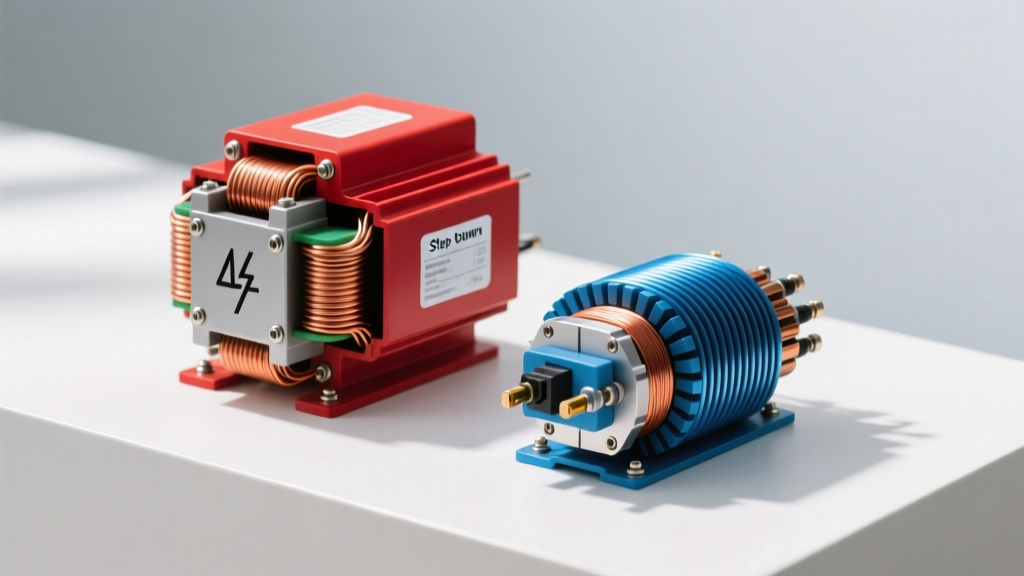
Matching the Load Profile to the Right AC Motor
In North America, induction motors are classified by NEMA (National Electrical Manufacturers Association) designs, which dictate the torque-speed curve. Choosing the wrong design for your load profile guarantees premature mechanical failure or nuisance tripping. According to the US Department of Energy's Advanced Manufacturing Office, matching the motor design to the driven equipment is the first step in achieving premium efficiency and reliability.
| NEMA Design | Typical Load Profile | Starting Torque Curve | Control / Starter Needs | Relative Cost |
|---|---|---|---|---|
| Design B | Centrifugal pumps, fans, blowers, machine tools | Normal (150% of full-load torque) | Standard Across-the-Line (DOL) or VFD | Baseline ($) |
| Design C | Loaded conveyors, reciprocating compressors, crushers | High (200-250% of full-load torque) | Reduced Voltage Starter or Heavy-Duty VFD | Moderate ($$) |
| Design D | Punch presses, hoists, high-inertia flywheels, oil well pumps | Very High (275%+ of full-load torque, high slip) | Across-the-Line (high rotor resistance handles heat) | Premium ($$$) |
Starter Selection and Terminal Wiring Identification
Once the motor design is selected, you must choose the starter topology. The starter dictates how voltage is applied to the stator windings during acceleration. For US industrial applications, NEMA standardizes starter sizes based on horsepower and voltage, ensuring the contacts can withstand the massive inrush current (Locked Rotor Amps, or LRA) without welding shut.
9-Lead Dual Voltage Terminal Identification (T1-T9)
Most US fractional and integral horsepower induction motors (up to ~500 HP) are dual-voltage, 9-lead machines. You must wire the terminal block correctly for your facility's voltage (e.g., 230V vs. 460V). Below is the standard NEMA terminal mapping for a Wye (Star) connected motor, which is the most common configuration for 9-lead dual-voltage motors.
| Voltage Setting | Internal Ties (Jumpered Terminals) | Line Power Connections (L1, L2, L3) |
|---|---|---|
| Low Voltage (230V) | Tie 4-5-6 together Tie 7-8-9 together |
L1 to T1 L2 to T2 L3 to T3 |
| High Voltage (460V) | Tie 4 to 7 Tie 5 to 8 Tie 6 to 9 |
L1 to T1 L2 to T2 L3 to T3 |
Sizing Rules of Thumb and Worked Load Example
A critical rule in motor sizing: never just convert HP to kW and size the breaker based on the math. A 10 kW load on a high-inertia flywheel requires a completely different starter, thermal overload setting, and wire gauge than a 10 kW centrifugal pump. The starting time and thermal mass of the load dictate the sizing.
Worked Example: 15 HP Conveyor Drive
Let us size a US electrical induction motor and starters for a new aggregate conveyor.
- Load: 15 HP, 460V 3-phase, 1750 RPM, NEMA Design C (high starting torque).
- Full Load Amps (FLA): Per NEC Table 430.250, a 15 HP motor at 460V has an FLA of 21A.
- Locked Rotor Amps (LRA): Typically 600% of FLA for Design C. 21A × 6 = 126A inrush.
- Starter Size: A NEMA Size 1 starter is rated for 10 HP at 460V. We must step up to a NEMA Size 2 starter (rated up to 25 HP at 460V) to handle the 126A inrush without contact degradation.
- Overload Protection: Set the solid-state overload relay to 115% of the motor's specific nameplate FLA (not the NEC table value). If the nameplate says 20.5A, set the dial to 23.5A.
- Wire Sizing: NEC 430.22 requires conductors sized at 125% of FLA. 21A × 1.25 = 26.25A. Using the 75°C column in NEC Table 310.16, 10 AWG THHN (rated 35A) is the minimum legal size, though 8 AWG is recommended if the run exceeds 50 feet to mitigate voltage drop during startup.
Diagnosing Failure Signatures: Hum, Overheat, and Stall
When an induction motor fails, the acoustic and thermal signatures tell you exactly what went wrong before you even open the peckerhead.
- The "Hum" (Single Phasing): If the motor hums loudly and refuses to start, or vibrates heavily while running, you have lost one phase. This is usually caused by a blown fuse on one leg of the disconnect, a failed contact in the magnetic starter, or a broken conductor. The remaining two phases will draw massive current, quickly burning out the stator windings if the overload relay does not trip.
- Overheat (Thermal Overload Trips): If the motor runs but trips the overload after 10-20 minutes, check the ambient temperature and ventilation. TEFC (Totally Enclosed Fan Cooled) motors rely on their external fan. If the fan cowl is packed with dust, or if the motor is placed near a heat source, the internal thermistors or external bi-metallic overloads will trip. Another cause is operating a 60Hz motor on a 50Hz supply without derating, which drops the cooling fan speed by 17%.
- Stall (Rotor Locked): If the motor energizes, draws LRA (126A+ in our example), and immediately trips the breaker or blows the fuse, the rotor is mechanically locked. Disconnect the load and spin the shaft by hand. If it spins freely, the issue is an undersized motor for the breakaway torque, or the VFD/soft starter ramp-up time is set too aggressively.
Frequently Asked Questions
What is the difference between NEMA and IEC induction motor starters?
NEMA starters (common in the US) are physically larger, heavily overbuilt, and rated by standardized horsepower sizes (Size 0 through 8). They are designed to be repaired, with replaceable contacts and coils. IEC starters (common in Europe and global OEM machinery) are compact, application-specific, and generally considered disposable. You cannot directly swap a NEMA Size 2 for an IEC equivalent without carefully matching the exact AC-3 utilization category and thermal characteristics.
How do I wire a 9-lead dual voltage US electrical induction motor for 230V Delta?
If your motor nameplate specifies a Delta connection for low voltage (230V), you must group the leads differently than a Wye motor. Tie T1, T6, and T7 together and connect to L1. Tie T2, T4, and T8 together and connect to L2. Tie T3, T5, and T9 together and connect to L3. Always verify the internal connection diagram on the inside of the terminal box cover before applying power.
Why does my induction motor trip the breaker on startup but run fine?
This is a classic symptom of an undersized breaker or an improperly set instantaneous trip (magnetic trip) on a motor circuit protector (MCP). Standard thermal-magnetic breakers are not designed for motor inrush. You must use a breaker with a high magnetic trip setting (often 10x to 15x FLA) or switch to an MCP specifically designed for motor starting, allowing the 600% LRA inrush to pass for the first 2-3 seconds without tripping.
Can I use a VFD instead of a soft starter for a high-inertia load?
Yes, and it is often the better choice. A soft starter only reduces voltage during the ramp-up, which also severely reduces starting torque (torque drops with the square of the voltage). A VFD reduces frequency and voltage simultaneously, allowing you to maintain 150% of full-load torque all the way up to base speed. For high-inertia loads like large fans or flywheels, a VFD prevents the prolonged high-current draw that causes soft starters to overheat.