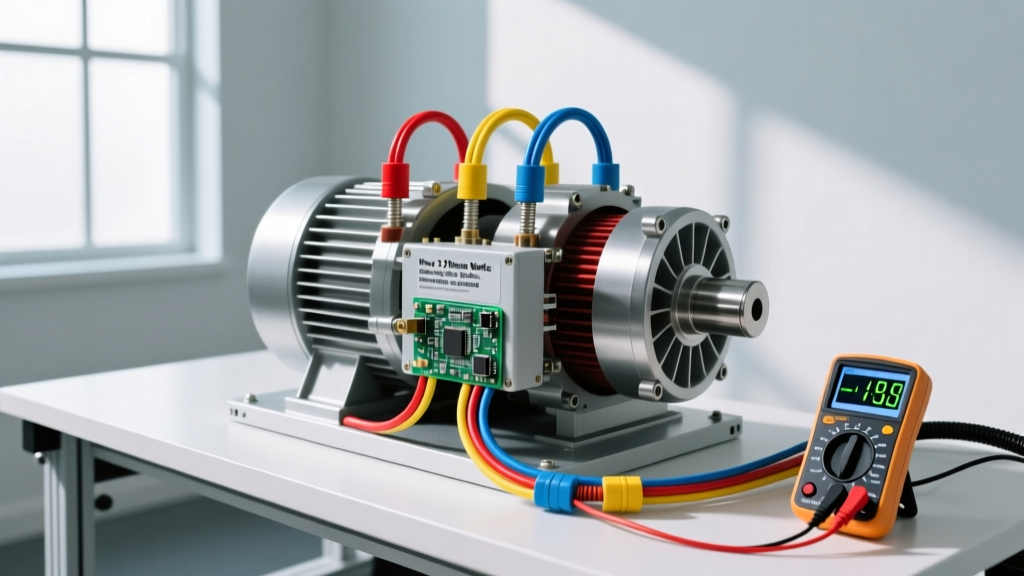
A single phase motor capacitor start is the definitive choice for hard-starting, high-inertia loads between 1/2 HP and 10 HP that require 250% to 400% of full-load starting torque. If you are driving an air compressor, a loaded conveyor, or a heavy-duty pump on a standard 120V/240V residential or light-commercial line, this motor topology provides the necessary phase-shifted magnetic kick to break static friction without tripping your branch breaker. Unlike shaded-pole or permanent split-capacitor (PSC) designs, the capacitor-start motor uses a dedicated start winding and an electrolytic capacitor to create a rotating magnetic field just long enough to get the rotor up to speed, after which a centrifugal switch removes the start circuit to prevent overheating.
Motor Type Comparison: Where Capacitor-Start Wins
Choosing the wrong single-phase motor topology is the most common reason for premature thermal overload trips and burned-out windings. The table below maps standard NEMA single-phase induction motor types against their torque profiles and ideal applications.
| Motor Type | Starting Torque (% FLT) | Torque Curve Profile | Control / Driver Needs | Relative Cost |
|---|---|---|---|---|
| Capacitor-Start (CS) | 250% - 400% | High breakaway, drops to standard run torque | Direct-On-Line (DOL), Contactor, Drum Switch | Medium-High |
| Capacitor-Start / Capacitor-Run (CS/CR) | 200% - 300% | High breakaway, high efficiency at run | DOL, Contactor | High |
| Permanent Split Capacitor (PSC) | 50% - 100% | Low breakaway, smooth acceleration | DOL, Simple VFD (rare) | Low-Medium |
| Split-Phase | 100% - 150% | Moderate breakaway, low efficiency | DOL, Manual Switch | Low |
| Shaded Pole | 25% - 75% | Very low, stalls easily under load | Direct line connection | Very Low |
For loads with high static friction—like a piston compressor that must start against residual tank pressure—the Capacitor-Start or CS/CR motor is mandatory. PSC and split-phase motors will simply hum and trip their thermal overloads when faced with these loads. Note that single-phase induction motors do not use Variable Frequency Drives (VFDs) for speed control in standard applications; they demand Direct-On-Line (DOL) contactors or manual drum switches for forward/reverse control.
Terminal Identification and Internal Wiring Anatomy
Before wiring a single phase motor capacitor start, you must understand the NEMA standard terminal markings. A standard reversible single-phase motor will have up to 8 leads brought out to the peckerhead (wiring box), typically labeled T1 through T8.
If you are working on a surplus motor with faded or missing lead tags, use a digital multimeter in resistance (Ohms) mode. The run winding will read very low resistance (typically 1 to 4 ohms). The start winding will read higher resistance (typically 10 to 20 ohms) because it uses thinner wire with more turns. The centrifugal switch leads will read near 0 ohms when the rotor is at rest (switch closed) and infinite ohms when you manually push the switch plunger in.
The standard NEMA wiring assignments for a single-phase motor are:
- T1 & T4: Run winding leads.
- T5 & T8: Start winding leads (connected in series with the start capacitor and centrifugal switch internally).
- T2 & T3: Often used for thermal overload protector connections or secondary run windings in dual-voltage motors.
To wire the motor for 240V operation, you parallel the run windings and connect the start circuit in parallel with the combined run windings. Line 1 (L1) connects to T1 and T5. Line 2 (L2) connects to T4 and T8. To reverse the direction of rotation, you do not swap L1 and L2. Instead, you must swap the start winding leads relative to the run winding (e.g., swap T5 and T8). Swapping the main line leads on a single-phase motor does nothing but change which side of the breaker feeds which winding; the phase relationship remains identical, and the motor will spin in the same direction.
Sizing Rule of Thumb and Worked Compressor Load Example
Never size a motor purely by matching the horsepower rating of the driven equipment without considering the load's breakaway torque and duty cycle. The golden rule for single phase motor capacitor start sizing is: Size the motor so the steady-state running load draws 80% to 90% of the motor's nameplate Full Load Amps (FLA), while verifying the starting torque exceeds the load's static friction requirement.
Worked Example: 5 HP Piston Air Compressor
Imagine you are replacing a burned-out motor on a 5 HP, two-stage piston air compressor operating on a 240V single-phase shop circuit.
- Calculate Load Requirements: A 5 HP compressor requires roughly 3,730 watts of mechanical output. Accounting for an 85% motor efficiency, the electrical input is about 4,388 watts. At 240V, the running current is roughly 18.3 Amps. However, piston compressors require roughly 150% to 200% of full-load torque just to break static friction and overcome trapped cylinder pressure.
- Select the Motor: You need a 5 HP, 240V, 1750 RPM (4-pole) capacitor-start motor. A standard NEMA 184T frame motor, such as the WEG CW21 series or Baldor-Reliance L1510T, will have a nameplate FLA of approximately 24A to 28A. This provides the necessary thermal mass and torque margin.
- Verify the Start Capacitor: A 5 HP capacitor-start motor typically utilizes a start capacitor in the range of 400 µF to 500 µF, rated for 250VAC or 330VAC. This capacitor must be an electrolytic type (not a metalized film run capacitor) designed for intermittent duty (maximum 3 seconds on-time per start).
- Branch Circuit Sizing: Per NEC-style guidance (Article 430), the branch circuit conductors must be sized at 125% of the motor FLA. For a 28A FLA motor, 1.25 x 28 = 35A. You must pull 8 AWG THHN copper wire (rated 50A at 75°C) to handle the continuous thermal load and voltage drop during the high-inrush starting phase. The inverse-time breaker should be sized at 250% of FLA for starting inrush, yielding a standard 70A breaker, paired with a properly sized motor starter with thermal overloads set precisely to 28A.
Failure Signatures: Hum, Overheat, and Stall
Single-phase motors fail in highly predictable ways based on the state of their start circuit. Recognizing these failure signatures saves you from replacing a perfectly good motor when a $15 component is the actual culprit.
| Symptom | Most Likely Cause | Diagnostic Measurement / Fix |
|---|---|---|
| Loud Hum, Rotor Locked (Will not start) | Failed open start capacitor, or centrifugal switch stuck open. | Measure capacitance with a multimeter. If reading is 0 µF or physically bulged, replace. Manually spin the shaft; if it runs up to speed smoothly, the start circuit is definitely open. |
| Motor Starts, but Overheats and Trips Overload Quickly | Centrifugal switch stuck closed. The start winding is remaining in the circuit during run, burning up due to its thin wire gauge. | Disconnect power. Remove the end-bell. Inspect the switch contacts for pitting or welding. Clean with contact file or replace the switch assembly. |
| Motor Stalls Under Load (Runs fine unloaded) | Low line voltage (excessive voltage drop on feeder), or motor is undersized for the breakaway torque of the load. | Measure L1-L2 at the motor peckerhead while the motor is attempting to start. If voltage drops below 216V (10% drop on a 240V nominal system), upsize the feeder wire. If voltage is stable, the motor is undersized. |
| Repeated Capacitor Failures (Bursting/Venting) | Using a continuous-duty run capacitor in the start circuit, or a load that requires too many starts per hour. | Verify the replacement is an electrolytic start capacitor. If the application cycles more than 20 times per hour, you must switch to a CS/CR motor or a 3-phase motor with a VFD. |
Decision Path: Selecting Your Exact Motor and Starter
Do not guess when specifying a drive for high-inertia machinery. Follow this decision matrix to lock in your exact hardware requirements.
- IF your load is a fan, blower, or centrifugal pump (low breakaway torque) THEN select a Permanent Split Capacitor (PSC) motor for higher running efficiency and quieter operation.
- IF your load is a piston compressor, auger, or loaded conveyor (high breakaway torque) AND you only have single-phase power THEN you must select a Capacitor-Start or CS/CR motor.
- IF your application requires frequent starting/stopping (more than 15 cycles per hour) THEN a standard capacitor-start motor will destroy its start capacitor and centrifugal switch. You must upgrade to a 3-phase motor paired with a VFD, or use a specialized high-cycle CS/CR design.
The Concrete Pick: For the vast majority of high-torque, single-phase shop and industrial applications (1 HP to 7.5 HP), specify the WEG CW21 Capacitor-Start series (or the equivalent Baldor-Reliance L1500 series). These NEMA Premium efficient motors feature robust centrifugal switches and high-grade electrolytic start capacitors rated for 240V/120V dual operation. Pair this motor with an Eaton XTCE series IEC contactor or a Square D Class 8536 NEMA starter, ensuring the thermal overload block is dialed exactly to the motor's nameplate FLA. This combination guarantees the breakaway torque you need while providing the thermal protection required to keep the windings intact during hard starts.