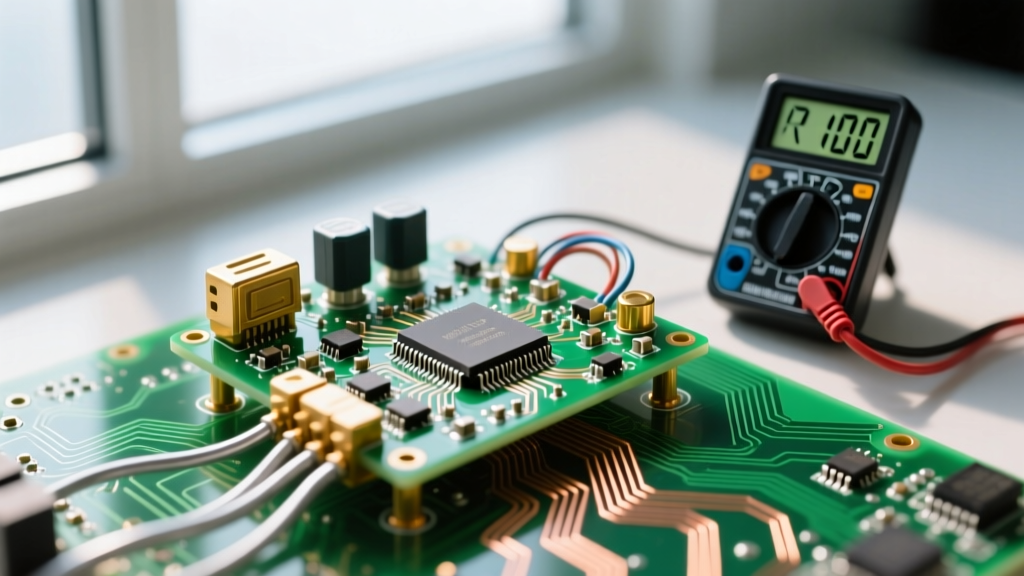

RMS (Root Mean Square) voltage is the equivalent DC voltage value that would deliver the exact same amount of heat or power to a resistive load. When you measure a standard US wall outlet and see 120V, you are looking at the RMS voltage, not the peak or the average. Because alternating current constantly changes direction and magnitude, we need a standardized way to express its effective work potential, and RMS provides that exact translation between AC and DC power delivery.
What RMS Voltage Actually Changes in a Circuit
In a DC circuit, calculating power is trivial: P = V² / R. But in an AC circuit, the voltage is a moving target. A standard 120V AC sine wave actually swings from +169.7V to -169.7V at the peaks. If you try to use the peak voltage in your power equations, your calculations will be wildly wrong.
What RMS voltage changes in a real installation is your ability to accurately size components for thermal limits. Power dissipation (heat) in a resistor, heating element, or motor winding is strictly a function of the RMS voltage. If you design a circuit using peak voltage values instead of RMS, you will miscalculate the current draw and thermal output, leading to undersized wire, tripped breakers, or melted insulation. According to All About Circuits, RMS is the only AC measurement that directly correlates to the physical work being done by the circuit.
The Math Without the Headache: A Worked Numeric Example
Let's look at a concrete bench example. You are building a DIY reflow oven and need to wire a 120V AC space heater element to serve as the primary heat source. The element has a measured cold resistance of 14.4 ohms.
The Correct Way (Using RMS):
The multimeter reads 120V RMS.
Power = V_rms² / R
Power = 120² / 14.4 = 14,400 / 14.4 = 1,000 Watts.
You select a 15A breaker and 14 AWG wire, which safely handles the ~8.3A RMS current draw.
The Mistake (Using Peak):
You hook up an oscilloscope and see the sine wave peaks at 169.7V. You mistakenly use this peak value for your power calculation.
Power = V_peak² / R
Power = 169.7² / 14.4 = 28,798 / 14.4 = ~2,000 Watts.
Thinking the element pulls 2,000W (16.6A), you oversize your wire to 12 AWG and install a 20A breaker. While oversizing wire isn't a fire hazard, if you made this mistake in reverse—using an average or peak-to-peak metric to undersize a transformer or solid-state relay (SSR)—the component would fail catastrophically under the actual 1,000W continuous thermal load.
Where You Meet RMS Voltage in Practice
You will encounter RMS specifications and measurement requirements in three primary areas on the bench and jobsite:
- Multimeter Selection (True-RMS vs. Average-Responding): Cheap multimeters assume a perfect sine wave. They measure the average value of the rectified AC waveform and multiply it by a fixed form factor (1.11) to guess the RMS. If you measure a non-linear load like a dimmer switch or a VFD (Variable Frequency Drive) output with an average-responding meter, your reading will be wrong by up to 40%. You need a True-RMS meter (like the Fluke 87V) which samples the waveform and calculates the actual root mean square mathematically. See Fluke's guide on True-RMS measurement for the exact sampling differences.
- Audio Amplifier Ratings: Marketing teams love 'Peak' watts because the numbers look bigger. A '500W Peak' car audio amplifier might only deliver 150W RMS. Always wire your speakers and calculate your alternator load based strictly on the RMS wattage, which represents continuous thermal handling.
- Solar Inverters and UPS Systems: When sizing an inverter for an off-grid cabin, the continuous AC load must be calculated using RMS voltage and RMS current. Modified sine wave inverters output choppy waveforms where the RMS value behaves differently than a pure utility sine wave.
Real-World Scenario Walkthrough: The Melted Pump Motor
The Setup:
A hobbyist is testing an off-grid solar setup. They connect a 120V AC, 1/4 HP pond pump to a 1000W modified sine wave inverter. The inverter's documentation states it outputs a '170V peak square wave' to mimic the peaks of standard grid power.
The Numbers:
For a pure utility sine wave, the relationship is V_rms = V_peak / √2. Therefore, a 170V peak sine wave yields 120V RMS.
However, a modified sine wave inverter outputs a bipolar square wave (switching abruptly between +170V and -170V). For a square wave, the RMS voltage is exactly equal to the peak voltage. Therefore, the inverter is actually outputting 170V RMS.
The Outcome:
The pump motor, designed for 120V RMS, receives 170V RMS. This 41% overvoltage pushes the motor core into magnetic saturation. The current draw spikes from a nominal 3A to over 9A. The thermal overload protector fails to trip fast enough, and the winding insulation melts, shorting the motor and destroying the inverter's H-bridge MOSFETs.
What Went Wrong:
The builder assumed that matching the *peak* voltage of a sine wave would result in the same *RMS* voltage, forgetting that RMS is entirely dependent on the shape of the waveform. As detailed in Electronics Tutorials, the form factor changes drastically between sine, square, and triangle waves. Always verify the RMS output of non-linear power sources with a True-RMS meter before connecting inductive loads.
Common Confusions: Peak, Average, and RMS
It is easy to mix up AC voltage metrics, especially when reading oscilloscope data. Here is how the values break down across common waveforms assuming a peak voltage (Vp) of 10V:
| Waveform | Peak Voltage (Vp) | Peak-to-Peak (Vpp) | Average (Full Cycle) | RMS Voltage |
|---|---|---|---|---|
| Pure Sine Wave | 10V | 20V | 0V (Mathematically) | 7.07V (Vp / √2) |
| Bipolar Square Wave | 10V | 20V | 0V | 10V (Equal to Vp) |
| Triangle Wave | 10V | 20V | 0V | 5.77V (Vp / √3) |
The 'Average' Trap: If you measure the mathematical average of a pure AC sine wave over a full cycle, it is exactly zero volts, because the positive half perfectly cancels the negative half. When engineers talk about 'average voltage' in power supplies, they are usually referring to a half-wave or full-wave rectified DC signal, not raw AC. Never use average-responding math for raw AC power calculations.
FAQ: Quick Answers to Bench Questions
Q: Does my $20 hardware store multimeter read RMS?
A: It reads RMS only if the waveform is a perfect, undistorted sine wave. It does this by measuring the average and multiplying by 1.11. If you measure the output of a LED dimmer, a computer power supply, or a VFD, that $20 meter will give you a dangerously inaccurate reading. Upgrade to a True-RMS meter for any non-linear loads.
Q: Why do audio amps and car subwoofers advertise 'Peak' watts instead of RMS?
A: Marketing. Peak watts represent the absolute maximum instantaneous power the amp can deliver for a fraction of a millisecond before clipping. RMS watts represent the continuous thermal power the amp can sustain. Always match your speaker's RMS handling to the amplifier's RMS output.
Q: If my oscilloscope shows 340V Peak-to-Peak, what is my RMS voltage?
A: First, divide Peak-to-Peak by 2 to get the Peak voltage (170V). Then, assuming a pure sine wave, divide by √2 (1.414). Your RMS voltage is 120V. If it's a square wave, your RMS is 170V.


