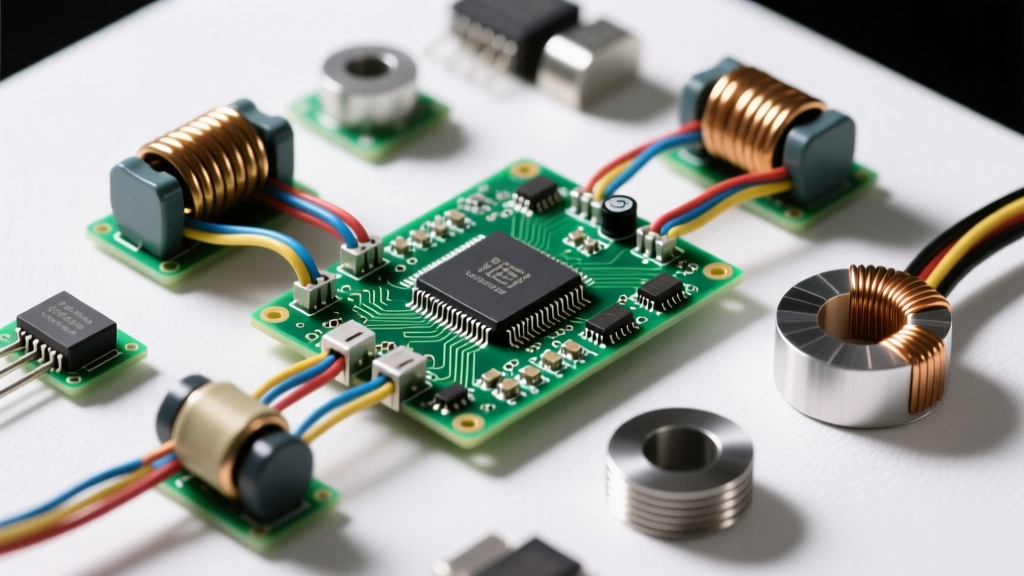
A residual current device (RCD) is a safety switch that instantly disconnects a circuit when it detects that electrical current is leaking to earth, preventing lethal shocks and electrical fires. Unlike a standard fuse or breaker that only monitors the total magnitude of current flowing through a single wire, an RCD fundamentally changes a real circuit by inserting a differential current transformer (a toroidal core) that continuously measures the vector sum of both the line and neutral conductors. If the current going out on the line doesn't exactly match the current returning on the neutral, the RCD knows current is escaping—potentially through a human body—and drops the mechanical latch to kill the power.
How a Residual Current Device Actually Works
At the heart of every RCD is a Core Balance Earth Leakage (CBEL) transformer. The line (hot) and neutral conductors pass directly through the center of a high-permeability magnetic toroid. In a healthy circuit, the alternating current flowing out on the line is exactly equal and opposite to the current returning on the neutral. Because these currents are 180 degrees out of phase, their magnetic fields perfectly cancel each other out, resulting in zero net magnetic flux inside the toroid.
When an earth fault occurs—say, a frayed wire touches a metal appliance chassis—some of the line current diverts through the earth wire (or a person) back to the ground. This creates an imbalance. The returning neutral current is now less than the outgoing line current. This difference, known as the residual current ($I_{\Delta}$), generates a net alternating magnetic flux in the toroid. That changing flux induces a small voltage in a secondary sensing wire wrapped around the core. If this induced current exceeds the device's rated threshold (typically 30mA for personal protection), it energizes a highly sensitive polarized trip relay. The relay pulls a mechanical pin, releasing the spring-loaded contacts and opening the circuit in milliseconds.
To visualize this, think of a closed-loop plumbing system where a pump pushes water out on a supply pipe and expects the exact same volume back on the return pipe. If a crack in the supply pipe leaks water into the ground, the return flow drops. A differential flow meter detects the missing volume and instantly shuts the main valve before the tank empties.
Worked Example: The 30mA Trip Threshold in a Real Fault
Let's look at the exact math and timing when an RCD saves a life. Suppose you are wiring a 230V AC outdoor socket circuit protected by a standard 30mA (0.03A) Type AC RCD. You are using a metal-cased hedge trimmer with a degraded insulation layer.
While trimming, the live conductor touches the metal casing. You are holding the trimmer, standing on damp soil. Your body's contact resistance in this wet, grounded scenario is approximately $1,000 \Omega$.
- Fault Current ($I_f$): Using Ohm's Law ($I = V / R$), the current flowing through your body to earth is $230V / 1000\Omega = 230mA$.
- The Imbalance: The RCD's toroid sees 230mA leaving on the line, but 0mA of that specific fault current returning on the neutral. The residual current $I_{\Delta}$ is 230mA.
- The Threshold Check: 230mA is vastly higher than the 30mA nominal trip threshold ($I_{\Delta n}$).
- The Trip Time: According to the IEC 61008 standard, a standard RCD must trip within 300ms at $1 \times I_{\Delta n}$ (30mA), and within 40ms at $5 \times I_{\Delta n}$ (150mA). Since 230mA is well over 5x the threshold, the RCD will physically open the contacts in roughly 20 to 30 milliseconds.
This sub-40ms interruption keeps the let-through energy far below the threshold that causes ventricular fibrillation in the human heart. The RCD doesn't limit the current to 30mA; it allows the 230mA to flow, but it cuts the time so short that the physiological damage is prevented.
Where You Meet RCDs in Practice
You will encounter residual current devices in several critical areas of modern electrical installations, often dictated by local wiring regulations (like BS 7671 in the UK or IEC 60364 internationally):
- Consumer Units (Breaker Panels): Modern boards use 'split-load' configurations or dual 100A RCDs to protect groups of circuits. This ensures that a fault on an outdoor socket doesn't plunge the entire house into darkness by tripping a single main switch.
- TT Earthing Systems: In rural installations where the earth is provided by a local ground rod rather than the utility's supply cable (TT system), the earth fault loop impedance is often too high for a standard breaker to trip magnetically. RCDs are absolutely mandatory here to clear faults.
- EV Chargers and Solar Inverters: These introduce complex waveforms and DC leakage into the AC grid. Standard RCDs can be 'blinded' by DC leakage, which is why specialized Type A, Type F, or Type B RCDs are required for these circuits, as detailed in IET Wiring Matters guidance on EV charging.
RCD vs. MCB vs. RCBO: Clearing Up the Confusion
The most common mistake DIYers and junior apprentices make is confusing an RCD with overcurrent protection. An RCD provides zero protection against short circuits or overloads. If you plug in a 5000W heater on a 15A circuit, the RCD will happily let the wires melt and catch fire because the current going out still perfectly matches the current coming back. Here is how the devices compare:
| Device | Primary Protection | What it Monitors | Typical Rating | Replaces / Combines |
|---|---|---|---|---|
| MCB (Miniature Circuit Breaker) | Overload & Short Circuit | Total current magnitude on Line | 6A, 16A, 32A | Old wire fuses |
| RCD (Residual Current Device) | Earth Leakage / Shock | Vector sum (imbalance) of Line + Neutral | 30mA, 100mA, 300mA | Old ELCBs (voltage operated) |
| RCBO (Residual Current Breaker with Overcurrent) | Shock, Overload & Short Circuit | Both magnitude AND vector imbalance | e.g., 16A / 30mA | An MCB and an RCD combined in one module |
The Takeaway: If you are replacing a faulty RCD in a consumer unit, you must ensure the circuits it protects already have MCBs in series downstream. If you want individual circuit protection without taking up double the DIN-rail space, swap the RCD+MCB combo for a single RCBO.
Frequently Asked Questions About Residual Current Devices
What is the difference between a residual current device and an RCBO?
An RCD only protects against earth leakage (shock and fire from insulation failure). It cannot detect a short circuit between line and neutral, nor can it detect an overload. An RCBO (Residual Current Breaker with Overcurrent) combines the earth-leakage detection of an RCD with the thermal and magnetic trip mechanisms of an MCB. If a circuit faults to ground, both will trip. If a circuit simply draws too much current (overload), only the RCBO will trip; the RCD will ignore it.
Why does my residual current device keep tripping with no load connected?
If an RCD trips with all appliances unplugged and the circuit seemingly 'dead', you are likely dealing with a neutral-to-earth fault, cumulative leakage, or a failing device. First, cumulative leakage: modern appliances with EMI filters (like PC power supplies and LED drivers) leak a few milliamps to earth continuously. If you have 15 computers on a single 30mA RCD, their combined normal leakage can hit 25mA, leaving only a 5mA margin before nuisance tripping. Second, a neutral-to-earth short downstream of the RCD will cause an imbalance the moment any other circuit on the same neutral bar draws current. Finally, the RCD's internal mechanical latch may be worn out, requiring replacement.
Do I need a Type A, Type F, or Type B residual current device for my EV charger?
Yes, you absolutely cannot use a standard Type AC RCD for an EV charger. Standard Type AC RCDs only detect pure AC sine wave leakage. EV chargers contain heavy rectifiers and switching power supplies that can generate pulsating DC or smooth DC fault currents. If a DC fault occurs, it can magnetically saturate the toroid core of a Type AC RCD, effectively 'blinding' it so it won't trip even if you touch a live wire. For standard single-phase EV chargers, a Type A RCD (handles pulsating DC) is usually the minimum legal requirement. If the charger manufacturer specifies it, or if you have a 3-phase setup with complex frequency drives, you must step up to a Type B RCD, which can detect smooth DC leakage up to 1000Hz. Always check the EVSE manufacturer's installation manual.
Can I use a standard IEC RCD on a US 120V circuit instead of a GFCI?
Functionally, a US GFCI (Ground Fault Circuit Interrupter) and an IEC-standard RCD operate on the exact same core-balance differential principle. However, you cannot simply swap them due to physical and regulatory differences. US GFCIs are built to fit standard NEMA enclosures and are rated for 120V/208V systems, typically tripping at a stricter 4mA to 6mA threshold. IEC RCDs are designed for DIN-rail mounting in consumer units and are rated for 230V/400V systems with 30mA thresholds. Furthermore, the NEC (NFPA 70) strictly requires GFCI devices to be UL-listed for use in US jurisdictions. Stick to GFCI receptacles and breakers for North American 120V/240V installations.