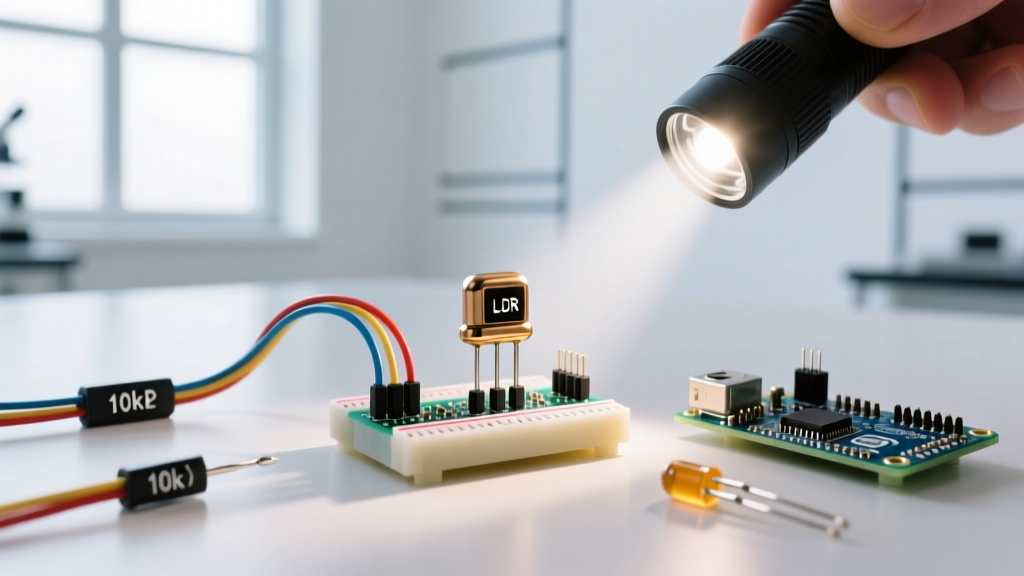

The Direct Answer: How Light Affects Photoresistor Resistance
No, a photoresistor's resistance does not increase with light; it decreases. Also known as a Light Dependent Resistor (LDR) or photocell, this passive component exhibits an inverse relationship between incident light intensity and electrical resistance. In total darkness, a standard cadmium sulfide (CdS) photoresistor will exhibit maximum resistance, often exceeding 1 MΩ. When exposed to bright light, that resistance plummets to as low as 1 kΩ or even a few hundred ohms.
The physics behind this is the internal photoelectric effect. The semiconductor material (typically CdS) has a specific bandgap. When photons with sufficient energy strike the lattice, they excite electrons from the valence band into the conduction band, creating electron-hole pairs. More light means more charge carriers, which directly translates to lower electrical resistance.
Numeric Example: Take the ubiquitous GL5528 LDR. In complete darkness (0 lux), its resistance is roughly 1 MΩ. Under a 10 lux light source (roughly equivalent to twilight or a dimly lit room), its resistance drops to between 10 kΩ and 20 kΩ. If you place this in a 5V voltage divider with a 10 kΩ fixed pull-down resistor, the analog output swings from ~0.05V in the dark to ~2.5V at 10 lux, providing a massive, easily readable swing for an Arduino or ESP32 ADC pin.
Photoresistor Material Types and Selection Criteria
Not all photoresistors are built from cadmium sulfide. The semiconductor material dictates the spectral response (which color of light it 'sees'), the base resistance, and the operating temperature range. Here is how to select the right chemistry for your circuit.
| Material | Spectral Peak | Dark Resistance | Light Resistance (10 lux) | Tempco | Typical Use Case |
|---|---|---|---|---|---|
| CdS (Cadmium Sulfide) | 540 nm (Visible Green) | 1 MΩ - 20 MΩ | 5 kΩ - 20 kΩ | Negative | Streetlight controllers, camera metering, nightlights |
| PbS (Lead Sulfide) | 2000 nm (Near-IR) | 100 kΩ - 1 MΩ | 1 kΩ - 10 kΩ | Negative | Flame detection, IR spectroscopy, gas analysis |
| InSb (Indium Antimonide) | 5000 nm (Mid-IR) | <100 Ω | <10 Ω | Negative | Thermal imaging, missile guidance (military/aerospace) |
| CdSe (Cadmium Selenide) | 720 nm (Red/Near-IR) | 500 kΩ - 5 MΩ | 2 kΩ - 10 kΩ | Negative | Specialized optical switches, older analog optocouplers |
Selection Rule of Thumb: For 95% of hobbyist and consumer IoT projects (like automatic blinds or sunrise alarm clocks), standard CdS cells are the correct choice because their spectral peak closely mimics the human eye's sensitivity to visible light. If you are building a flame sensor or need to detect an IR remote control beam, you must step up to a PbS cell or, more commonly in modern designs, a dedicated silicon phototransistor.
Decoding LDR Markings and Physical Codes
Photoresistors rarely have their exact resistance values printed on them. Instead, they rely on a standardized alphanumeric coding system and physical visual cues. The most common series you will encounter on the bench or from distributors like DigiKey is the GL55xx series.
| Part Number | Diameter | Light Resistance (10 lux) | Dark Resistance | Best Application |
|---|---|---|---|---|
| GL5516 | 5 mm | 5 kΩ - 20 kΩ | 0.5 MΩ | Bright light switching, outdoor daylight sensing |
| GL5528 | 5 mm | 10 kΩ - 20 kΩ | 1.0 MΩ | General purpose, indoor ambient light tracking |
| GL5537-1 | 5 mm | 20 kΩ - 30 kΩ | 0.5 MΩ | Low-light activation, dusk-to-dawn circuits |
| GL5539 | 5 mm | 50 kΩ - 100 kΩ | 2.0 MΩ | High-sensitivity darkroom or shadow detection |
| GL125xx | 12 mm | Varies | Varies | High power (200mW) industrial lighting control |
Reading the Physical Part: Look closely at the orange face of a CdS cell. You will see a zig-zag or spiral trace. This is the actual cadmium sulfide semiconductor deposited on a ceramic substrate. The wider and closer together the traces, the lower the base resistance. The two wire leads connect to opposite ends of this trace. The epoxy dome over the trace acts as both a protective moisture barrier and a rudimentary lens to scatter light across the surface.
Failure Modes and Visual Diagnostics
While LDRs are passive and lack the complex failure mechanisms of integrated circuits, they are highly susceptible to environmental degradation. Here is how to diagnose a failing photoresistor on the workbench.
- Moisture Ingress (The 'Cloudy Dome' Failure): The epoxy coating on cheap LDRs is porous. In high-humidity environments, moisture penetrates the dome and reacts with the cadmium sulfide. Visual Symptom: The bright orange dome turns cloudy, yellowed, or exhibits micro-cracks. Electrical Symptom: Dark resistance drops significantly (e.g., from 1 MΩ to 50 kΩ), and the cell becomes overly sensitive to temperature changes.
- Thermal Overload (The 'Scorched Substrate'): Standard 5mm LDRs are rated for a maximum power dissipation of roughly 100 mW at 25°C. If you connect an LDR directly across a voltage source without a current-limiting resistor, or use it to switch a high-current relay coil directly, it will overheat. Visual Symptom: The ceramic substrate darkens or chars, and the epoxy melts or blisters. Electrical Symptom: The part fails short (near 0 Ω) or open (infinite Ω).
- Hysteresis and Memory Effect: CdS cells suffer from 'light memory.' If an LDR is exposed to intense light for hours, its dark resistance will take minutes or even hours to recover to its true baseline once placed in the dark. This is not a physical failure, but a material limitation that ruins precision light-metering circuits.
Safe Substitution When the Exact LDR is Missing
If your schematic calls for a GL5528 and you only have a GL5516 or a generic unmarked LDR in your bin, you can safely substitute it by adjusting the surrounding passive components. Do not just swap the part and expect the circuit to behave identically.
- Match the Voltage Divider Ratio: Most LDR circuits use a voltage divider feeding a microcontroller ADC or a comparator (like an LM393). If your substitute LDR has a lower light resistance than the original, you must proportionally lower the value of the fixed series resistor to keep the trigger threshold voltage the same. For example, if swapping a 10 kΩ light-resistance cell for a 5 kΩ cell, halve the fixed pull-down resistor from 10 kΩ to 4.7 kΩ.
- Verify the Spectral Peak: Never substitute a visible-light CdS cell with an IR-sensitive PbS cell just because the resistance values match. The circuit will become blind to room lighting and only react to heat sources or IR remotes.
- The Active Alternative (When Speed is Required): If you are substituting an LDR because the original design suffered from slow response times, replace the LDR and its pull-down resistor with a phototransistor (such as the Everlight PT334-6C). Wire the phototransistor's collector to VCC, the emitter to your ADC pin, and use a 10 kΩ to 100 kΩ pull-down resistor to ground. This yields a response time in the microsecond range while maintaining a similar analog voltage swing.
Frequently Asked Questions
Why does my multimeter read 'OL' or infinite resistance on a photoresistor in the dark?
This is usually normal operation, not a broken part. A healthy CdS photoresistor in total darkness can easily exceed 20 MΩ. Most standard digital multimeters max out their resistance measurement range at 20 MΩ or 40 MΩ and will display 'OL' (Over Limit) when the resistance exceeds this threshold. To verify the part is actually working, shine a bright LED flashlight directly onto the dome; the reading should immediately drop into the single-digit kilo-ohm range. If it stays at 'OL' under bright light, the internal wire bond has snapped and the part is dead.
Can I use a standard CdS photoresistor for high-speed RPM counting or a tachometer?
No. The physical mechanism of electron-hole recombination in cadmium sulfide takes tens of milliseconds. If you attempt to use an LDR to count the slots on a spinning motor encoder wheel at 3000 RPM (50 Hz), the LDR will not have time to transition between its high and low resistance states, resulting in a smeared, unreadable analog signal. For tachometers, slot sensors, or high-speed optical encoders, you must use a photodiode or a phototransistor paired with an IR emitter.
Does ambient temperature change a photoresistor's resistance even if light is constant?
Yes. Photoresistors have a negative temperature coefficient (tempco). As the ambient temperature rises, the thermal energy alone is enough to excite some electrons into the conduction band, causing the resistance to drop even if the light level remains perfectly constant. In precision applications, this thermal drift can mimic a change in light intensity. If your circuit operates in an environment with wide temperature swings (e.g., an outdoor solar tracker), you must add a thermistor to your microcontroller circuit to mathematically compensate for the LDR's thermal drift.
Are cadmium sulfide (CdS) photoresistors still legal for new commercial products in 2026?
For commercial production in the EU, UK, and regions adhering to strict RoHS directives, the answer is generally no. Cadmium is a highly restricted heavy metal. While you can still buy CdS LDRs for hobbyist repairs, educational kits, and legacy maintenance, new consumer electronics designs have largely abandoned them. Modern commercial designs instead use I2C Ambient Light Sensors (ALS) like the Vishay VEML7700 or discrete silicon phototransistors, which are RoHS compliant, highly linear, and feature built-in IR rejection filters.


