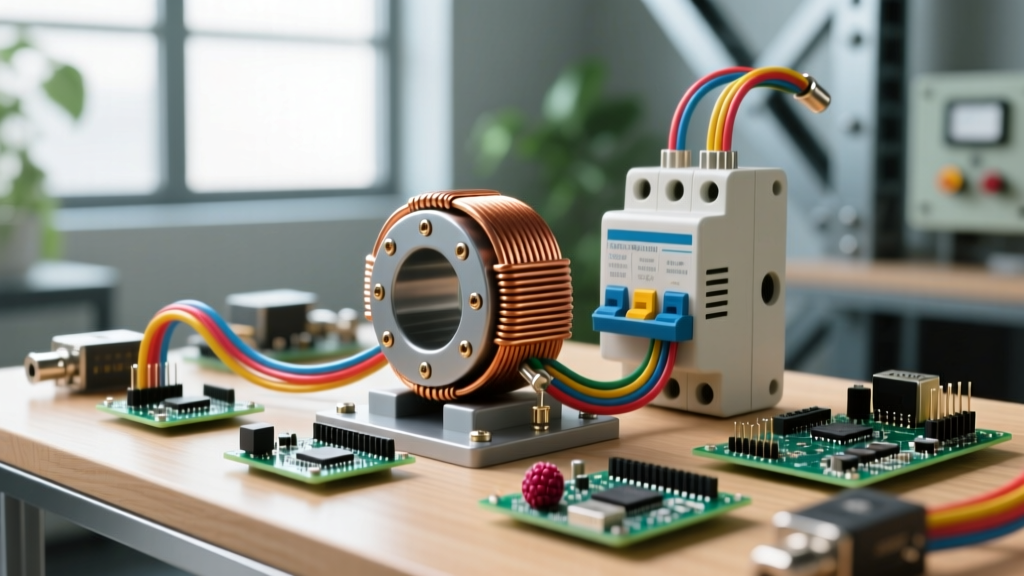
The permanent magnet and electromagnet difference boils down to a single operational trade-off: passive persistence versus active control. If your build requires a constant, zero-power magnetic field in a compact footprint—like a BLDC motor rotor, a magnetic reed switch target, or a battery-powered IoT door latch—the permanent magnet is the undisputed winner. If your application demands adjustable force, rapid on/off switching, or extreme field strengths exceeding 2.0 Tesla—such as in solenoid valves, magnetic particle clutches, or scrap yard cranes—the electromagnet takes the crown. You cannot swap them without fundamentally redesigning your power delivery, thermal management, and failsafe logic.
The Single Physical Difference That Drives Everything
Every functional difference between these two components stems from how their magnetic domains are aligned and maintained.
In a permanent magnet (like NdFeB or Ferrite), the magnetic field is a persistent material property. During manufacturing, the ferromagnetic domains within the crystal lattice are aligned under a massive external field and physically locked into place. The electron spins remain aligned indefinitely without external energy input. The limitation is that this lattice alignment can be disrupted by heat or opposing magnetic fields.
In an electromagnet, the field is generated dynamically via Ampere’s Law. Moving charges (current flowing through copper or aluminum wire) generate an orthogonal magnetic field. An iron or silicon-steel core is typically added not to create the field, but to provide a low-reluctance path that concentrates and amplifies the flux. The moment you cut the power, the macroscopic field collapses, leaving only minor residual hysteresis in the core.
Head-to-Head Spec Sheet & Performance Data
To make an informed component selection, you need to look past generic descriptions and compare actual material limits and flux densities. The table below contrasts the most common permanent and electromagnetic configurations used in bench and industrial builds.
| Magnet Type | Max Flux Density (Tesla) | Power Draw | Operating Temp Limit | Approx. Cost (per kg) |
|---|---|---|---|---|
| N52 Neodymium (Permanent) | 1.48 T | 0 W | 80°C (Irreversible loss begins) | $120 - $160 |
| Grade 8 Ceramic/Ferrite (Permanent) | 0.39 T | 0 W | 250°C | $10 - $20 |
| Copper-Wound DC (Electromagnet) | 1.5 - 2.2 T (Core dependent) | 50 - 500+ W | 155°C (Class F enamel limit) | $35 - $60 (Wire + Core) |
| Superconducting NbTi (Electromagnet) | > 10.0 T | Cryo cooling only | 4 K (-269°C) | > $10,000 |
Note: Electromagnet flux density is heavily dependent on the core material's saturation point. Once a soft iron core reaches roughly 2.0 to 2.2 Tesla, it saturates, and adding more current only generates waste heat without increasing magnetic pull. Data sourced from K&J Magnetics material specifications and standard Georgia State University HyperPhysics electromagnetic references.
Where They Are NOT Interchangeable (Failure Modes & Limits)
Assuming you can just swap a coil for a chunk of neodymium is a fast track to a failed project or a safety hazard. Here is where the physics strictly forbids substitution:
Failsafe Braking and Holding
If you are designing a magnetic brake for a hoist, an elevator, or a robotic arm, you must use a permanent magnet or a spring-loaded mechanism for the failsafe state. If an electromagnet is used to hold a 50 kg load and the facility loses power (or a MOSFET blows), the field collapses and the load drops. Permanent magnet fail-safe brakes (PM brakes) use a spring to disengage the magnet and require electrical power to release the brake, ensuring a power failure results in a locked, safe state.
High-Temperature Environments
Neodymium magnets have a notoriously low maximum operating temperature (80°C for standard N52 grades). If you place an N52 magnet inside a motor housing that runs at 110°C, it will suffer irreversible demagnetization. You would have to downgrade to Samarium Cobalt (SmCo) or Alnico, which survive higher temps but offer significantly lower flux density. Electromagnets do not suffer from demagnetization in heat; their limit is purely the melting point of the wire enamel. By winding an electromagnet with Kapton-coated or fiberglass-served magnet wire, you can easily operate in 250°C+ environments where a permanent magnet would fail entirely.
Variable Force Requirements
A permanent magnet's pull force is fixed by its geometry and grade. If your application requires proportional control—such as a magnetic particle clutch in a web-tensioning system or a variable damper—you must use an electromagnet. You can modulate the holding force of an electromagnet from 0% to 100% using a simple PWM signal and a current-limiting driver; a permanent magnet cannot be dynamically scaled without physically moving it away from the target.
Choose A When / Choose B When (Decision Framework)
Use this framework to finalize your bill of materials. Sourcing is also a factor: high-grade NdFeB magnets are subject to rare-earth export quotas and price fluctuations, whereas copper magnet wire (like 18 AWG or 22 AWG from MWS Wire Industries) is highly stable and allows you to custom-wind coils to fit odd geometries.
Choose a Permanent Magnet When:
- You are building battery-powered IoT devices: A permanent magnet on a reed switch or Hall effect sensor draws exactly zero standby current, preserving battery life for years.
- You are designing a BLDC or PMSM motor rotor: The rotor requires a persistent, high-density field to interact with the stator's rotating field without requiring slip rings or rotor excitation current.
- Space and weight are at a premium: An N52 neodymium disc can provide 50 lbs of pull force in a volume smaller than a coin, whereas an electromagnet generating the same force would require a heavy iron core and hundreds of turns of copper.
Choose an Electromagnet When:
- You need rapid, high-cycle switching: Solenoid valves, relays, and contactors rely on electromagnets to pull an armature in milliseconds and release it instantly when de-energized.
- You require extreme, scalable force: MRI machines and particle accelerators require multi-Tesla fields that physically cannot be achieved with permanent materials; superconducting electromagnets are the only option.
- The operating environment exceeds 100°C: If your build sits near an engine block or inside a high-temperature kiln, a custom-wound electromagnet with high-temp polyimide wire insulation will outlast any standard rare-earth magnet.
Understanding the permanent magnet and electromagnet difference ensures you don't over-engineer a simple latch with a power-hungry coil, or critically under-engineer a high-temp actuator with a neodymium disc destined to lose its magnetism. Match the physics to the failure modes of your specific build, and size your wire and thermal margins accordingly.