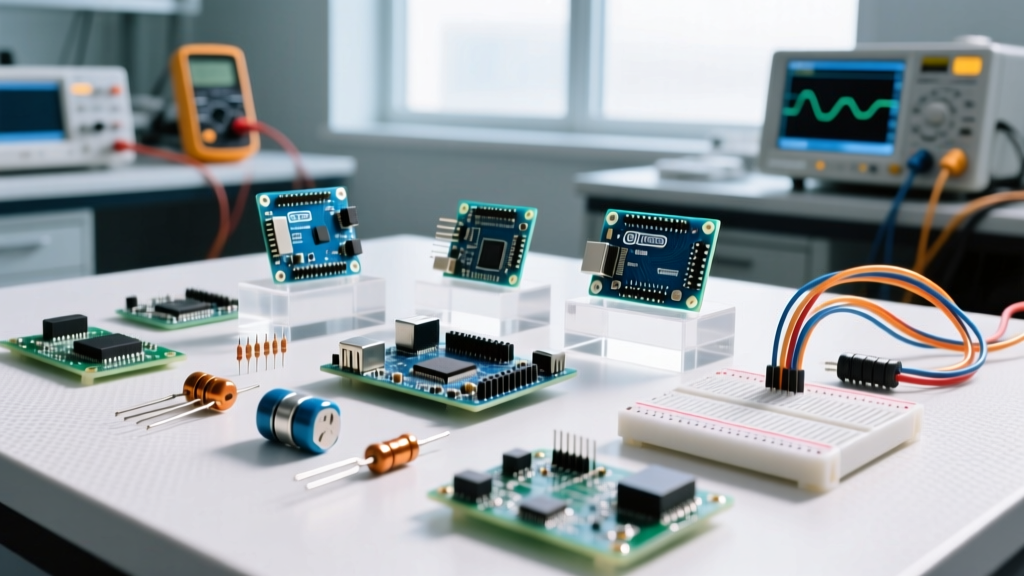

An open source electronics platform is a hardware and software ecosystem where the schematic designs, PCB layouts, and core firmware code are publicly licensed for anyone to study, modify, and manufacture. In a real circuit installation or prototyping run, this changes your workflow from waiting weeks for proprietary evaluation boards and signing NDAs for silicon datasheets to immediately downloading reference schematics and spinning up custom PCBs in free tools. Beginners commonly confuse 'open source hardware' (OSH) with 'open source software running on closed hardware'—like running Python on a proprietary PLC—or mistakenly assume 'open source' means the physical board is free of charge rather than free to modify.
The Anatomy of an Open Source Electronics Platform
To use these platforms effectively at the bench, you need to understand the four distinct layers that make them function. Unlike closed ecosystems where a single vendor controls the stack, open platforms rely on community-driven modularity.
- Silicon and Datasheets: The underlying microcontroller (e.g., Espressif ESP32, RP2040) is usually proprietary, but the platform ensures the silicon datasheets, register maps, and errata are publicly available without NDA restrictions.
- Reference Hardware: The platform provides complete, CC-BY-SA or CERN OHL-licensed schematics and PCB layout files. This includes the exact bill of materials (BOM), impedance-controlled USB routing, and power tree design.
- Firmware and Bootloaders: The hardware abstraction layer (HAL), bootloaders, and core libraries (like Arduino core or ESP-IDF) are open, allowing you to debug down to the register level.
- EDA Integration: The ecosystem relies on open Electronic Design Automation tools. Today, KiCad is used for over 70% of hobbyist and prosumer open-source PCB designs, replacing expensive proprietary CAD licenses.
Numeric Example: Thermal Variance in Platform Clones
Because an open source electronics platform allows anyone to manufacture the reference hardware, the market is flooded with 'clones.' While the schematic might be identical, the physical component tolerances often vary, which drastically changes real-world circuit behavior.
Let's calculate the thermal performance of the onboard 5V-to-3.3V low-dropout (LDO) voltage regulator on an ESP32 development board when driving a 500mA continuous load (e.g., transmitting over WiFi with a sensor array).
The Math:
Power dissipated ($P$) = $(V_{in} - V_{out}) \times I$
$P = (5.0V - 3.3V) \times 0.5A = \mathbf{0.85W}$
| Board Variant | LDO Package | Thermal Resistance ($\theta_{JA}$) | Temp Rise ($\Delta T$) | Junction Temp ($T_J$ at 25°C ambient) |
|---|---|---|---|---|
| Official DevKitC | SOT-223 | ~50°C/W | 42.5°C | 67.5°C (Safe) |
| Cheap Clone Board | SOT-89 | ~120°C/W | 102.0°C | 127.0°C (Thermal Derating) |
The Circuit Impact: At 127°C, the SOT-89 LDO on the cheap clone will enter thermal derating. The output voltage will droop below the 3.3V required by the ESP32, causing continuous brownout resets during WiFi transmission. The open-source schematic told you the circuit topology, but the clone manufacturer's BOM substitution changed the physics. Always verify the LDO package and copper pour area on clone boards before deploying them in high-current applications.
Where You Meet This In Practice
You will encounter open source electronics platforms across three primary environments, each demanding a different approach to the hardware:
- Makerspaces and Prototyping: You meet this as breadboard-friendly development modules (NodeMCU, Arduino Nano, Raspberry Pi Pico). The focus here is on rapid iteration using pre-built libraries and jumper wires.
- Custom PCB Design: You meet this when transitioning from a breadboard to a custom board. You import the platform's open-source KiCad footprint libraries and route your own traces, following the vendor's hardware design guidelines for RF impedance and decoupling capacitor placement.
- University and Research Labs: You meet this in data acquisition rigs where platforms like the Arduino Mega or Teensy are used to interface with specialized scientific sensors via SPI or I2C, leveraging open-source drivers to avoid vendor lock-in.
Common Mistakes When Adopting Open Hardware
Adopting an open platform is not as simple as buying a board and plugging it in. Here are the most frequent errors that lead to failed builds or bricked silicon:
- Assuming Pinout Uniformity: Just because two boards are labeled 'ESP32 DevKit V1' does not mean their GPIO mappings are identical. Clone manufacturers frequently shift the EN, VP, and VN pins to optimize their specific PCB routing. Always map pins by physical board tracing, not just the silkscreen.
- Ignoring the USB-to-UART Bridge: Official boards often use CP2102 or CH340 chips. The CH340 requires specific drivers on older Windows machines and has different baud-rate stability characteristics at speeds above 1Mbps compared to the CP2102.
- Violating the License in Commercialization: If you copy an open-source PCB layout licensed under the CERN Open Hardware Licence (OHL), you are legally required to open-source your modified design files if you manufacture and distribute the product.
FAQ: Open Source Electronics Platforms
Is an open source electronics platform safe for commercial production?
Yes, but with strict caveats. The reference schematics are an excellent starting point, but you must perform your own Design for Manufacturing (DFM) and Design for Assembly (DFA) reviews. Commercial production requires you to verify component supply chains, add proper ESD protection (like TVS diodes on all external GPIOs), and ensure the PCB meets IPC-2221 standards for creepage and clearance. Do not send a raw open-source development board layout directly to a PCB fab for commercial deployment.
What is the difference between open source hardware and open source software in electronics?
Open source software (OSS) means the code (like the Arduino IDE or ESP-IDF) is free to view, modify, and distribute. Open source hardware (OSH) means the physical design files—schematics, Gerber files, and BOMs—are similarly available. Running open source software on a closed-source proprietary microcontroller (like running MicroPython on a closed STM32 board) does not make the board an open source electronics platform. True OSH requires the physical hardware design to be open.
How do I verify if an open source electronics platform clone is safe to use?
Visually inspect the board under a magnifying glass or microscope. Check the LDO regulator package (SOT-223 is preferred over SOT-89 for high current). Verify that the decoupling capacitors are actually populated (cheap clones sometimes omit them to save fractions of a cent). Finally, use a multimeter to check for continuity between the ground plane and any exposed metal shielding to ensure proper grounding. If the board smells heavily of cheap flux or the USB port feels loose, discard it.
Can I sell a product based on an open source electronics platform design?
You can sell products based on the hardware, but your obligations depend on the specific license attached to the design. If the hardware is licensed under Creative Commons Attribution-ShareAlike (CC BY-SA) or the CERN OHL, you can manufacture and sell the physical boards, but you must provide attribution to the original creator and release your modified design files under the same open license. If you want to keep your hardware design closed and proprietary, you must design the PCB from scratch using only the silicon vendor's datasheet, rather than copying an open-source reference layout.


