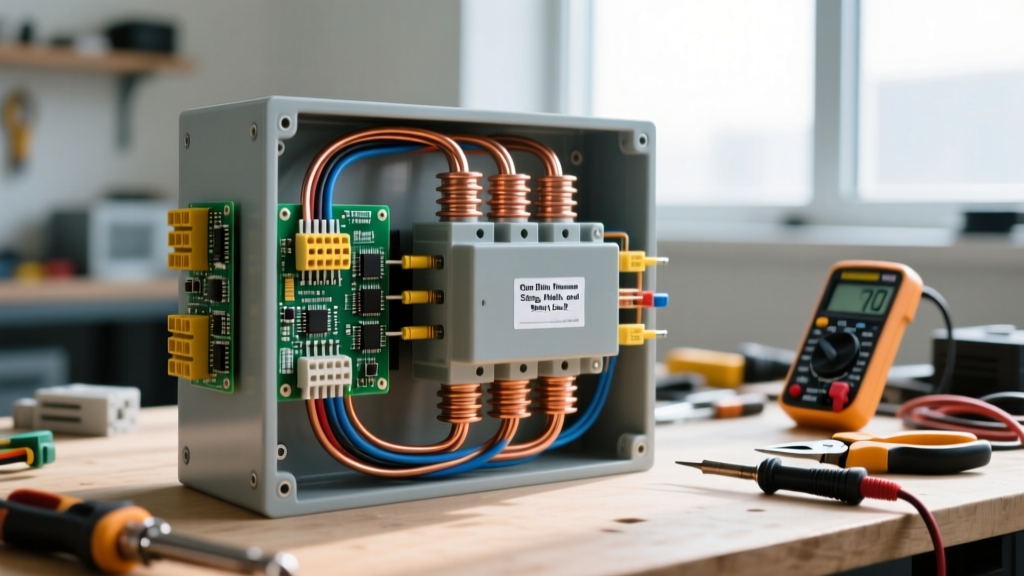

An open delta transformer bank is a three-phase power configuration that uses only two single-phase transformers to supply a three-phase load, operating at 57.7% of the combined physical capacity of the two units. In a real installation, this configuration changes your economics and footprint: it lowers upfront hardware costs and reduces pole or pad space, but it fundamentally limits your available kVA headroom and degrades voltage regulation under heavily unbalanced loads. Technicians frequently confuse it with a 'broken delta'—which is an intentionally open corner on a three-transformer secondary used strictly for ground-fault relay detection, not power delivery.
The Math Behind the 57.7% Capacity Rule
When you wire two identical single-phase transformers in an open delta (often called a V-V connection), you might assume the total bank capacity is simply the sum of the two nameplates. It is not. Because the two transformers must supply three-phase power, the phase angle shift forces one transformer to carry a disproportionate share of the vector sum under balanced loads.
The governing formula for the usable three-phase capacity of an open delta bank is:
Usable kVA = √3 × (Rating of One Transformer)
You install two 25 kVA, 7200V/240V single-phase pole-top transformers.
• Physical installed capacity: 25 kVA + 25 kVA = 50 kVA.
• Usable 3-phase capacity: √3 × 25 kVA = 43.3 kVA.
• Capacity utilization: 43.3 / 50 = 86.6% of the physical hardware, which equates to 57.7% of what a full three-transformer (75 kVA) closed delta bank would provide.
That missing 13.4% of physical capacity is 'lost' to the phase geometry. If you attempt to pull 50 kVA of balanced three-phase load through this 43.3 kVA bank, the transformers will overheat and the secondary voltage will sag severely. For deeper theory on vector relationships in these configurations, refer to the three-phase transformer connection guides at All About Circuits.
Where You Meet Open Delta Banks in Practice
You will rarely see an open delta bank specified for a new, high-density commercial building. Instead, this configuration dominates three specific scenarios:
- Rural Utility Distribution: Running a third transformer out to a remote irrigation pump or a small rural grain elevator is cost-prohibitive. Utilities use open delta to deliver just enough three-phase power (usually under 50 kVA) to spin the motors without stringing extra hardware.
- Temporary Construction Power: When a site needs temporary three-phase power for tower cranes or heavy machinery, renting and wiring two single-phase padmounts is faster and cheaper than sourcing a single massive three-phase unit or a three-transformer bank.
- Emergency Fallback (Redundancy): If one transformer in a standard closed-delta bank fails or blows a fuse, utility linemen can isolate the dead unit and reconfigure the remaining two into an open delta. The facility stays online at 57.7% capacity until the replacement unit arrives.
Open Delta vs. Closed Delta vs. Wye: The Decision Tree
Choosing the right transformer bank topology requires matching the load profile to the geometry. Use this decision path to terminate your design choice.
| Condition / Load Profile | Recommended Topology | Why It Wins |
|---|---|---|
| Balanced 3-phase motor load < 45 kVA; tight budget/space | Open Delta | Lowest hardware cost; minimal pole/pad footprint. |
| Mixed load: heavy 120/240V single-phase lighting + 3-phase motors | Closed Delta (4-wire High-Leg) | Provides a stable neutral for 120V loads while supporting 3-phase motors. |
| Load > 75 kVA; strict voltage regulation requirements | Wye-Wye or Delta-Wye | Handles massive unbalance gracefully; provides a solid neutral and better fault clearing. |
| Need ground-fault detection on an ungrounded delta secondary | Broken Delta | Uses 3 PTs with an open corner to measure zero-sequence voltage for relays. |
Field Mistakes: Open Delta vs. Broken Delta
The most dangerous confusion on the jobsite is mixing up an open delta with a broken delta. While both involve 'missing' connections, their purposes are entirely different.
Another common field error is failing to derate the overcurrent protection on the primary side. According to Eaton's medium-voltage distribution transformer guidelines and NEC Article 450, primary fusing for an open delta bank must be sized based on the usable bank capacity and the specific phase currents, which are not perfectly symmetrical in an open delta setup under unbalanced loads. Always calculate the primary current using the 43.3 kVA usable figure, not the 50 kVA physical sum.
Sizing Your Bank and Concrete Specifications
When drafting the bill of materials for an open delta installation, you must account for the fact that single-phase transformers are manufactured in standard discrete steps: 5, 10, 15, 25, 37.5, 50, 75, and 100 kVA. Because you lose capacity to the √3 factor, you must step up your hardware size to meet the load.
Sizing Workflow:
- Calculate the maximum continuous three-phase load in kVA.
- Divide that load by 0.866 (the utilization factor) to find the minimum required physical nameplate rating per transformer.
- Round up to the next standard single-phase kVA size.
Example: Your calculated 3-phase load is 35 kVA.
35 kVA / 0.866 = 40.4 kVA per transformer required.
You must purchase two 50 kVA single-phase transformers. (Two 37.5 kVA units would only yield 32.4 kVA usable, which is insufficient).
For padmount applications, specify compartmentalized single-phase units (like the Eaton single-phase padmount series) with separate high-voltage and low-voltage compartments to maintain safety clearances when linemen or electricians are working on the open delta secondary busbars. Ensure the secondary busbar is rated for the full line current of the usable capacity, as the physical conductors connecting the two transformers must carry the full vector sum of the phase currents.
Frequently Asked Questions
Can I add a third transformer later to upgrade an open delta to a closed delta?
Yes. This is a common utility growth strategy. You install two transformers now to serve a light load, and when the facility expands, you drop a third identical transformer on the pole or pad, wire it into the open leg, and instantly increase your capacity by roughly 73% without replacing the original hardware.
Does an open delta bank provide a neutral for 120V single-phase loads?
No. A standard open delta provides a 3-wire, 240V three-phase output. If you need 120V/240V split-phase power alongside three-phase power, you must use a closed delta with a center-tapped transformer (high-leg delta) or a wye configuration. Attempting to derive a neutral from an open delta by grounding a center tap on one of the two transformers will result in severe voltage unbalance and is a direct violation of NEC grounding rules.
What happens to the voltage if one transformer in an open delta bank fails?
Unlike a closed delta bank where a failed transformer leaves you with two units to form an open delta, a failure in an existing open delta bank means you lose one of your only two phases. The system will collapse to single-phase power, and three-phase motors will stall, draw locked-rotor current, and trip their overload protection or burn out if not properly protected by phase-loss relays.


