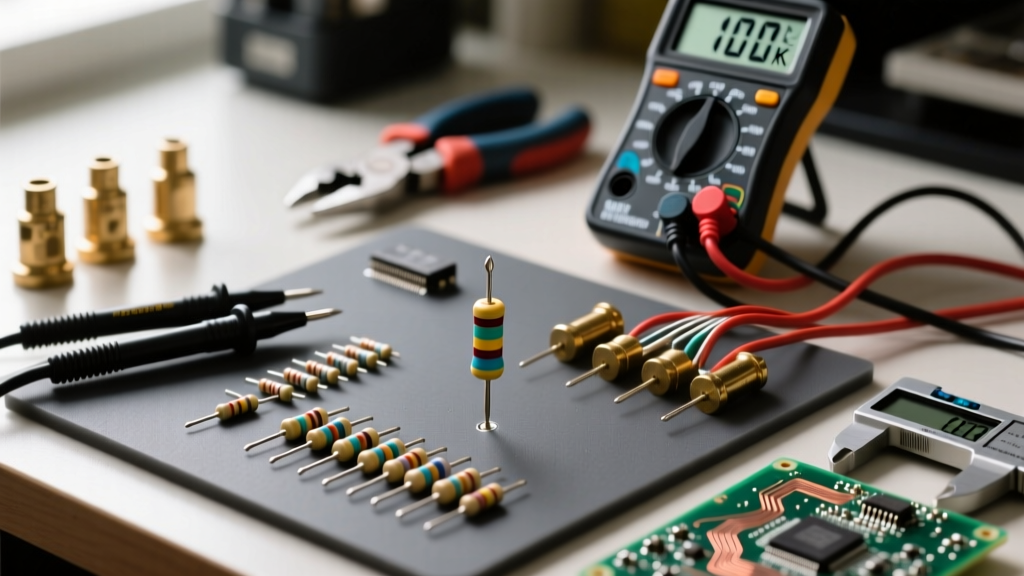
The ohms symbol is the uppercase Greek letter Omega (Ω), the SI unit for electrical resistance. On schematics, it manifests as a zig-zag line (US standard) or a hollow rectangle (international standard), while on PCB silkscreens and multimeters, it frequently collapses into the letter 'R' or prefixes like 'k' and 'M'. Below is the definitive bench reference for interpreting this symbol across every medium you will encounter in electronics.
The Complete Ohms Symbol & Resistor Notation Reference Table
How to read this table: The 'Context' column tells you where you will physically see this notation, while the 'Meaning in Practice' column explains how to interpret it when reading a BOM, schematic, or DMM display.
| Symbol / Notation | Context | Governing Standard | Meaning in Practice |
|---|---|---|---|
| Ω (Uppercase Omega) | General Unit / DMM Display | SI Base (NIST) | The base unit of resistance. 1 Ω = 1 Volt per Ampere. |
| Zig-Zag Line | US Schematics | ANSI/IEEE 315 | Standard resistor symbol in North American documentation. |
| Hollow Rectangle | International Schematics | IEC 60617 | Standard resistor symbol in EU/UK/Asian documentation. |
| R (e.g., 4R7, R22) | PCB Silkscreen / BOM | BS EN 60062 | 'R' acts as a decimal point (4R7 = 4.7 Ω) or a reference designator (R22 = Resistor #22). |
| kΩ / MΩ | Multimeter Dial / Schematic | IEC 61010 | Kilo (1,000 Ω) and Mega (1,000,000 Ω) multipliers. |
| ω (Lowercase omega) | AC Theory / Formulas | IEEE 260 | Trap: This is NOT resistance. It represents angular frequency (2πf) in radians/second. |
| Ω with Diode Symbol | Multimeter Dial | IEC 61010 | Combined continuity (beep) and diode forward-voltage test mode. |
Regional and Standard Variants: US vs. IEC Schematics
If you are downloading a service manual or tracing a PCB, the schematic symbol for a resistor will immediately tell you the origin of the documentation.
The US Standard (ANSI/IEEE 315)
In North America, the resistor is drawn as a zig-zag line. This standard is deeply entrenched in older US military specs, vintage audio gear, and legacy educational materials. When you see a zig-zag, you are almost certainly looking at a schematic drafted by a US-based engineer or using a legacy US template in CAD software like Altium or OrCAD.
The International Standard (IEC 60617)
The rest of the world (and modern international CAD defaults) uses a hollow rectangle. This is the standard you will encounter in modern consumer electronics, EU-manufactured industrial drives, and datasheets from companies like STMicroelectronics or Infineon. The rectangle is cleaner for dense, multi-layer schematic sheets and is less likely to be confused with inductor coils (which are drawn as looping scallops).
Silkscreen and BOM Notation (BS EN 60062)
On the physical PCB, you will rarely see the Ω symbol printed. Instead, the British Standard (adopted internationally as BS EN 60062) uses the letter 'R' to save space and avoid printing tiny Greek letters. A resistor marked 4R7 on the silkscreen is 4.7 Ω. A resistor marked R47 is 0.47 Ω. A resistor marked 47R is 47 Ω.
Notations and Rows People Get Wrong
Misinterpreting the ohms symbol or its derivatives is a fast track to blowing a fuse or misdiagnosing a board. Here are the most common bench errors.
Confusing Ω (Resistance) with ω (Angular Frequency)
In AC circuit theory and filter design, the lowercase omega (ω) represents angular frequency, calculated as ω = 2πf. If you are reading a formula for inductive reactance (X_L = ωL) and assume the ω is the ohms symbol, you will completely misinterpret the math. Uppercase Ω is always a static resistance value; lowercase ω is always a frequency variable.
The 'R' Designator vs. Decimal Trap
When reading a BOM or silkscreen, context is everything. If you see R14, that is the reference designator for the 14th resistor on the board. If you see 2R2, that is the value of the resistor (2.2 Ω). Beginners frequently order 14-ohm resistors when they see 'R14' on a parts list, rather than looking up the actual value assigned to that designator in the schematic.
Never measure resistance (Ω) on a live circuit. Multimeters inject a small known current to measure the voltage drop and calculate resistance. If the circuit is powered, external voltage will backfeed into the DMM's analog-to-digital converter, instantly blowing the internal meter fuse or destroying the ADC chip. Always de-energize, discharge capacitors, and verify dead before switching your dial to Ω.
Safe Interpretation When Markings are Faded or Missing
Power resistors, snubber networks, and current-sense shunts often run hot enough to char the silkscreen or melt the paint off color bands. If you encounter a burned resistor with missing markings:
- Never guess based on physical size. A 5W cement resistor could be 0.1 Ω (current sense) or 470 Ω (bleeder).
- Desolder one leg to isolate it from parallel circuit paths, then measure with your DMM in Ω mode.
- If it reads 'OL' (Open Loop), the resistor has failed open. You must trace the schematic, find the driver IC datasheet (e.g., checking the recommended sense resistor for a DRV8871 motor driver), or locate an identical unburned board to identify the intended value.
Frequently Asked Questions
What is the ohms symbol on a digital multimeter dial?
On a DMM, the ohms symbol is the uppercase Omega (Ω). It is usually grouped with continuity (a soundwave icon) and diode test (an arrow hitting a line). On manual-ranging meters, you will see specific tiers: 200Ω, 2kΩ, 20kΩ, 200kΩ, 2MΩ, and 20MΩ. Always start on the highest range (20MΩ) and step down to get the most significant digits without overloading the display.
Why is the Greek letter omega used as the ohms symbol?
The unit is named after German physicist Georg Simon Ohm, who formulated Ohm's Law in 1827. In the late 19th century, the scientific community adopted the Greek alphabet for standardized scientific units to avoid conflicts with Latin letters already used for variables (like 'O' for Origin or 'R' for Radius). The uppercase Omega (Ω) was selected to represent the Ohm, as documented by the National Institute of Standards and Technology (NIST) in their SI unit guidelines.
How do I type the ohms symbol in schematic software or text?
In modern EDA tools like KiCad, Altium, or EasyEDA, you do not type the symbol manually; the software appends it automatically based on the value field. For word processors or forum posts:
- Windows: Hold
Altand type234on the numeric keypad (Ω). - Mac: Press
Option + Z. - HTML/Markdown: Use the entity
Ωor UnicodeU+03A9.
What does the ohms symbol with a 'k' or 'M' prefix mean on a DMM?
These are standard SI prefixes indicating multipliers, crucial for reading resistor color codes and values. 'k' stands for kilo (×1,000), so 4.7kΩ is 4,700 ohms. 'M' stands for Mega (×1,000,000), so 2.2MΩ is 2,200,000 ohms. If your DMM displays '1.5' and the dial is set to the 'kΩ' range, the actual resistance is 1,500 Ω. If the display shows '0.047' on the 'MΩ' range, that equals 47,000 Ω (or 47 kΩ).