
Decoding the NPN Transistor Datasheet
When browsing through Digi-Key's BJT catalog, the sheer volume of NPN transistors can be paralyzing. Unlike MOSFETs, which are voltage-controlled, Bipolar Junction Transistors (BJTs) are current-controlled devices. Selecting the right NPN transistor for your prototyping breadboard or custom PCB requires looking past the marketing hype and diving straight into the silicon specifications. Before you add to your cart, you must understand the four pillars of BJT selection.
| Parameter | Symbol | Real-World Prototyping Meaning |
|---|---|---|
| Collector-Emitter Voltage | VCEO | The absolute maximum voltage the transistor can block when turned OFF. Always derate this by 20% for safety. |
| Continuous Collector Current | IC | The maximum current the load can draw through the transistor. Exceeding this will melt the internal silicon die. |
| DC Current Gain | hFE (Beta) | The amplification factor. Crucial for calculating your base resistor. Note that hFE drops significantly at high currents. |
| Collector-Emitter Saturation | VCE(sat) | The voltage drop across the transistor when fully ON. Lower is better for switching; high values cause severe heat. |
The Maker's Inventory: 4 Essential NPN Transistors
Rather than buying a random assortment kit from an unverified marketplace, professional DIYers and hardware engineers stock specific, proven NPN models. Here is the definitive buying guide for the four transistors that should live in your component drawers.
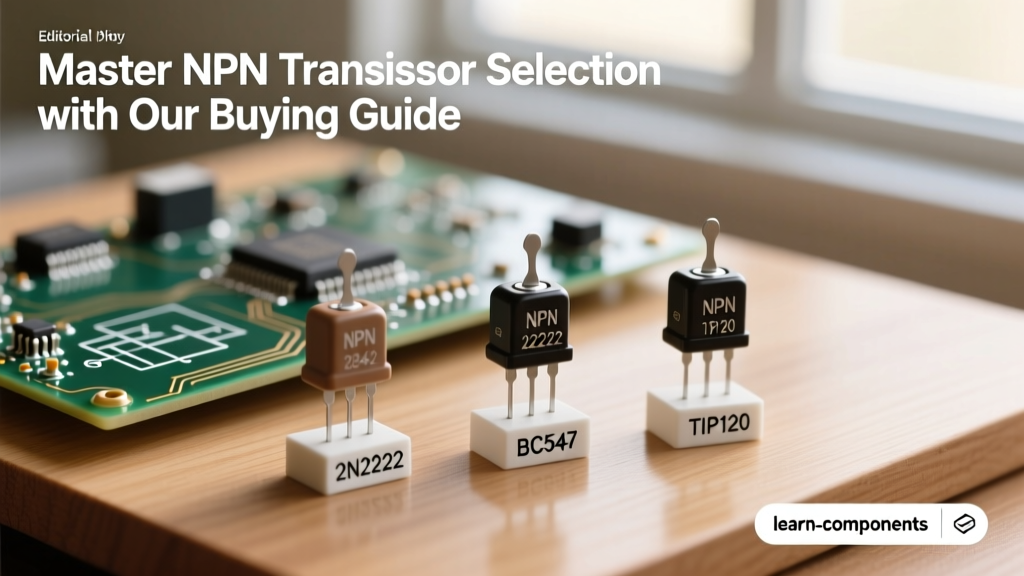
1. BC547 (The Signal King)
Best for: Audio pre-amplifiers, sensor interfacing, and low-current logic shifting.
Specs: 45V VCEO, 100mA IC, hFE up to 800 (C-grade).
Buying Advice: The BC547 comes in a TO-92 package. Pay attention to the suffix: BC547A, B, and C denote different hFE gain bins. For audio amplification, buy the BC547C for its high, predictable gain. Expect to pay around $0.03 to $0.05 per unit in bulk.
2. 2N3904 / PN2222 (The Switching Workhorses)
Best for: Driving LEDs, small relays, and general-purpose microcontroller GPIO buffering.
Specs: 40V VCEO, 200mA IC.
Buying Advice: Many beginners ask for a '2N2222'. Historically, the true 2N2222 comes in a metal TO-18 can, which is annoying for breadboarding. What you actually want is the PN2222A (the TO-92 plastic equivalent) or the 2N3904. The 2N3904 is slightly better optimized for high-speed switching. Refer to the ON Semiconductor 2N3904 datasheet to see its excellent switching time characteristics. Price: ~$0.05 each.
3. TIP120 (The Darlington Heavyweight)
Best for: Switching high-current DC motors, solenoids, and LED strips directly from a 5V Arduino pin.
Specs: 60V VCEO, 5A IC, massive hFE of 1000+.
Buying Advice: The TIP120 is a Darlington pair (two transistors in one package). While it offers massive gain, it suffers from a terrible VCE(sat) of roughly 2.0V. If you pass 3 Amps through it, it will dissipate 6 Watts of heat—a TO-220 package requires a heatsink at this level. Buy these only when you need high current but have limited base drive current. Price: ~$0.80 each.
4. 2N3055 (The Power Brick)
Best for: Linear power supplies, dummy loads, and high-power audio outputs.
Specs: 60V VCEO, 15A IC.
Buying Advice: Housed in a robust TO-3 metal can, this is a classic power transistor. However, its hFE is notoriously low (often between 20 and 70). You will need to drive the base with substantial current, often requiring a smaller driver transistor (like a 2N3904) in a Darlington configuration. Price: ~$1.50 to $3.00.
Application-Specific Selection Framework
Choosing an NPN transistor is not just about max limits; it is about matching the silicon to the physics of your load.
Switching Inductive Loads (Relays & Motors)
When turning off a relay coil, the collapsing magnetic field generates a massive reverse voltage spike (inductive kickback). If your NPN transistor's VCEO is lower than this spike, the collector-base junction will avalanche and destroy the silicon. Selection Rule: Always choose an NPN with a VCEO at least double your supply voltage, and always wire a 1N4007 flyback diode in reverse parallel across the coil.
Audio Amplification & Signal Processing
For audio circuits, switching speed and high current limits are irrelevant. What matters is low noise and high linearity. Selection Rule: Avoid Darlingtons (like the TIP120) due to their crossover distortion and high VCE(sat). Instead, select low-noise signal transistors like the BC549C or 2N3904, and bias them carefully in the active region using voltage divider networks.
The Saturation Trap: Calculating the Base Resistor
The most common mistake DIYers make when buying and using BJTs is treating the datasheet's hFE as a fixed, guaranteed number. In reality, hFE is a broad range that plummets as the transistor approaches its maximum IC.
The Forced Beta Rule: To guarantee an NPN transistor acts as a closed switch (hard saturation), do not use the datasheet's typical hFE. Instead, assume a 'forced beta' of 10. Calculate your base resistor using:
RB = (VGPIO - 0.7V) / (IC / 10)
This overdrives the base, ensuring VCE(sat) drops to its minimum, keeping your transistor cool.
If your microcontroller GPIO cannot supply the required base current calculated via the forced beta rule, you have selected the wrong NPN transistor. You must either step up to a Darlington (TIP120) or abandon BJTs entirely in favor of a logic-level MOSFET (like the IRLZ44N).
Real-World Failure Modes in Prototyping
Even with the right part, poor circuit design will fry your NPN. Watch out for these two silent killers:
1. Thermal Runaway
BJTs have a negative temperature coefficient regarding their base-emitter voltage. As the transistor heats up, it requires less voltage to turn on, which causes it to draw more current, which makes it hotter. This positive feedback loop is called thermal runaway. The Fix: Never wire a BJT's base directly to a voltage rail. Always use a base resistor to limit current, and in linear applications, add an emitter degeneration resistor to provide negative feedback.
2. Base Current Starvation
Forgetting the base resistor or using a value that is too high leaves the transistor in the 'linear' or 'active' region instead of saturation. In this state, the transistor acts like a variable resistor, dropping massive amounts of voltage and converting it directly into heat. A 2N3904 switching a 100mA motor without proper base drive will overheat and fail in seconds.
Sourcing Strategy: Dodging Counterfeit Silicon
The market for discrete semiconductors is flooded with counterfeits. Fake NPN transistors often contain much smaller silicon dies than advertised, meaning a counterfeit 'TIP120' might melt at 1 Amp instead of 5 Amps. For critical power stages or commercial prototypes, avoid random marketplace bins. Source your BJTs from authorized distributors like Mouser, Digi-Key, or Farnell. For deeper theoretical foundations on how these junctions operate, All About Circuits offers an excellent primer on BJT physics.
Conclusion
Selecting the right NPN transistor is a balancing act between current capacity, voltage limits, gain, and thermal realities. By stocking the BC547, 2N3904, TIP120, and 2N3055, you cover 95% of DIY electronics use cases. Always respect the forced beta rule, protect against inductive spikes, and buy from reputable distributors to ensure your silicon is genuine. Master these fundamentals, and your prototyping success rate will skyrocket.