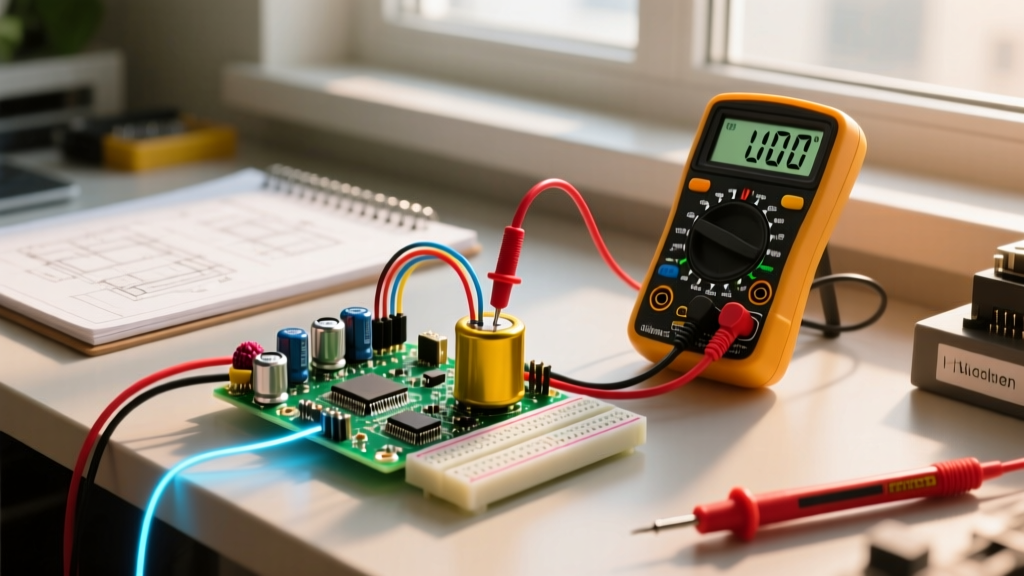
If you have spent any time on DIY solar forums or van-build Facebook groups, you may have encountered the dangerous claim that overcurrent protection devices are not necessary for dc circuits. This is a lethal misconception. An overcurrent protection device (OCPD) is a fuse or circuit breaker that automatically interrupts a circuit when current exceeds a safe threshold, preventing wire insulation meltdown and electrical fires. In a real installation, an OCPD changes a catastrophic, structure-burning thermal event into a minor inconvenience costing the price of a replacement fuse. While low-voltage DC systems (like 12V automotive) lack the high-voltage "shock" hazard of AC mains, they possess massive short-circuit current potential that demands rigorous protection.
The Physics of DC Faults: Why the Myth is Dangerous
The myth usually stems from a misunderstanding of how electricity behaves at lower voltages. Makers often assume that because a 12V or 24V battery won't electrocute you, it won't start a fire. The reality of DC physics proves the exact opposite.
In an AC circuit, the voltage crosses zero 120 times per second (on a 60Hz grid). When a breaker trips and its internal contacts separate, this zero-crossing naturally helps extinguish the electrical arc that forms between the contacts. DC voltage, however, is a continuous, unidirectional push. When a DC breaker opens under a heavy fault load, the resulting plasma arc has no zero-crossing to rely on for extinction. Think of an AC arc like a pulsing spray from a hose that naturally stops and starts, whereas a DC arc is like a continuous high-pressure water hose blasting through a gap. Without specialized internal geometry—such as magnetic blowouts, arc chutes, or longer physical contact gaps—a standard breaker will sustain the arc, melt its own housing, and weld its contacts shut while the wire catches fire.
Where You Meet This in Practice
You will encounter the critical need for DC-rated OCPDs in three primary DIY and trade environments:
- Solar PV Arrays: Combiner boxes and DC disconnects between the roof panels and the charge controller or hybrid inverter.
- Energy Storage Systems (ESS): The main positive feeder between lithium (LiFePO4) or lead-acid battery banks and the main DC busbar or inverter.
- Automotive and Marine: 12V/24V van conversions, RV house banks, and boat DC distribution panels where vibration and moisture increase short-circuit risks.
Worked Scenario: The Unfused 48V LiFePO4 Bank Meltdown
To understand what happens when builders skip the fuse, let us walk through a real-world bench failure involving a popular DIY server-rack battery setup.
- The Setup: A DIYer connects a 48V 100Ah LiFePO4 server rack battery (nominal 51.2V resting) to a 5000W hybrid inverter using 2/0 AWG flexible welding cable. Relying solely on the battery's internal Battery Management System (BMS), they install no external Class T fuse between the battery positive terminal and the inverter busbar.
- The Numbers: The inverter draws a maximum continuous current of 110A. However, the battery's internal cells and copper busbars can deliver a dead-bolt short-circuit current exceeding 4,500 Amps for a brief fraction of a second.
- The Outcome: While tightening a lug on the positive busbar, an uninsulated wrench slips, bridging the positive terminal to the grounded metal chassis of the battery rack.
- What Went Wrong: The BMS detected the massive overcurrent and attempted to open its internal MOSFETs to stop the flow. However, 4,500A far exceeded the let-through current limits of the silicon junctions. In microseconds, the MOSFETs physically exploded and failed in a "shorted" state. With the BMS defeated, the 2/0 AWG wire acted as a resistive heater, melting its insulation and igniting the surrounding plywood before the battery terminals finally melted apart to break the circuit.
The Fix: An external Bussmann JJN-400 Class T fuse (costing roughly $45) installed on the positive lead would have cleared the 4,500A fault in milliseconds, safely sacrificing itself and leaving the wire, BMS, and workshop completely intact. For proper component selection, refer to Littelfuse Industrial and DC Fuse Application Guides to ensure your fuse has an adequate Ampere Interrupting Capacity (AIC) for lithium banks.
Sizing DC Overcurrent Protection: A Numeric Example
Sizing a DC OCPD requires balancing the maximum continuous current, the National Electrical Code (NEC) continuous load multipliers, and the ampacity of your chosen wire. Let us size the main OCPD for a solar PV branch circuit.
The System: Four 200W 12V nominal solar panels wired in parallel.
- Panel Short Circuit Current (Isc): 11.5A per panel.
- Total Array Isc: 11.5A × 4 = 46A.
The Math (NEC 690.8 Compliance):
Solar arrays are considered continuous loads. The NEC requires multiplying the Isc by 1.25 to determine the minimum OCPD and wire sizing baseline.
46A × 1.25 = 57.5A.
Wire Selection:
We select 6 AWG PV wire (dual-rated USE-2/RHW-2). In the 90°C column for free air, it handles 90A, but we must use the 75°C column for termination limits at the breaker, which rates 6 AWG copper at 65A.
OCPD Selection:
We need a DC-rated breaker that is at least 57.5A but does not exceed the wire's 65A ampacity. We select a 60A DC-rated breaker (such as the MidNite Solar MNEPV60). Using a standard 60A AC breaker from a big-box store here is a severe fire hazard, as it lacks the internal arc-chute geometry required to safely interrupt 60A of continuous DC voltage.
Common Confusions: BMS Cutoffs and AC/DC Ratings
When researching why some claim overcurrent protection devices are not necessary for dc circuits, you will run into two major points of confusion that lead to unsafe builds.
Confusion 1: "My BMS has overcurrent protection built-in."
A Battery Management System is designed to protect the lithium cells from over-discharge, over-charge, and moderate overcurrent (e.g., pulling 150A from a 100A rated battery). It is not designed to protect the wire from a dead short. A dead short bypasses the BMS's ability to react safely, as demonstrated in the server-rack scenario above. The OCPD protects the wiring; the BMS protects the chemistry. You need both.
Confusion 2: "Voltage is voltage; an AC breaker works for 12V DC."
Standard thermal-magnetic AC breakers (like common Square D Homeline or Siemens QP models) are strictly tested and rated for AC zero-crossing environments. While they might physically fit in a DC distribution box and trip under a massive thermal overload, their magnetic trip mechanism and arc-extinguishing chambers are not calibrated for DC. Under a high-current DC fault, the arc will jump the gap, carbonize the breaker housing, and keep the circuit energized while the wires melt. Always buy breakers explicitly marked with a DC voltage rating (e.g., "125VDC Max").
FAQ: DC Circuit Protection Realities
Why do some people claim overcurrent protection devices are not necessary for dc circuits?
This myth usually originates from 12V automotive wiring, where the alternator's output and the battery's internal resistance naturally limit short-circuit current to levels that sometimes just melt a small wire before starting a massive fire. However, as DIYers move to massive 48V LiFePO4 banks or high-current solar arrays capable of delivering thousands of amps, this "natural limitation" no longer exists, making external fuses mandatory.
Do I need a fuse on both the positive and negative DC wires?
No. In a standard grounded DC system (where the negative is bonded to the chassis or a common ground bus), you only place the OCPD on the ungrounded (positive) conductor. Fusing the negative wire can create a dangerous situation where a ground fault bypasses the fuse entirely, or where a blown negative fuse leaves the entire system energized but non-functional, masking a live hazard.
What is the difference between an ANL fuse and a Class T fuse?
Both are common in DC systems, but their interrupt ratings differ vastly. An ANL fuse typically has an Ampere Interrupting Capacity (AIC) of around 2,700A at 32V. A Class T fuse (like the Bussmann JJN series) boasts an AIC of 20,000A at 125VDC. For small 12V van builds, ANL is fine. For 48V lithium server-rack batteries capable of massive fault currents, Class T is strictly required to prevent the fuse itself from exploding during a short circuit.