Mosquito zapper voltage refers to the high-voltage, low-current electrical pulse (typically 1,800V to 3,000V DC) generated by an internal oscillator and voltage multiplier circuit to electrocute insects across a charged metal grid. This extreme potential difference dictates the physical arc gap distance between the protective and lethal meshes, the lethality to varying insect exoskeleton thicknesses, and the device's human safety profile. Hobbyists and repair technicians most commonly confuse this secondary high-voltage output with the primary input voltage (a 3.7V Li-ion or 4V lead-acid battery), or mistakenly apply the continuous-DC "amps kill, not volts" adage to what is actually a high-impedance capacitive discharge circuit.
The Circuit Theory: Stepping Up to Mosquito Zapper Voltage
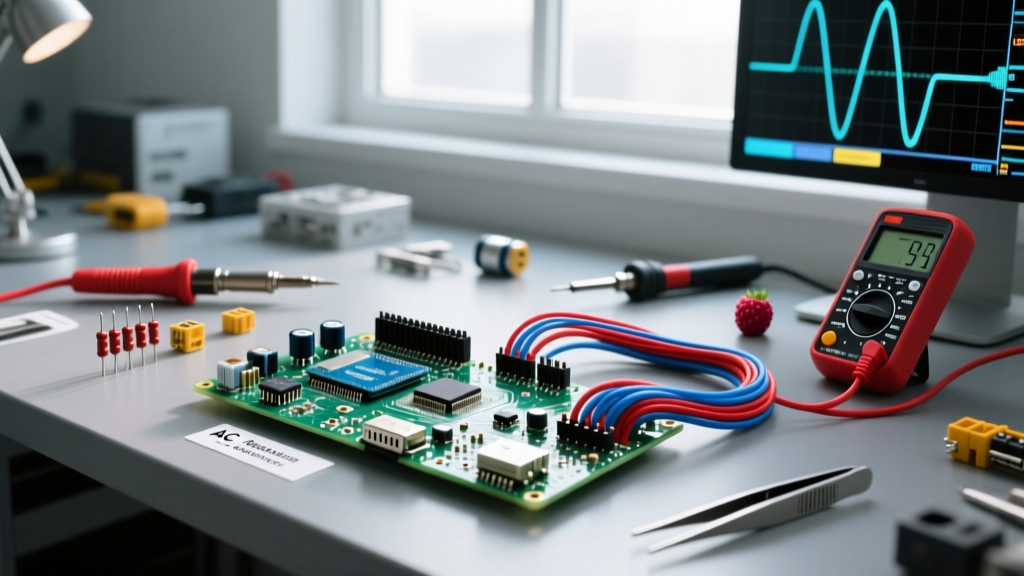
To understand the output, you have to look at the two distinct stages on the zapper's printed circuit board: the blocking oscillator and the voltage multiplier.
The primary stage is a self-oscillating flyback converter. When you press the activation switch, DC power from the battery (usually 3.7V from a 14500 Li-ion cell or 4V from a sealed lead-acid block) feeds into a high-frequency ferrite transformer. A switching transistor—almost universally an S8050 NPN in commercial units—chops this DC into high-frequency AC (typically 20kHz to 50kHz). The transformer's winding ratio steps this up to roughly 150V to 250V AC.
The secondary stage is a Cockcroft-Walton voltage multiplier. This is a ladder network of high-voltage diodes and capacitors that rectifies the AC and stacks the peak voltages. A standard zapper uses a 4-stage or 6-stage multiplier. Each stage adds the peak AC voltage to the running total. By the time the circuit reaches the final storage capacitor, the 200V AC peaks have been multiplied into a steady 2,200V DC potential waiting at the metal grid.
Numeric Example: Calculating the Lethal Energy Threshold
Why does 2,200V shock you but not stop your heart? The answer lies in capacitive energy storage, not just voltage. The final capacitor in the multiplier ladder acts as a reservoir. We can calculate the exact energy delivered in a single zap using the standard capacitor energy formula:
E = 0.5 × C × V²
- C (Capacitance): The final storage capacitor in a typical commercial zapper is a 2nF (0.000000002 Farads) CBB film capacitor.
- V (Voltage): Let's assume a fully charged grid at 2,200V DC.
Calculation:
E = 0.5 × (2 × 10⁻⁹ F) × (2,200)²
E = 0.5 × 0.000000002 × 4,840,000
E = 0.00484 Joules (4.84 mJ)
Where You Meet This in Practice
If you are repairing, modifying, or building custom high-voltage grids, mosquito zapper voltage dictates your physical layout and component selection.
1. Grid Spacing and Paschen's Law
The distance between the outer protective grid and the inner lethal grid is not arbitrary. At standard temperature and pressure, the dielectric breakdown of air (Paschen's Law) is roughly 3kV per millimeter. However, high ambient humidity, dust, and vaporized insect debris drastically lower this threshold. In practice, manufacturers set the mesh gap between 2.0mm and 3.5mm. If you are 3D printing a custom enclosure for a replacement grid, spacing the meshes closer than 2mm will result in continuous arc-over, draining the battery and burning out your switching transistor.
2. Diagnosing a Dead Zapper on the Bench
When a zapper fails to spark but the power LED illuminates, the primary oscillator is usually functioning, but the high-voltage secondary has failed. The most common culprit is the final 2nF storage capacitor. Over time, the high electric field degrades the dielectric, causing the capacitor to fail short. When it shorts, the voltage multiplier cannot stack charge, and the grid voltage drops to near zero. The second most common failure is the S8050 transistor shorting internally due to thermal runaway from holding the trigger switch down for too long.
Common Confusions: Volts, Amps, and Stored Energy
The most pervasive myth in electronics is "amps kill, not volts." While true for continuous power supplies (like a 120V AC wall outlet that can deliver hundreds of amps), it is dangerously misleading when applied to capacitive discharge circuits like mosquito zappers, camera flashes, and defibrillators.
In a zapper, the continuous current is indeed limited to microamps by the high impedance of the multiplier diodes. If you touch the grid, your body resistance limits the continuous current. However, the initial strike is a capacitive dump. For the first few microseconds, the capacitor will push several amps through your skin until it is depleted. The danger in high-voltage capacitors is measured in Joules (energy) and Coulombs (charge), not continuous amperage. Never assume a high-voltage circuit is safe just because the power supply is rated for low current; the storage capacitor is the actual hazard.
Decision Path: Selecting or Repairing Zapper Components
Use this decision tree to troubleshoot a broken unit or select components for a DIY high-voltage insect grid.
| Scenario / Symptom | Diagnostic Step | Concrete Action / Part Pick |
|---|---|---|
| Zapper won't spark, but LED is ON | Test primary oscillator with an oscilloscope; check for AC at the transformer secondary. | If no AC, replace the switching transistor with an S8050 NPN (or equivalent CJ750). |
| Weak spark, or spark dies after 1 second | Inspect the voltage multiplier ladder for burnt diodes or a shorted final capacitor. | Replace the final storage cap with a 2nF 2kV CBB21/CBB60 film capacitor. |
| Continuous arcing between grids (no bugs present) | Measure grid gap with calipers; check for carbon tracking on the plastic frame. | Increase mesh gap to 3.0mm and clean the plastic frame with isopropyl alcohol to remove conductive carbon paths. |
| Building a custom DIY zapper grid from scratch | Need a reliable, safe high-voltage driver module. | Use a dedicated ZVS (Zero Voltage Switching) flyback driver module powered by 12V, limited to 2mA output. |
Safety, Arc-Over, and Flammability
While 4.84 mJ will not stop a human heart, it is more than enough to ignite flammable vapors. The minimum ignition energy (MIE) for many common household solvents, aerosol propellants (like butane or propane), and alcohol vapors is between 0.2 mJ and 1.0 mJ. Never operate a mosquito zapper immediately after spraying aerosol insecticide, near open solvent containers, or in environments with combustible dust. The 2,200V spark will reliably trigger a flash fire or explosion in these conditions.
Frequently Asked Questions
Can I power a mosquito zapper grid directly from a 120V AC wall outlet?
No. Commercial zapper grids are designed for high-voltage DC. Feeding 120V AC directly to the grid will not multiply the voltage sufficiently to reliably arc across a 3mm gap, and it creates a massive continuous-current electrocution hazard for humans and pets. Always use an isolated oscillator and multiplier circuit.
Why does my zapper make a high-pitched whining sound before I even press the button?
This indicates a failing trigger switch or a shorted S8050 transistor. The transistor is stuck in the 'on' state, causing the blocking oscillator to run continuously. This will rapidly drain your battery and eventually overheat the ferrite transformer. Desolder and replace the S8050 immediately.
Is it safe to use a multimeter to measure the grid voltage?
Standard CAT III or CAT IV digital multimeters are generally rated for 600V to 1000V DC. Applying a 2,500V zapper pulse to the probes will likely arc internally, destroying the multimeter's input protection and potentially shocking you. If you must measure it, use a high-voltage probe rated for at least 5kV, or measure the primary AC side of the transformer and calculate the multiplier output mathematically.