If you have ever walked into a dark room only to find your fixtures emitting a faint, ghostly light, you are experiencing a well-documented electrical phenomenon. The short answer to why LED bulbs glow when off is micro-leakage current. Smart switches, illuminated wall plates, and capacitive coupling in long cable runs allow tiny amounts of current to bypass the switch. This current slowly charges the bulk capacitor inside the LED driver until it hits the semiconductor's turn-on threshold, resulting in a continuous dim glow or a rhythmic strobe flash.
Unlike a 60W incandescent bulb, which requires massive current to heat a tungsten filament to 2,700°C, modern LEDs can produce visible light with less than 0.5 watts. This extreme sensitivity turns minor circuit anomalies into visible symptoms. Below, we break down the circuit theory, load mathematics, and exact hardware fixes required to eliminate phantom glowing.
The Physics of Phantom Glow: Leakage Current and Driver Capacitors
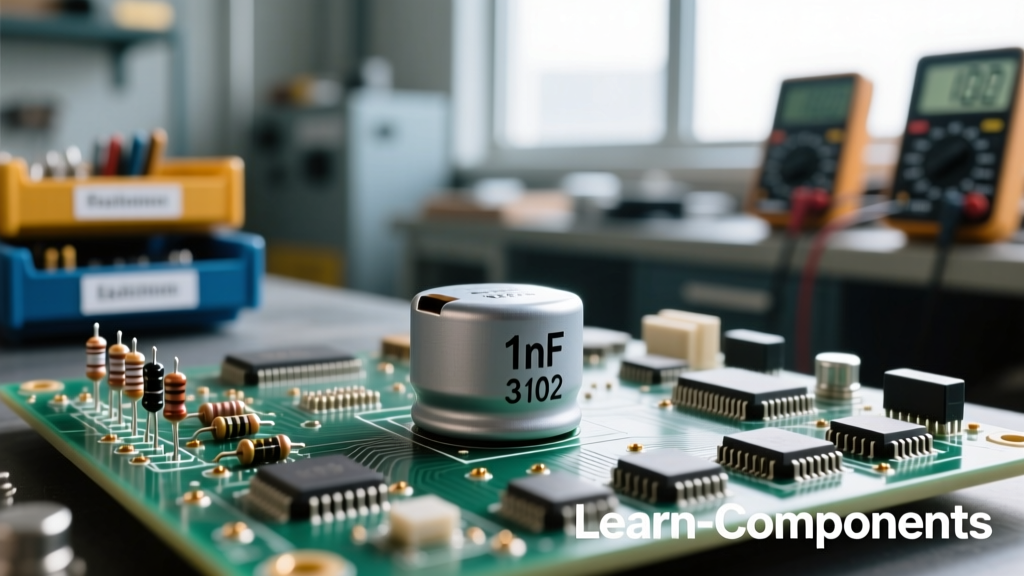
To understand the glow, you have to look inside the LED bulb's base. An LED does not run directly on 120V AC. It uses an internal driver circuit—typically a capacitive dropper or a switched-mode power supply (SMPS)—to rectify AC to DC and step down the voltage. This driver contains a bulk smoothing capacitor.
Circuit Impact Math: Power Factor and Inrush
LED drivers are notoriously poor at power factor correction (PFC) at the residential level. If a 10W LED bulb has a Power Factor (PF) of 0.5, its Apparent Power (S) is 20VA. It draws 166mA of RMS current, even though it only consumes 10W of real power.
When you flip the switch on, the empty bulk capacitor acts as a dead short for the first few milliseconds of the AC cycle. The inrush current can spike to 30A for 200µs. Conversely, when the switch is off, we are dealing with micro-currents. A typical Wi-Fi smart switch without a neutral wire leaks about 1mA to 2mA of standby current through the load to keep its internal radio powered.
If your smart switch leaks 1mA into a driver with a 10µF bulk capacitor, we can calculate the time it takes to reach the driver IC's Under-Voltage Lock-Out (UVLO) threshold (typically around 45V DC). Using the formula
t = (C × ΔV) / I, we get (10µF × 45V) / 1mA = 0.45 seconds. The capacitor charges for half a second, fires the LED, drains, and repeats. This is why ghosting often looks like a slow, rhythmic pulse rather than a steady glow.
Lumens, Watts, and Efficacy: Sizing the Load
Paradoxically, the better the LED technology gets, the worse the glowing problem becomes. High-efficacy bulbs draw so little real power that the total circuit load often falls below the minimum holding current required by legacy dimmers and switches. When sizing a circuit, you must look at lumens per watt (efficacy) to understand the actual electrical load you are placing on the switch.
| Incandescent Baseline | Legacy LED (2018 era) | Modern High-Efficacy LED (2026) | Target Lumens |
|---|---|---|---|
| 40W (0.33A) | 5W (PF 0.5 / 10VA) | 3.5W (PF 0.9 / 3.8VA) | 450 lm |
| 60W (0.50A) | 8W (PF 0.6 / 13.3VA) | 5.5W (PF 0.9 / 6.1VA) | 800 lm |
| 75W (0.62A) | 11W (PF 0.6 / 18.3VA) | 7.5W (PF 0.9 / 8.3VA) | 1100 lm |
| 100W (0.83A) | 15W (PF 0.7 / 21.4VA) | 10W (PF 0.9 / 11.1VA) | 1600 lm |
Source: Efficacy benchmarks aligned with US Department of Energy Solid-State Lighting guidelines. Note that modern high-efficacy bulbs draw drastically less apparent power (VA), which directly impacts dimmer minimum-load requirements.
Dimmer and Switch Compatibility: Trailing Edge vs. Leading Edge
If your LED bulbs glow when off or flicker at low dimming levels, you are likely using a Leading Edge (TRIAC) dimmer designed for incandescent loads. TRIACs require a minimum 'holding current' (usually 20mA to 50mA) to stay latched in the ON state. If your LED load drops below this, the TRIAC misfires, causing flickering or allowing enough bleed-through to cause ghosting.
Which Dimmer/Driver for Your Fixture Count?
You must calculate the total load against the dimmer's minimum requirement. Let us assume you are installing four 5.5W high-efficacy LED bulbs on a single switch.
- Total Real Power: 4 × 5.5W = 22W.
- Total Apparent Power (assuming PF 0.9): 4 × 6.1VA = 24.4VA.
The Fix: You must use a Trailing Edge (ELV/IGBT) dimmer. Trailing edge dimmers use MOSFETs or IGBTs to chop the back half of the AC sine wave. They do not rely on holding current to latch, making them immune to the low-load misfire issue. For a 24.4VA load, select a trailing-edge dimmer with a stated minimum load of 5W or less (such as the Lutron Diva DVCL-153P or Leviton Decora DSL06). Always verify the manufacturer's specific LED compatibility matrix before purchasing, as driver topologies vary wildly between brands.
Thermal and Enclosure Constraints for LED Drivers
Heat is the silent killer of LED drivers and a secondary culprit for erratic glowing and flickering. The electrolytic capacitors inside the bulb's base are highly sensitive to ambient temperature. When you install an LED bulb in an enclosed fixture (like an IC-rated recessed can or a sealed globe pendant), the ambient temperature inside the enclosure can easily exceed 65°C.
At elevated temperatures, the electrolyte inside the capacitor slowly boils off, reducing its capacitance and increasing its Equivalent Series Resistance (ESR). A degraded capacitor will charge faster from micro-leakage currents and discharge erratically, turning a minor ghosting issue into a violent strobe effect.
If a fixture is fully enclosed, you must purchase LEDs explicitly rated for 'Enclosed Fixtures.' These bulbs use high-temperature polymer capacitors or specialized driver ICs that implement thermal foldback (throttling current when the internal NTC thermistor reads >85°C) to prevent catastrophic driver failure.
Frequently Asked Questions: Ghosting, Flickering, and Glowing
Why do my LED lights glow when switched off on a 3-way circuit?
In a 3-way or 4-way circuit, the 'traveler' wires run parallel to each other inside the same conduit or NM-B cable for long distances. This creates a parasitic capacitor between the live traveler and the switched hot wire. Through capacitive coupling, a tiny AC voltage is induced on the switched leg, even when the switch is open. This induced voltage is enough to trickle-charge the LED driver. The fix is to install a dummy load resistor (like the Lutron LUT-MLU) across the hot and neutral at the first fixture, which provides a low-impedance path to bleed off the phantom voltage.
How do I stop LED bulbs from glowing with a smart switch?
If your smart switch does not have a neutral wire connected, it is stealing standby power through the LED bulb itself. To fix this, you have two options. First, swap the switch for a 3-wire smart switch that requires a neutral connection; this routes the 1mA standby current back to the panel via the neutral wire, completely bypassing the LED load. Second, if a neutral wire is not available in your switch box, you must wire a bypass module (typically a 0.47µF X2 safety capacitor or a specialized resistor pack) in parallel with the first LED bulb on the circuit to absorb the leakage current.
Can a glowing LED bulb cause a fire hazard?
No. The energy required to produce a ghostly glow is typically under 0.2 watts, which generates virtually no heat and poses zero fire risk. However, the continuous micro-cycling (charging and discharging the driver capacitor hundreds of times a day) will prematurely degrade the internal components of the bulb, leading to early failure and flickering. It is an annoyance and a hardware-degradation issue, not a safety hazard.