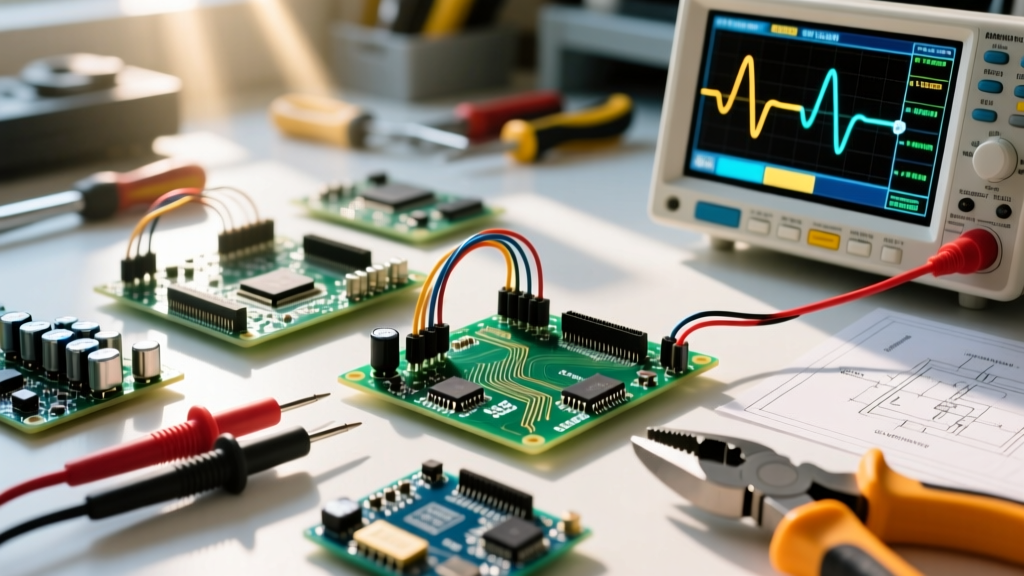
The three most common kinds of resistor you will encounter on the bench are thick film (for general SMD), metal film (for precision through-hole), and wirewound (for high power). If you need 1% tolerance and low thermal noise, use metal film. If you are hand-soldering a basic LED driver, microcontroller pull-up network, or general logic circuit, thick film SMD is your default. If you are dumping 5 watts into a dummy load or designing a power supply bleed network, use wirewound. Selecting the wrong type doesn't just affect accuracy; in high-frequency or high-power circuits, it leads to parasitic oscillation or catastrophic thermal failure.
The Core Resistor Types: A Spec-Sheet Comparison
Not all resistors are created equal. The manufacturing process dictates the component's parasitic inductance, capacitance, thermal stability, and noise floor. Below is a spec-sheet comparison of the primary kinds of resistor you will stock in your lab.
| Type | Construction | Tolerance Range | Tempco (ppm/°C) | Typical Use & Part Example | Approx. Cost (1k reel) |
|---|---|---|---|---|---|
| Carbon Composition | Carbon powder and clay binder | 5% to 20% | 1000+ | Vintage audio repair, high-pulse snubbers (e.g., Allen Bradley 1/2W) | $80 - $150 |
| Carbon Film | Carbon layer on ceramic rod, spiral cut | 2% to 5% | -200 to +500 | General purpose through-hole, hobby kits (e.g., Yageo CFR-25) | $10 - $15 |
| Metal Film (TH) | NiCr or tin/antimony on ceramic, spiral cut | 0.1% to 1% | 15 to 100 | Precision analog, active filters, low-noise audio (e.g., Vishay RN55) | $30 - $50 |
| Thick Film (SMD) | Ruthenium oxide paste fired on alumina | 1% to 5% | 100 to 250 | 90% of all modern SMD PCBs, pull-ups, current limiting (e.g., Yageo RC0603) | $2 - $5 |
| Thin Film (SMD) | NiCr sputtered on ceramic, laser trimmed | 0.01% to 0.5% | 5 to 25 | ADC voltage dividers, precision references, medical (e.g., Susumu RG1608) | $40 - $80 |
| Wirewound | Nichrome or manganin wire on ceramic core | 1% to 5% | 20 to 50 | High power dissipation, current sensing, dummy loads (e.g., Ohmite 25W) | $150 - $300 |
Decoding the Markings: Color Bands vs. SMD Codes
Reading the markings on physical parts is a mandatory bench skill. While through-hole parts use the legacy color band system, SMD components rely on printed alphanumeric codes due to their microscopic size.
Through-Hole Color Bands
For a standard 4-band resistor, the first two bands are significant digits, the third is the multiplier, and the fourth is tolerance.
Example: Brown (1), Black (0), Red (x100), Gold (5%) = 1,000 ohms (1kΩ) at 5% tolerance.
For precision 5-band resistors, the first three bands are significant digits, the fourth is the multiplier, and the fifth is tolerance.
Example: Brown (1), Black (0), Black (0), Brown (x10), Brown (1%) = 1,000 ohms (1kΩ) at 1% tolerance.
SMD Printed Codes
SMD resistors use three distinct coding systems depending on their tolerance and size:
- 3-Digit Code (5% tolerance): Two significant digits + multiplier. 472 = 47 x 10² = 4,700Ω (4.7kΩ).
- 4-Digit Code (1% tolerance): Three significant digits + multiplier. 4701 = 470 x 10¹ = 4,700Ω (4.7kΩ).
- EIA-96 Code (1% tolerance, 0603 size and smaller): A two-digit lookup number followed by a letter multiplier. 01C = 100 (from EIA table) x 10² (C multiplier) = 10,000Ω (10kΩ). You must keep an EIA-96 lookup chart at your bench for these.
On SMD resistors below 10 ohms, the letter 'R' acts as a decimal point. A marking of 4R7 means 4.7Ω, not 4.7 ohms times a multiplier. A marking of R10 means 0.10Ω. Misreading these as high-value resistors will cause you to troubleshoot a dead short for hours.
Failure Modes and Visual Symptoms on the Bench
Resistors rarely fail without a reason, and they don't just 'break'. Their failure mode is heavily dictated by their construction material and the stress applied. According to SparkFun's resistor guide, understanding these failure modes saves hours of oscilloscope probing.
- Thick/Metal Film (Over-power): Fails open. When the power rating is exceeded, the microscopic resistive trace vaporizes. Visual symptom: The epoxy body may look perfectly fine, or you might see a tiny blister or charred spot on the silkscreen. You must test with a multimeter to confirm.
- Carbon Composition (Moisture/Age): Fails high. The phenolic resin binder absorbs ambient moisture over decades, swelling and pushing the carbon particles apart, increasing resistance. Visual symptom: None externally. Common in 1970s audio gear where a 100kΩ plate resistor drifts to 140kΩ, shifting the tube bias point.
- Wirewound (Thermal Shock): Fails open or shorted. If the wire snaps from thermal expansion, it goes open. If the enamel insulation melts due to severe overcurrent, adjacent turns short together, dropping the total resistance. Visual symptom: Discolored ceramic core, melted solder joints at the end caps, or a distinct burnt-ozone smell.
- High-Voltage SMD (Arcing): Fails short. If you exceed the maximum working voltage of an SMD part (e.g., applying 200V across a 0603 resistor rated for 75V), the voltage will arc across the surface of the component, carbonizing the epoxy and creating a low-resistance path.
Safe Substitution Rules When the Exact Part is Missing
When you are prototyping or repairing a board and lack the exact BOM part, you can substitute, but you must follow strict electrical rules. Always assume a standard 25°C ambient temperature for power ratings unless the datasheet specifies a derating curve.
- Wattage can go UP, never DOWN. You can safely replace a 1/4W (0.25W) resistor with a 1/2W (0.5W) part, provided it physically fits the PCB pads or through-holes. The larger part will run cooler and last longer. Never replace a 1/2W with a 1/4W; it will overheat and fail open.
- Tolerance can go TIGHTER, never LOOSER. If the schematic calls for a 1% metal film resistor, you can substitute a 0.1% thin film. You cannot substitute a 5% carbon film, as the circuit (likely an active filter or precision voltage divider) relies on the tight matching to function correctly.
- Watch the Maximum Working Voltage. This is the most common substitution trap. A standard 1206 SMD resistor is rated for 1/4W, but its maximum working voltage is typically 200V. If you need a 1MΩ bleed resistor across a 400V DC bus, a single 1206 resistor will arc over, even though P = V²/R calculates to only 0.16W. You must use two 500kΩ 1206 resistors in series to divide the voltage safely.
- Avoid Wirewound in RF or High-Speed Digital. Wirewound resistors are essentially inductors. In an RF matching network or a high-speed digital termination (like a 50Ω SPI line), the parasitic inductance of a wirewound part will cause signal reflections and ringing. Always use thick or thin film for high-frequency substitution.
For a deeper dive into the physics of parasitic inductance in passive components, All About Circuits provides excellent AC theory breakdowns on why component geometry matters at high frequencies.
Frequently Asked Questions
What kinds of resistor are best for audio circuits?
For audio signal paths, you want low thermal noise and low current noise. Metal film and thin film resistors are the standard choices because their granular structure is highly uniform, generating minimal excess noise. Avoid carbon composition and thick film resistors in the preamp or DAC output stages; their granular carbon/ruthenium structure generates significant 'current noise' (measured in nV/V) when DC current flows through them, which can be amplified into audible hiss.
How do I know if a resistor is bad without desoldering it?
You can measure a resistor in-circuit with a multimeter, but you must interpret the reading correctly. Because the resistor is in parallel with the rest of the circuit, the measured value will almost always be lower than the printed value. If your multimeter reads a value higher than the resistor's nominal value (accounting for its tolerance band), the resistor is definitively degraded or open and must be replaced. If it reads lower, it might be fine, or it might be shorted; you must lift one leg out of the pad to test it in isolation for a definitive answer.
Why do some kinds of resistor have a blue body while others are beige?
Body color is an industry-standard visual shorthand for the resistive element and tolerance. Beige or tan bodies are almost universally carbon film resistors with a 5% tolerance. Blue bodies indicate metal film resistors, typically with a 1% or 0.5% tolerance. You will also occasionally see green-bodied resistors; these are usually precision metal film or specialized fusible resistors designed to fail open safely under severe overcurrent conditions, acting as both a resistor and a fuse.
Can I use a 5W wirewound resistor to replace a 5W metal oxide film resistor?
Electrically, yes, but mechanically and thermally, maybe not. Wirewound resistors dissipate heat differently than metal oxide film (MOF) resistors. MOF resistors often have a specific thermal mass and physical footprint designed for the PCB's copper pours. Furthermore, if the circuit operates at high frequencies, the wirewound's parasitic inductance will alter the circuit's behavior. Stick to the same construction type unless you have verified the AC impedance and thermal profile of the substitute.