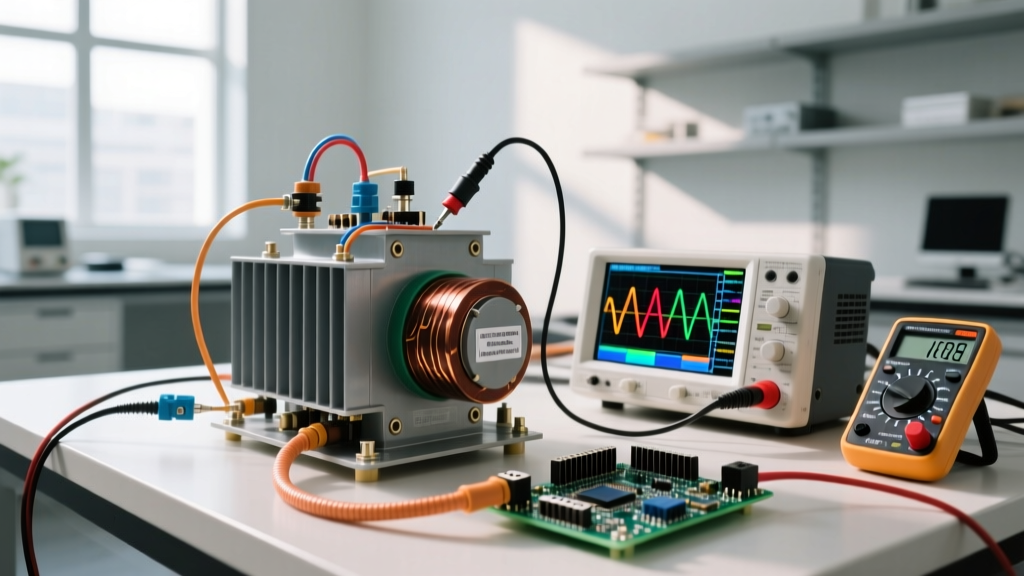
A car battery is strictly DC (Direct Current). Specifically, a standard automotive battery provides a nominal 12V DC output, measuring between 12.6V when fully charged and roughly 11.8V when deeply discharged. While your vehicle’s alternator generates Alternating Current (AC) while the engine is running, an internal rectifier converts this to DC before it ever reaches the battery or the vehicle's electrical bus. You cannot store AC power chemically; batteries inherently rely on unidirectional electron flow for charging and discharging.
The 12V DC Auto Power System: Source to Load
To understand why the system is DC, we need to trace the power flow from the source to the load. A modern vehicle electrical system operates as a closed-loop DC microgrid. Here is the exact system block sequence:
- AC Generation (The Alternator): The engine turns a rotor inside a stator, generating 3-phase AC power. This is highly efficient for generation but useless for chemical storage.
- Rectification (The Diode Bridge): A set of six heavy-duty diodes inside the alternator acts as one-way valves, chopping the AC sine waves and converting them into pulsating DC.
- Regulation & Storage (The Battery): The voltage regulator smooths the pulsating DC to a steady ~14.2V to 14.4V. This DC voltage pushes current backward through the lead-acid (or AGM/LiFePO4) battery, reversing the chemical reaction to store energy.
- Distribution (The Fuse Box): When the engine is off, the battery becomes the source, delivering 12V DC to the ECU, lights, infotainment, and starter motor.
- Inversion (Optional AC Loads): If you need to run a 120V AC laptop charger or power tool, a DC-to-AC inverter is wired directly to the battery terminals to synthesize an AC sine wave from the DC source.
Because the chemical reactions inside a battery only occur in one direction at a time (discharge vs. charge), the entire storage and distribution architecture must be DC. For a deeper look at how DC circuits govern these chemical reactions, the Cadex Battery University discharging guide provides excellent baseline chemistry data.
Sizing Inverters and Batteries for AC Loads
Knowing your car battery is DC is only half the battle. The real challenge on the bench or in a van-build is sizing the battery and inverter to handle AC loads without causing catastrophic voltage sag. Let us run the sizing math for a common scenario: running a 1000W AC coffee maker off a 12V car battery system.
Step 1: Inverter Sizing and Efficiency Math
Inverters are not 100% efficient. A quality pure sine wave inverter operates at about 85% to 90% efficiency under heavy load.
- AC Load: 1000W
- Inverter Efficiency: 85% (0.85)
- Required DC Power: 1000W / 0.85 = 1176W
- DC Current Draw: 1176W / 12V = 98 Amps
To handle this safely, you need an inverter rated for at least 1500W continuous (to account for startup surges) and 2 AWG copper wire (or 1/0 AWG for runs over 5 feet) to handle the 98A continuous draw without melting or causing excessive voltage drop.
Step 2: Peukert’s Law and Battery Capacity
If you attempt this with a standard 100Ah flooded lead-acid (FLA) starting battery, you will run into Peukert’s Law. Battery capacity ratings are based on a slow 20-hour discharge rate (a 5A draw). When you pull 98A (nearly a 1C discharge rate), the effective capacity of a lead-acid battery plummets due to internal resistance and sulfation. A 100Ah FLA battery might only deliver 40Ah of usable energy at a 98A draw before the voltage crashes below the inverter's low-voltage cutoff (usually 10.5V).
Step 3: Charge/Discharge Limits (C-Rate and DoD)
Every battery chemistry has strict operational limits:
- Flooded Lead-Acid (FLA): Maximum Depth of Discharge (DoD) is 50%. Maximum continuous C-rate is 0.2C (20A for a 100Ah battery). Drawing 98A will warp the lead plates and boil the electrolyte.
- AGM (Absorbent Glass Mat): Max DoD is 50-80%. Can handle higher C-rates (up to 0.5C), but still struggles with 1000W continuous loads on a single 100Ah unit.
- LiFePO4 (Lithium Iron Phosphate): Max DoD is 80-100%. Easily handles 1C continuous discharge (100A from a 100Ah battery) with minimal voltage sag and zero Peukert penalty.
Series vs. Parallel: Scaling Voltage and Amp-Hours
When a single 12V battery cannot meet your C-rate or capacity requirements, you must build a battery bank. The decision between series and parallel wiring fundamentally changes the system's voltage and Amp-hour (Ah) profile. Use the decision-tree-table below to map your architecture.
| Wiring Configuration | Voltage Consequence | Amp-Hour (Ah) Consequence | Best Use Case |
|---|---|---|---|
| Series (Positive to Negative) | Voltages Add (12V + 12V = 24V) | Ah Stays the Same (100Ah) | Reducing current draw for high-power inverters; 24V/48V solar systems. |
| Parallel (Positive to Positive) | Voltage Stays the Same (12V) | Ah Adds (100Ah + 100Ah = 200Ah) | Extending runtime for 12V DC loads; maintaining 12V alternator charging compatibility. |
| Series-Parallel | Both Scale (e.g., 2S2P = 24V, 200Ah) | Both Scale | Large off-grid or marine banks requiring high voltage and high capacity. |
The Mismatch Rule: Never wire batteries in parallel unless they are the exact same chemistry, brand, capacity, age, and state of charge. If you parallel a new 100Ah battery with an old 100Ah battery, the new battery will constantly overcharge the old one, leading to thermal runaway in lithium or severe gassing in lead-acid. If you need more capacity in a 12V system and already have an older battery, buy a larger single unit (e.g., a 200Ah LiFePO4) rather than paralleling mismatched units.
Frequently Asked Questions About Car Batteries and AC/DC Power
Does a car alternator produce AC or DC power?
The alternator itself generates 3-phase Alternating Current (AC). However, it is bolted directly to a rectifier assembly (a bridge of heavy-duty diodes) that converts the AC into pulsating Direct Current (DC) before it leaves the alternator housing. By the time the power reaches your car's wiring harness, it is strictly DC.
Can I plug AC appliances directly into a 12V car battery?
No. Plugging a 120V AC appliance directly into a 12V DC battery will result in the appliance failing to turn on, or if modified incorrectly, it could cause a dead short and a fire. To run AC appliances, you must wire a DC-to-AC power inverter to the battery terminals. The inverter uses high-frequency switching (PWM) to synthesize a 120V/60Hz (or 230V/50Hz) AC sine wave from the 12V DC source.
Why do cars use DC batteries instead of AC power?
Batteries rely on electrochemical reactions to store and release energy. Chemical reactions are inherently unidirectional—electrons flow from the anode to the cathode during discharge, and reverse during charge. Alternating Current, by definition, reverses direction 50 to 60 times a second. You cannot store rapidly reversing AC power in a chemical medium; it must be rectified to DC first. Furthermore, the solid-state electronics (ECUs, sensors, infotainment) in modern vehicles require clean, stable DC voltage to operate.
Is a Tesla or EV battery pack AC or DC?
The massive battery pack under the floor of an Electric Vehicle (EV) like a Tesla or Ford F-150 Lightning stores strictly DC power, typically ranging from 400V to 800V DC. However, the traction motors that drive the wheels are predominantly AC induction or AC permanent magnet synchronous motors. The vehicle uses a massive, liquid-cooled DC-to-AC inverter to convert the battery's DC power into the precisely timed 3-phase AC required to spin the drive motors.