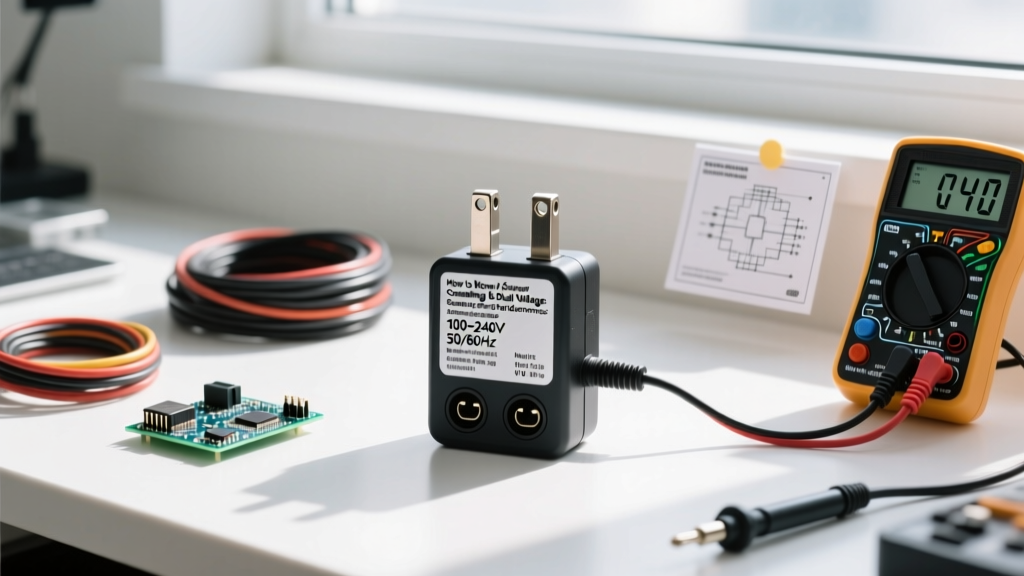

Dual voltage means a device's internal power supply can automatically or manually accept two distinct AC input voltage ranges (typically 110-120V and 220-240V) and output the correct DC voltage to the circuit. If you are staring at a power brick, appliance label, or imported motor trying to figure out if it will survive a trip overseas or a shop rewiring, that single line of text is the difference between a working tool and a melted plastic fire hazard. Understanding how to know if something is dual voltage requires looking past the physical plug shape and reading the electrical nameplate data.
The Core Concept: What It Is and What It Changes
In practical terms, a dual-voltage device contains a switching power supply (SMPS) or a multi-tap transformer that adapts to the grid it is plugged into. What this changes in a real circuit is the input current draw and the thermal load on the wiring. When a device operates at 230V instead of 120V, it pulls roughly half the current to deliver the same wattage. This halves the $I^2R$ heating losses in the supply cord and allows manufacturers to use thinner, lighter copper wire for the AC input side. However, it also dictates whether you need a heavy, expensive step-down transformer or just a cheap plastic plug adapter to connect to a foreign wall outlet.
How to Know if Something Is Dual Voltage: Reading the Nameplate
Manufacturers are required by IEC and UL standards to print input ratings on the device or its power supply. Here is the step-by-step process to verify compatibility:
- Locate the 'INPUT' line: Ignore the 'OUTPUT' line for now (that tells you what the device sends to your electronics, usually 5V, 12V, or 20V DC). Focus strictly on 'INPUT' or the '~' (AC) symbol.
- Check the voltage range: If you see a range like 100-240V or 110-220V, the device is auto-switching dual voltage. If you see a single number like '120V' or '230V', it is single voltage only.
- Look for the frequency rating: You will usually see '50/60Hz' next to dual-voltage devices. This confirms the internal rectifiers and capacitors can handle both the North American (60Hz) and European/Asian (50Hz) grid cycles.
- Check for a physical voltage selector switch: On older desktop PC power supplies or benchtop lab equipment, dual voltage isn't automatic. You must manually slide a small red switch on the back to select 115V or 230V before applying power.
Worked Numeric Example: The Power Math Behind the Label
Let us look at a standard 180W laptop power brick rated for INPUT: 100-240V ~ 50/60Hz 2.0A. The power ($P$) remains constant at 180W regardless of the grid, but the current ($I$) changes based on Ohm's Law and the power equation ($P = V imes I$).
| Grid Voltage | Power Draw | Calculated Current ($I = P/V$) | Practical Impact |
|---|---|---|---|
| 120V (US/Japan) | 180W | 1.5 Amps | Standard 18 AWG cord is sufficient; runs slightly warmer. |
| 230V (EU/UK/AU) | 180W | 0.78 Amps | Lower current means less voltage drop over long extension cords. |
Because the power supply uses active power factor correction (PFC), it dynamically adjusts its internal switching duty cycle to draw exactly the wattage it needs from either grid. This is why modern switch-mode power supplies are inherently dual voltage without needing heavy copper transformers.
Where You Meet This in Practice (And Common Confusions)
You will encounter dual voltage requirements most often in three scenarios: international travel with consumer electronics, importing industrial machinery or 3D printers, and wiring off-grid solar inverters that might be sold in global markets.
When dealing with these scenarios, people commonly confuse two critical concepts:
- Plug Adapters vs. Voltage Converters: A plug adapter only changes the physical shape of the prongs. Think of it like a water pipe fitting: it changes the thread shape so the hose connects, but it does absolutely nothing to reduce the water pressure. If your device is not dual voltage, an adapter will feed full 230V pressure into a 120V pipe, blowing it apart. A voltage converter (transformer) actually steps the pressure down.
- Dual Voltage vs. Dual Frequency: A device might handle 120V and 230V, but if it contains an AC synchronous motor (like a vintage clock or a turntable), the 50Hz vs 60Hz grid frequency will change the motor's physical RPM. Switch-mode power supplies don't care about frequency, but inductive AC motors do.
For a comprehensive breakdown of global physical plug types and their native voltages, the IEC World Plugs guide is the definitive standard reference.
Real-World Scenario Walkthrough: The Fried Hair Dryer Disaster
To understand what happens when you ignore the nameplate, let us walk through a classic bench-and-travel failure mode.
The Setup: A traveler takes a high-end US hair dryer (rated 120V, 1600W) to France. The French grid supplies 230V. The traveler buys a $5 plastic plug adapter to make the US flat prongs fit the French round wall socket, assuming the adapter 'converts' the power.
The Numbers: A hair dryer is a purely resistive load (a nichrome heating wire). Its resistance ($R$) is fixed by the manufacturer. Using the power formula $P = V^2 / R$, we can find the resistance of the heating element designed for the US: $$R = 120^2 / 1600 = 14,400 / 1600 = 9\ \Omega$$
When plugged into the 230V French grid through the adapter, the resistance is still $9\ \Omega$. The new power draw becomes: $$P = 230^2 / 9 = 52,900 / 9 = 5,877\text{ Watts}$$
The Outcome: The hair dryer attempts to draw nearly 6,000 watts (about 25.5 Amps). The internal thermal fuse blows instantly, but not before the nichrome wire glows white-hot, melting the plastic casing, scorching the wall outlet, and tripping the 16A branch circuit breaker in the hotel panel.
What Went Wrong: The traveler confused a physical adapter with an electrical transformer. For a 1600W resistive load, a step-down transformer capable of handling 2kW would weigh over 15 lbs and cost upwards of $120—far more than simply buying a local 230V hair dryer. For a deeper look at how AC power behaves across resistive circuits, review the All About Circuits AC power calculations.
FAQ: Testing and Verifying Dual Voltage
Can I test if an unmarked device is dual voltage with a multimeter?
You cannot safely test AC input compatibility with a standard multimeter while the device is live. However, if the device has a manual voltage selector switch on the back, you can unplug the unit, set your multimeter to continuity mode, and probe the switch terminals to verify it physically routes the AC line to different transformer taps or varistor networks. If you are testing a switch-mode power supply, the only safe bench method is using an isolation transformer and a Variac to slowly ramp the AC input from 100V to 240V while monitoring the DC output with a meter, ensuring it stays within regulation.
What if the label is rubbed off or missing?
If the nameplate is illegible, assume the device is single voltage matching the country where it was originally purchased. Do not plug it into a different grid. You can sometimes find the exact input rating by searching the FCC ID (usually printed on the casing) on the FCC ID database, which hosts internal photos and electrical schematics of the power supply.
Are all USB-C chargers dual voltage?
Yes, virtually every modern USB-C wall charger (from 20W phone bricks to 140W laptop chargers) uses a high-frequency switch-mode power supply rated for 100-240V. When traveling, you only need a physical plug adapter for your USB-C chargers. To ensure you are measuring the output of these chargers accurately on the bench, always use a meter with true-RMS capabilities, as detailed in this Fluke True-RMS measurement guide.


