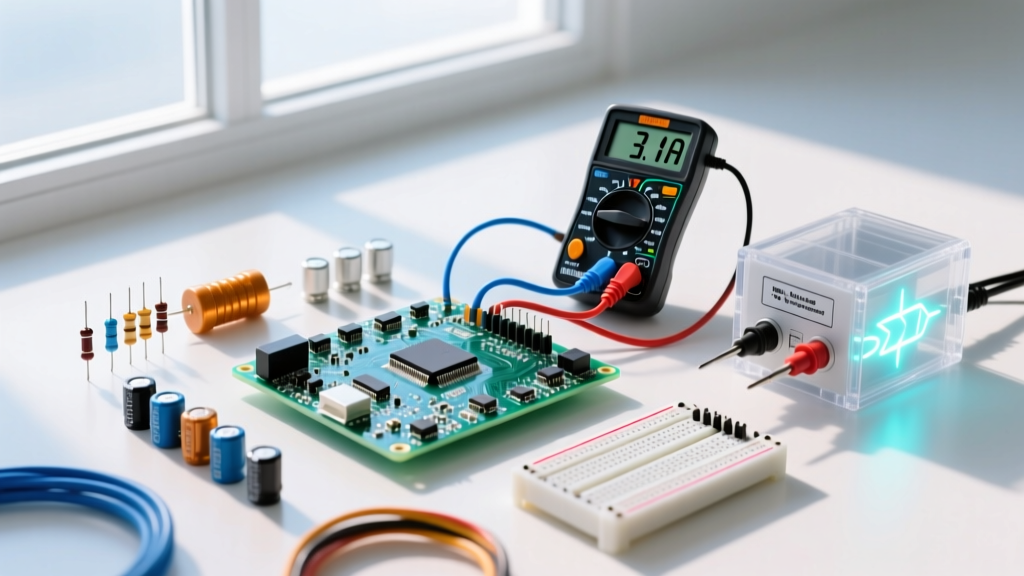

Watts measure the actual rate of energy consumption (power), while amps measure the volume of electrical current flowing through a circuit, meaning you cannot convert 3.1 amps to watts without knowing the system voltage. If you are staring at a device label that reads '3.1A' and trying to figure out if your generator, inverter, or solar setup can handle it, the amperage alone is only half the story. The actual wattage will shift dramatically depending on whether that 3.1A is flowing through a 12V DC battery bank, a 120V AC household outlet, or a 230V AC European mains circuit.
The Direct Answer: How Much is 3.1 Amps in Watts?
Because power (Watts) equals current (Amps) multiplied by voltage (Volts), the wattage of a 3.1A load scales linearly with the system voltage. Here is exactly what 3.1 amps translates to across the most common electrical systems you will encounter on the bench or in the field:
- 12V DC System: 3.1A × 12V = 37.2 Watts
- 24V DC System: 3.1A × 24V = 74.4 Watts
- 120V AC System (US): 3.1A × 120V = 372 Watts (assuming a Power Factor of 1.0)
- 230V AC System (EU/UK): 3.1A × 230V = 713 Watts (assuming a Power Factor of 1.0)
The Missing Variable: Why Voltage Dictates the Wattage
To understand why the wattage changes, think of electricity like water in a pipe. Amps are the flow rate (gallons per minute), volts are the water pressure, and watts are the total mechanical work the water can do when it hits a turbine. A high flow rate at low pressure (high amps, low volts) might do the exact same work as a low flow rate at high pressure (low amps, high volts).
For DC circuits, the math is strictly P = I × V. But for AC circuits, we have to introduce a third variable: Power Factor (PF). Inductive loads like motors and transformers cause the current and voltage waveforms to fall out of phase, meaning not all the current flowing through the wire is doing real work.
Worked Numeric Example: AC Motor Load
Suppose you are wiring a 120V AC exhaust fan in your workshop. The nameplate states it draws 3.1 Amps and has a Power Factor of 0.82.
- Calculate Apparent Power (VA): 3.1A × 120V = 372 Volt-Amps (VA).
- Calculate Real Power (Watts): 372 VA × 0.82 PF = 305.04 Watts.
Even though the circuit must be sized to handle 372 VA of apparent power, the actual energy consumed and converted into mechanical work and heat is only 305 Watts. This distinction is critical when sizing an inverter or calculating battery drain.
Where You Meet 3.1 Amps in Practice
A 3.1A draw is a very specific middle-ground current. It is too high for delicate PCB-level electronics but too low for heavy household appliances. Here is where you will typically see this exact current draw in real-world installations:
| System Voltage | Typical Device Drawing ~3.1A | Real-World Wattage |
|---|---|---|
| 12V DC (Automotive/Solar) | 35W Off-road LED light bar (at 11.5V alternator output) | ~35.6W |
| 24V DC (Truck/Off-grid) | 24V DC diesel cabin heater fan on high setting | ~74.4W |
| 120V AC (US Mains) | 1/6 HP shallow well jet pump or a 350W desktop PC PSU | ~372W |
| 230V AC (EU Mains) | Small 700W countertop microwave oven | ~713W |
Bench Scenario: The Inverter Overload That Tripped the BMS
Confusing AC amperage with DC amperage is a classic mistake that leads to blown fuses and tripped Battery Management Systems (BMS). Here is a real-world walkthrough of how this happens.
The Setup
A hobbyist is building a 12V LiFePO4 off-grid solar setup. They have a 100Ah battery with a built-in 30A BMS and a 400W pure sine wave inverter. They want to plug in a 120V AC portable air compressor to inflate tires. The compressor nameplate reads: 120V AC, 3.1 Amps.
The Numbers
The hobbyist assumes that because their battery is 12V, the compressor will draw 3.1 Amps from the battery, equating to roughly 37 Watts. They figure a 400W inverter and a 30A BMS will handle 37 Watts with ease.
The Outcome
They turn on the inverter and plug in the compressor. The compressor motor starts, runs for about two seconds, and then the entire system goes dead. The inverter screen flashes 'DC Over-Current' and the battery BMS disconnects.
What Went Wrong
The hobbyist confused the AC load rating with the DC draw. The compressor requires 372 Watts of AC power (120V × 3.1A). Because inverters are not 100% efficient (assume 85% efficiency here), the DC power required from the battery is actually 372W / 0.85 = 437.6 Watts.
To deliver 437.6 Watts at a nominal battery voltage of 12V, the DC current draw is: 437.6W / 12V = 36.4 Amps.
The 30A BMS correctly identified a 36.4A draw as an over-current fault and shut down the battery to prevent a fire. The lesson? Always calculate the wattage first, then divide by your DC battery voltage to find the true DC amp draw.
What People Commonly Confuse About Amps and Watts
When sizing wire, breakers, and power supplies, mixing up these units leads to oversized components or, worse, melted insulation. Here is what changes in a real circuit depending on which metric you prioritize:
- Wire Sizing is Driven by Amps, Not Watts: A 372W load at 12V DC pulls 31 Amps and requires thick 8 AWG wire. That exact same 372W load at 120V AC pulls only 3.1 Amps and can safely run on thin 18 AWG lamp cord. The heat generated in the wire is a function of current (I²R losses), not wattage.
- Apparent Power (VA) vs. Real Power (W): As shown in the motor example, a 3.1A load might only consume 305W of real power, but your generator or UPS must be sized for the full 372 VA. Sizing a UPS strictly on the Wattage rating will result in an overload trip when the reactive current hits.
- Device Labels (Input vs. Output): Phone chargers and laptop bricks often list '3.1A' on the USB-C or DC barrel output side. This is the maximum current the charger can supply to the device, not the current it will constantly draw from your 120V wall outlet.
FAQ: Sizing Breakers and Wires for a 3.1A Load
What size breaker do I need for a continuous 3.1A load at 120V?
According to NEC Article 210.20, continuous loads (those running for 3 hours or more) require the branch circuit to be sized at 125% of the load. 3.1A × 1.25 = 3.875A. While a 5A breaker would technically suffice, standard residential branch circuits use 15A or 20A breakers. You would place this on a standard 15A breaker, ensuring the total continuous load on that entire circuit does not exceed 12A (80% of 15A).
What wire gauge should I use for 3.1A at 12V DC?
While 18 AWG wire can safely carry 3.1A without melting, low-voltage DC systems suffer from severe voltage drop. If your 12V LED array is 15 feet away from the battery, 18 AWG will drop nearly 0.8V, leaving your lights dim. For a 15-foot run at 3.1A, step up to 12 AWG copper wire to keep the voltage drop under 3% (0.36V).
Can I use a 5A fuse for a device that draws 3.1A?
Yes, a 5A fast-acting fuse is appropriate for a steady 3.1A resistive load (like a heater). However, if the 3.1A device is a motor or compressor, it will have an inrush current (Locked Rotor Amps) that can spike to 15A or 20A for a fraction of a second. In that case, you must use a 5A slow-blow (time-delay) fuse to prevent nuisance blowing during startup.