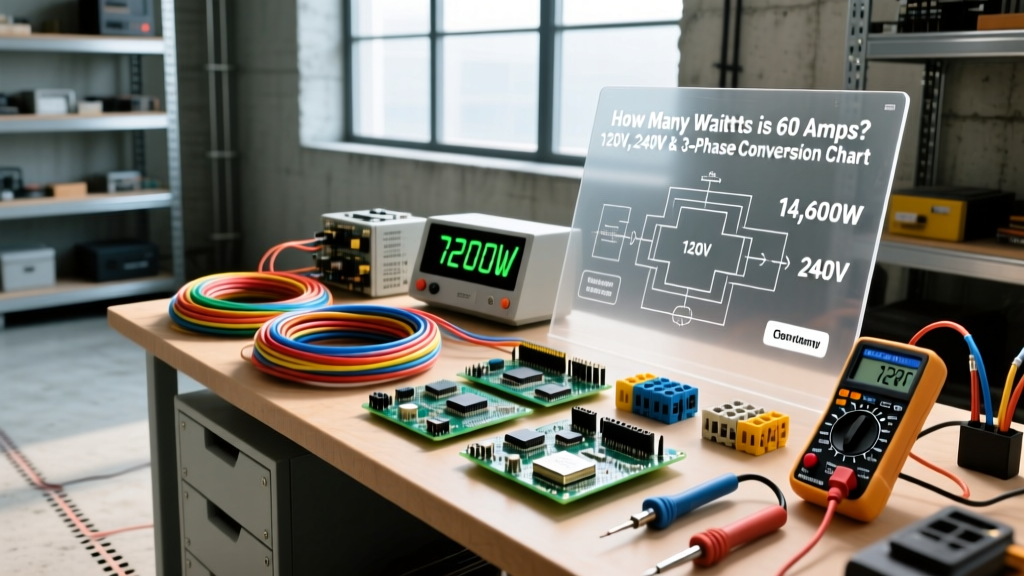

How many watts is 60 amps? At a standard US residential 120V single-phase circuit, 60 amps equals exactly 7,200 watts (assuming a purely resistive load with a 1.0 power factor). At 240V single-phase (like an electric range or EV charger), 60 amps equals 14,400 watts. For a 208V 3-phase commercial supply, 60 amps delivers 19,454 watts (assuming a typical 0.9 power factor) or 21,615 watts (at a 1.0 power factor).
The Core Formula and Fixed Assumptions
To convert amps to watts, you cannot rely on current alone. The exact wattage is fixed by three critical assumptions: Voltage (V), Phase configuration, and Power Factor (PF). Without locking in these variables, any single-number answer is a guess.
For DC or Single-Phase AC:
The formula is Watts = Volts × Amps × PF.
Substituting our values for a 120V circuit: W = 120V × 60A × 1.0 = 7,200W.
For 3-Phase AC:
The formula introduces the square root of 3: Watts = √3 × Volts × Amps × PF.
Substituting our values for a 208V 3-phase system at 0.9 PF: W = 1.732 × 208V × 60A × 0.9 = 19,454W.
60 Amps to Watts Conversion Table (±20% Range)
In real-world troubleshooting, you rarely see exactly 60.0 amps on your clamp meter. Below is a reference chart covering a ±20% variance (48A to 72A) across the three most common supply voltages. All single-phase values assume a 1.0 PF, while the 3-phase values assume a 0.9 PF to reflect typical commercial motor loads.
| Measured Current (Amps) | 120V Single-Phase (Watts) | 240V Single-Phase (Watts) | 208V 3-Phase @ 0.9 PF (Watts) |
|---|---|---|---|
| 48A (-20%) | 5,760 W | 11,520 W | 15,576 W |
| 54A (-10%) | 6,480 W | 12,960 W | 17,523 W |
| 60A (Nominal) | 7,200 W | 14,400 W | 19,454 W |
| 66A (+10%) | 7,920 W | 15,840 W | 21,399 W |
| 72A (+20%) | 8,640 W | 17,280 W | 23,345 W |
How Voltage, Phase, and Code Shift the Wattage
The jump from 120V to 240V doubles your wattage without increasing the current, which is why high-draw appliances use split-phase 240V. In Europe, where the nominal single-phase voltage is 230V, a 60A draw yields 13,800 watts. This higher baseline voltage allows European homes to run heavy loads on lower-amperage breakers compared to North American 120V circuits.
However, raw mathematical wattage is not what your breaker panel cares about. You must factor in the NEC continuous load rule. According to NFPA 70 (NEC) Article 210.20(A), a branch circuit overcurrent device must be rated at 125% of the continuous load (any load expected to run for 3 hours or more).
A note on wire sizing for 60A: To wire a 60A circuit, you typically use 6 AWG copper THHN (rated 65A in the 75°C termination column). However, if you are running NM-B (Romex) cable, NEC 334.80 restricts ampacity to the 60°C column. In the 60°C column, 6 AWG is only rated for 55A. To legally protect a 60A breaker with NM-B, you must step up to 4 AWG copper (rated 85A at 60°C).
Frequently Asked Questions
How many watts can a 60 amp breaker handle continuously?
A 60 amp breaker can handle 7,200 watts continuously on a 120V circuit, and 11,520 watts continuously on a 240V circuit. This is calculated by applying the NEC 80% continuous load derating rule (60A × 0.80 = 48A maximum continuous current), then multiplying by the circuit voltage. For non-continuous loads (like a microwave running for 2 minutes), it can handle the full 14,400 watts at 240V.
Is 60 amps enough to run a modern electric vehicle charger?
Yes, a 60 amp breaker is the standard requirement for the most common high-speed residential Level 2 EV chargers, such as the ChargePoint Home Flex or Tesla Wall Connector configured for 48A continuous output. At 240V, this delivers 11,520 watts (11.5 kW), which adds roughly 35 to 45 miles of range per hour of charging to a typical EV battery pack.
How many watts is 60 amps in a 12V DC solar or automotive system?
In a 12V DC system, 60 amps equals exactly 720 watts (12V × 60A = 720W). Because DC circuits do not have a power factor or phase angle, the math is strictly linear. This is a common threshold for mid-sized solar charge controllers (like a 60A MPPT controller) or heavy-duty automotive winches and inverters. Note that in a 12V system, pushing 60A requires thick cabling—at least 4 AWG or 2 AWG copper—to prevent severe voltage drop and fire hazards over long runs.