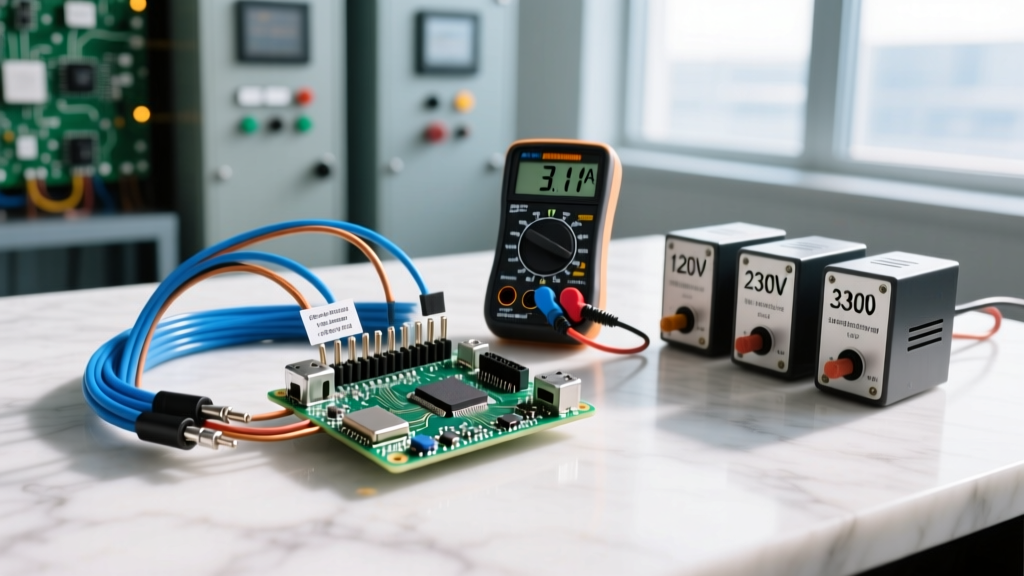

At a standard US household voltage of 120V, 3.1 amps equals exactly 372 watts. At the European and UK standard of 230V, 3.1 amps equals 713 watts. The foundational formula used to calculate this is Power (Watts) = Current (Amps) × Voltage (Volts), which substitutes directly to 372W = 3.1A × 120V for North American resistive circuits. Because amps measure the flow rate of electrical charge and watts measure the actual work performed, you cannot convert amps to watts without first locking in the system voltage, the phase configuration, and the power factor of the load.
Standard Voltage Conversions for 3.1 Amps
The wattage of a 3.1A load scales linearly with voltage. A 3.1A draw on a 12V DC automotive circuit is a modest 37.2W, but that exact same 3.1A draw on a 277V commercial lighting circuit represents a massive 858.7W. Below is the exact conversion for 3.1 amps across the most common global AC and DC voltages, assuming a purely resistive load (Power Factor = 1.0).
| Voltage | System Type | Watts (PF=1.0) | Common 3.1A Application |
|---|---|---|---|
| 12V DC | Auto / Marine | 37.2W | LED light bars, winch solenoids |
| 24V DC | Industrial / Solar | 74.4W | PLC relays, HVAC control boards |
| 120V AC | US Residential | 372.0W | Desktop PCs, large TVs, sump pumps |
| 208V AC | US Commercial | 644.8W | Server racks, commercial HVAC fans |
| 230V AC | EU / UK Residential | 713.0W | Kettles, washing machines, power tools |
| 277V AC | US Commercial Lighting | 858.7W | High-bay LED drivers, HID ballasts |
| 480V AC | US Industrial (Line-to-Neutral) | 1488.0W | Heavy machinery control circuits |
When troubleshooting or sizing components, you rarely hit exactly 3.1 amps. Loads fluctuate based on line voltage sags, temperature, and mechanical binding. Here is how the wattage shifts across a ±20% range of your target current at the two most common residential voltages.
| Current (Amps) | Variance | Watts @ 120V AC | Watts @ 230V AC |
|---|---|---|---|
| 2.5A | -19% | 300W | 575W |
| 2.8A | -10% | 336W | 644W |
| 3.1A | Exact Target | 372W | 713W |
| 3.4A | +10% | 408W | 782W |
| 3.7A | +19% | 444W | 851W |
The Hidden Variables: Power Factor and Phase Shift
The calculations above assume a Power Factor (PF) of 1.0, which is only true for purely resistive loads like incandescent heaters or toasters. The moment you introduce coils, capacitors, or switching power supplies, the conversion changes entirely.
Single-Phase AC with Power Factor
For a single-phase AC circuit, the formula shifts to: Watts = Amps × Volts × Power Factor.
If your 3.1A load is a compressor motor on a 230V circuit with a typical PF of 0.85, the real power is:
3.1A × 230V × 0.85 = 606.05 Watts.
Notice how this is significantly lower than the 713W resistive calculation. Sizing your generator or UPS based on the 713W figure would result in buying over-specced, inefficient equipment.
Three-Phase AC Systems
In industrial environments, 3.1A is a very common reading on a 3-phase motor feeder. The geometry of three-phase power introduces a multiplier of the square root of 3 (≈1.732). The formula becomes: Watts = √3 × Volts(Line-to-Line) × Amps × Power Factor.
For a 3.1A draw on a 480V 3-phase system with a 0.90 PF:
1.732 × 480V × 3.1A × 0.90 = 2,318 Watts.
For a deeper mathematical breakdown of why the √3 multiplier exists in wye and delta configurations, refer to the All About Circuits three-phase power guide.
Sizing Wire and Breakers for a 3.1A Load
Knowing the wattage is only half the battle; you must also protect the circuit. A 3.1A load presents specific sizing considerations depending on whether it is a continuous or non-continuous duty cycle.
- Non-Continuous Loads (Under 3 hours): If the 3.1A device is a sump pump or a power tool that runs intermittently, standard overcurrent protection applies. On a 120V US branch circuit, the legal minimum wire size is 14 AWG NM-B or THHN, protected by a 15A breaker. While 18 AWG wire could technically handle 3.1A on a low-voltage DC bench, the NEC strictly prohibits anything smaller than 14 AWG for standard 120V/240V building wiring.
- Continuous Loads (3 hours or more): If your 3.1A load is a server, an aquarium heater, or a continuously running exhaust fan, NEC Article 210.20(A) requires you to multiply the current by 125% to prevent breaker nuisance tripping from ambient heat buildup. 3.1A × 1.25 = 3.875A. You still use a 15A breaker and 14 AWG wire, but if you were sizing a fuse for a DC solar array, you would need a fuse rated for at least 4A, pushing you to a standard 5A or 6A automotive blade fuse.
- Inrush Current Edge Cases: A device that draws a steady 3.1A might have an inrush current of 15A to 20A for the first 50 milliseconds as capacitors charge or motors overcome static friction. If you are pairing this load with a sensitive electronic breaker or a DC BMS (Battery Management System), ensure the BMS has a peak discharge rating that accommodates the inrush spike, otherwise, it will trip into low-voltage or over-current protection immediately upon startup.
Frequently Asked Conversion Questions
Can I measure watts directly with a standard clamp meter?
No. A standard AC clamp meter only measures current (Amps). To measure real power (Watts) directly, you need a true power meter or a power quality analyzer (like a Fluke 1730 or a Kill A Watt plug-in meter) that samples both voltage and current waveforms simultaneously to calculate the phase angle and power factor.
Why does my 3.1A LED driver get hot if it's only 372 watts?
Switching LED drivers are highly efficient but not perfect. If the driver is 90% efficient, it must draw roughly 413W from the wall to output 372W of DC power to the LEDs. The remaining 41W is dissipated as heat inside the driver's aluminum housing. Ensure the driver has adequate convective airflow and is not buried in insulated ceiling cavities.


