
The Direct Answer: Grid Voltage vs. Mains Input
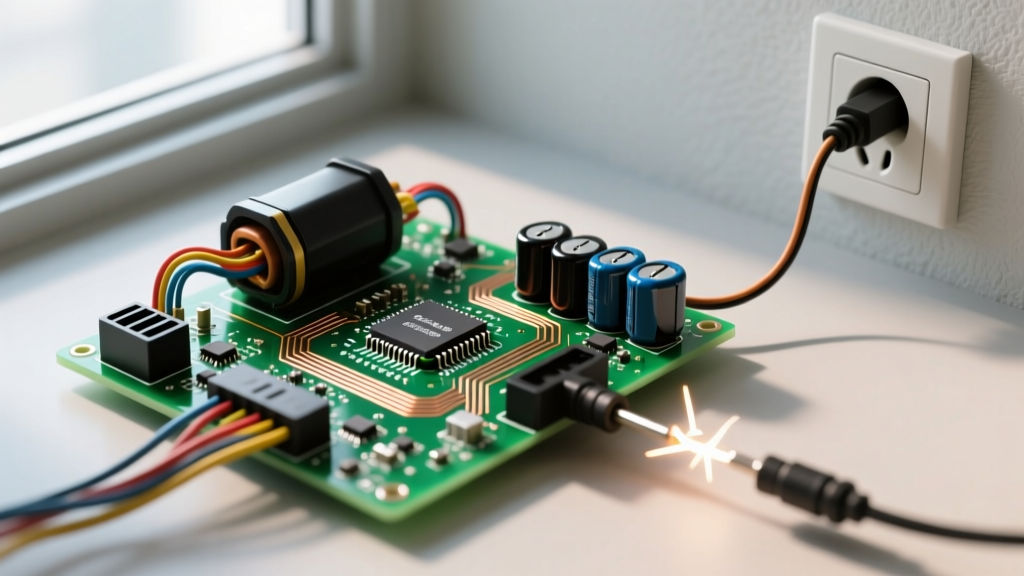
A standard outdoor bug zapper outputs between 2,000 and 4,000 volts DC across its killing grid, while drawing standard 120V AC (North America) or 230V AC (Europe/UK) from the wall. The most common baseline for a heavy-duty outdoor unit is 3,000V. This high voltage is not pulled directly from the wall; it is achieved internally by rectifying the mains input, feeding a high-frequency oscillator, and stepping the voltage up through a transformer or Cockcroft-Walton multiplier. The wall provides the power (watts), but the internal circuitry dictates the potential (volts) required to arc across the grid and kill an insect.
The Step-Up Formula: How Mains Becomes Lethal to Insects
To understand how a 120V wall outlet creates a 3,000V shock, we have to look at the internal step-up transformer. The mains voltage is first rectified to DC, then chopped by an oscillator into high-frequency AC (typically 10kHz to 50kHz). This high-frequency AC is fed into the primary coil of a step-up transformer. The relationship between the input and output voltage is governed by the transformer turns ratio formula:
Vout = Vin × (Ns / Np)
Where:
- Vout = Secondary (grid) voltage
- Vin = Primary (oscillator) voltage
- Ns / Np = Ratio of secondary turns to primary turns
Worked Example: Assume the internal oscillator feeds the primary coil with 12V RMS at 20kHz. To achieve our baseline 3,000V on the secondary side, the transformer must have a turns ratio of 250:1.
3,000V = 12V × 250
According to principles outlined by All About Circuits, this massive step-up in voltage results in a proportional step-down in current. The secondary side outputs high voltage but very low current (usually 2 to 5 milliamps), which is enough to vaporize an insect but generally non-lethal to a human touching it.
Neighboring Voltage Outputs (±20% Range)
Not all zappers are built the same. The grid voltage is tuned based on the target insect's exoskeleton thickness and the physical gap between the grid wires. Here is the spec-sheet breakdown for the ±20% range around our 3,000V baseline:
| Grid Voltage | Application Class | Typical Arc Current | Target Insects |
|---|---|---|---|
| 2,400V | Indoor / Light Duty | 1 - 2 mA | Gnats, fruit flies, small mosquitoes |
| 2,700V | Standard Patio | 2 - 3 mA | Houseflies, small moths |
| 3,000V | Heavy Duty Outdoor | 3 - 5 mA | Large flies, wasps, beetles |
| 3,300V | Commercial Fly Trap | 4 - 6 mA | Dense fly populations (farms/barns) |
| 3,600V | Industrial / Hornet | 5 - 8 mA | Hornets, large cicadas, hard-shelled beetles |
How Input Voltage Shifts (120V vs 230V vs 3-Phase)
What assumption fixes the answer? The internal oscillator frequency and the physical transformer turns ratio fix the grid voltage. The wall voltage simply feeds the power supply. Here is how the math shifts depending on your mains supply:
120V AC vs. 230V AC
Modern bug zappers utilize a Switching Mode Power Supply (SMPS) or an internal voltage doubler circuit that accepts a wide input range (100V–240V AC). The SMPS normalizes the internal DC bus to roughly 300V–400V before the oscillator takes over. Therefore, a Flowtron BK-15D outputs exactly the same 3,000V on its grid whether you plug it into a 120V US outlet or a 230V UK outlet. The input changes, but the grid output remains fixed.
3-Phase Power
Applying 3-phase power calculations to a bug zapper is meaningless. Bug zappers are strictly single-phase, low-draw appliances (typically 15W to 40W). Connecting a 40W zapper to a 208V or 480V 3-phase industrial panel requires a bulky step-down transformer and is a massive waste of breaker space. They are designed exclusively for single-phase branch circuits.
When the Conversion is Meaningless
If you attempt to calculate the grid voltage from the input wattage using Ohm's law derivatives (like V = P / I), the conversion fails. A 20W zapper and a 40W zapper might both output exactly 3,000V. The 40W unit simply has a larger UV bulb or a transformer capable of sustaining a higher current (more milliamps) across the arc to kill larger insects, not a higher voltage. Without knowing the internal power factor and the exact current split between the UV ballast and the high-voltage transformer, input-to-output voltage math breaks down entirely.
Bug Zapper Voltage Selection Decision Tree
Use this decision path to select the correct voltage class for your specific environment. Do not over-spec voltage for indoor use, as higher voltages create louder, more disruptive arcs and increase the risk of igniting fine household dust.
| Target Environment & Insect | Required Grid Voltage | Concrete Pick / Part Class |
|---|---|---|
| Indoor Kitchen / Bedroom: Mosquitoes, gnats, fruit flies. | 2,000V – 2,500V | Pick: Aspectek 20W HR (Indoor UV trap with enclosed low-current grid). |
| Residential Patio / Deck: Houseflies, moths, standard wasps. | 3,000V | Pick: Flowtron BK-15D (Standard 15W outdoor with 3kV octenol attractant compatibility). |
| Farm / Barn / Heavy Brush: Hornets, large beetles, dense fly swarms. | 4,000V+ | Pick: Flowtron BK-55D or commercial Vectronics 40W (Features high-current 4kV+ transformer and heavy-duty weather housing). |
Frequently Asked Questions
Why do bug zappers fail to kill mosquitoes?
It is rarely a voltage issue; it is an aerodynamics issue. Mosquitoes are incredibly light. As the CDC notes regarding mosquito behavior, they are weak fliers. The heat from the UV bulb and the transformer creates an upward convection current that physically blows mosquitoes away from the grid before they can touch it. Furthermore, mosquitoes track CO2, not UV light. For mosquitoes, a 2,000V trap with a fan (suction trap) is vastly superior to a 4,000V open-grid zapper.
Can a 3,000V bug zapper start a fire?
Yes. The high-voltage arc generates intense localized heat. If a zapper is mounted near dry brush, pine needles, or in a dusty barn where fine combustible particulate is suspended in the air, the continuous arcing can ignite the debris. Always maintain at least a 3-foot clearance from combustible materials, as recommended by standard appliance safety listings.
Does the grid voltage drop when an insect hits it?
Yes. When an insect bridges the gap, it creates a short circuit. The voltage across the grid will temporarily sag (sometimes dropping below 500V) while the transformer struggles to push current through the insect's biomass. This is why zappers have a high-voltage capacitor in parallel with the grid—to dump a stored charge instantly and maintain the arc long enough to vaporize the target before the voltage recovers.