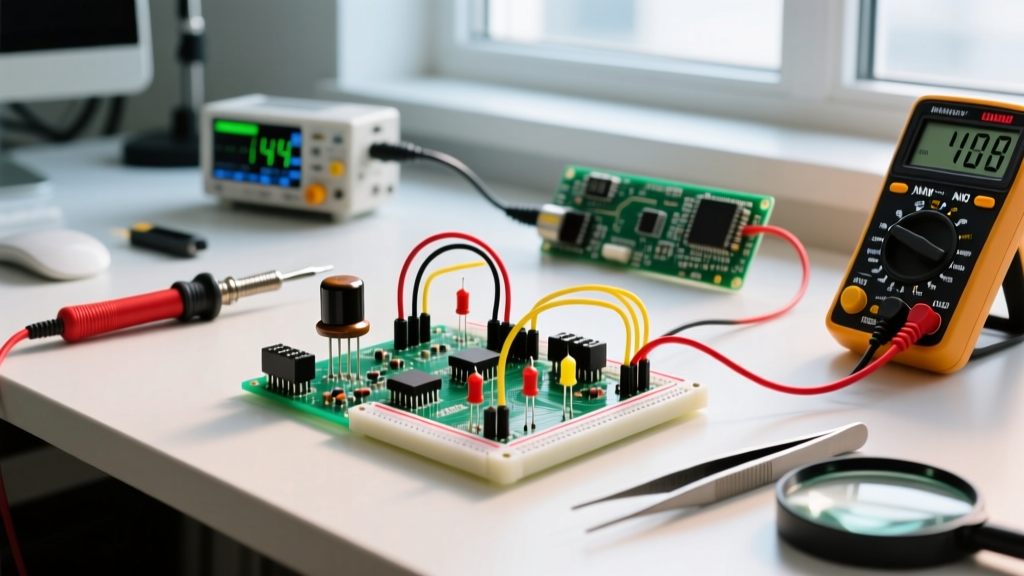
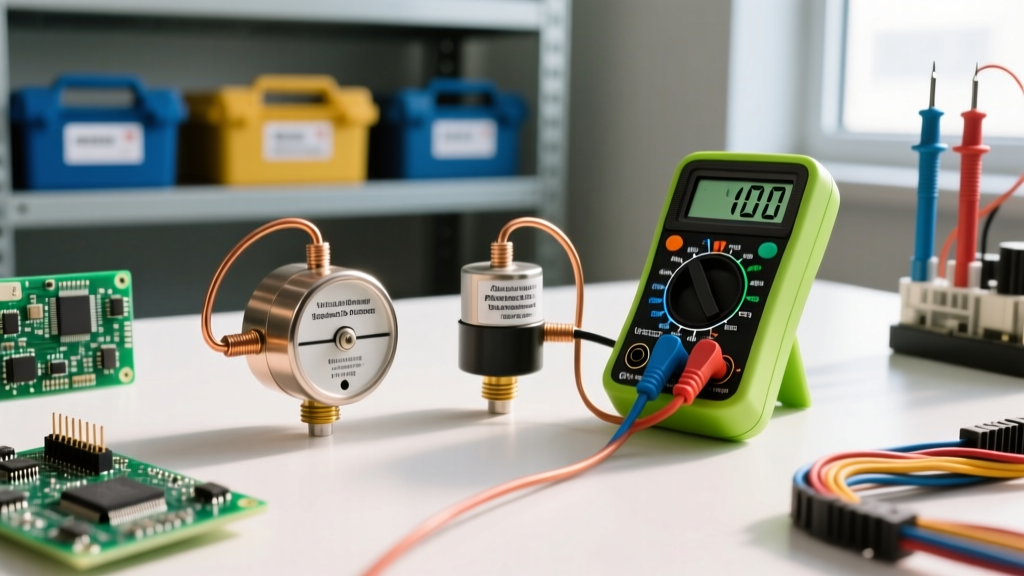
Strictly speaking, there are zero amps "in" 5 volts because volts measure electrical potential (pressure) while amps measure current (flow). However, if you are asking how many amps a standard 5V system draws or delivers, the baseline answer for a common 10W USB device is exactly 2 amps. You cannot convert volts to amps without a third variable—either Power (Watts) or Resistance (Ohms). Using the standard DC power formula, we substitute the values: I = 10W ÷ 5V = 2A.
This guide breaks down the exact math, shows you how neighboring wattages affect your amperage, and provides a concrete decision path for sizing your 5V power supplies and wiring.
The Core Conversion: Watts to Amps at 5V
In DC circuits—which is where 99% of 5V applications live (USB power, Arduino logic, Li-ion BMS outputs)—the relationship between power, voltage, and current is defined by Joule's Law. The formula is I = P ÷ V (Current = Power ÷ Voltage).
If you are designing a 5V circuit, you rarely have exactly 10W. Below is a reference table showing the amperage draw for a ±20% range around our 10W baseline. This is critical for sizing fuses and selecting the right USB-C power delivery (PD) brick.
| Power (Watts) | Voltage (Volts) | Current (Amps) | Common Application |
|---|---|---|---|
| 8W | 5V | 1.60A | Standard smartphone charging |
| 9W | 5V | 1.80A | Raspberry Pi Zero / Sensors |
| 10W | 5V | 2.00A | Baseline USB wall adapter |
| 11W | 5V | 2.20A | ESP32 with WiFi + peripherals |
| 12W | 5V | 2.40A | Apple 12W iPad charger standard |
What Assumptions Fix the Answer (And When It Is Meaningless)
To get a concrete amperage value from a 5V source, one of two assumptions must be fixed:
- Fixed Power (Watts): As shown above, if the load consumes a known wattage, I = P ÷ V.
- Fixed Resistance (Ohms): If you know the resistance of the component, you use Ohm's Law: I = V ÷ R. For example, if you connect a 2.5Ω power resistor across a 5V VCC and GND rail, the current is exactly 2A (5 ÷ 2.5 = 2).
If you ask how many amps are "in" a 5V LiFePO4 battery sitting on a workbench, the answer is 0A. Current only flows when a closed circuit exists (an open circuit draws zero amps). Furthermore, in AC systems, if the Power Factor (PF) is unknown, converting apparent power (VA) to true current is meaningless. The reactive component (inductance/capacitance) hides the actual amperage, which is why industrial AC measurements require a true-RMS clamp meter, not just a math equation.
How the Answer Shifts: 5V DC vs 120V, 230V, and 3-Phase AC
While 5V is almost exclusively a DC standard, understanding how current shifts across different voltages is a fundamental theory concept. If we hold the load constant at 10W, here is how the required amperage shifts from a 5V DC source up to a 400V 3-phase AC industrial supply. Notice how higher voltages drastically reduce current, which is why power grids use high voltage for transmission to minimize I²R (heat) losses in the wires.
| System Type | Nominal Voltage | Formula Used | Current (Amps) |
|---|---|---|---|
| DC (USB/Logic) | 5V | I = P ÷ V | 2.000A |
| 1-Phase AC (US) | 120V | I = P ÷ V (Assuming PF=1) | 0.083A |
| 1-Phase AC (EU/UK) | 230V | I = P ÷ V (Assuming PF=1) | 0.043A |
| 3-Phase AC (Industrial) | 400V | I = P ÷ (V × √3) (Assuming PF=1) | 0.014A |
Source reference: For deeper reading on AC power formulas and Power Factor corrections, consult the HyperPhysics AC Power concepts hosted by Georgia State University.
Decision Path: Sizing Your 5V Power Supply and Wiring
Do not guess your wire gauge or power supply based on voltage alone. Use this decision tree to terminate your design with a concrete part number and wire size. This assumes a standard ambient temperature of 30°C and chassis wiring (not bundled in conduit).
| If Your 5V Load Is... | Expected Amperage | Minimum Wire Gauge (AWG) | Concrete Power Supply Pick |
|---|---|---|---|
| Microcontrollers (ESP32, Arduino Nano), basic sensors | < 1A | 22 AWG | Standard 5V 1A USB Wall Wart |
| Single-board computers (Raspberry Pi 4), short LED strips | 1A to 3A | 20 AWG | Anker 30W USB-C PD Brick (set to 5V) |
| High-torque servos, long WS2812B addressable LED runs | 3A to 7A | 18 AWG | Mean Well LRS-35-5 (5V 7A Enclosed PSU) |
| Massive LED matrices, multiple Pi clusters, heating elements | > 7A | 14 AWG (with ferrules) | Mean Well LRS-75-5 (5V 15A Enclosed PSU) |
Frequently Asked Questions
Can a 5V source deliver 100 amps?
Yes, but it requires a 500W power supply and massive conductors. A 5V 100A system is common in electroplating and high-current battery testing. At 100A, you must use at least 4 AWG THHN copper wire (rated for 85A in standard tables, requiring derating calculations or parallel runs for continuous 100A loads) and heavy-duty terminal blocks. Standard solder joints will melt at this current; use crimped lugs with a calibrated crimper.
How many amps does a standard 5mm 5V LED draw?
A standard indicator LED does not connect directly to 5V without a current-limiting resistor, or it will draw infinite current until it vaporizes. Assuming a typical forward voltage of 2.0V and a target current of 20mA (0.02A), you would use a 150Ω resistor in series. The total draw from the 5V rail is exactly 0.02A per LED.
Does a 5V battery's mAh rating tell me its amps?
No. Milliamp-hours (mAh) is a measure of capacity (energy storage), not instantaneous current. A 5V 2000mAh power bank can theoretically supply 2 amps for 1 hour, or 1 amp for 2 hours. The actual amps delivered at any given second depend entirely on the resistance of the device you plug into it.