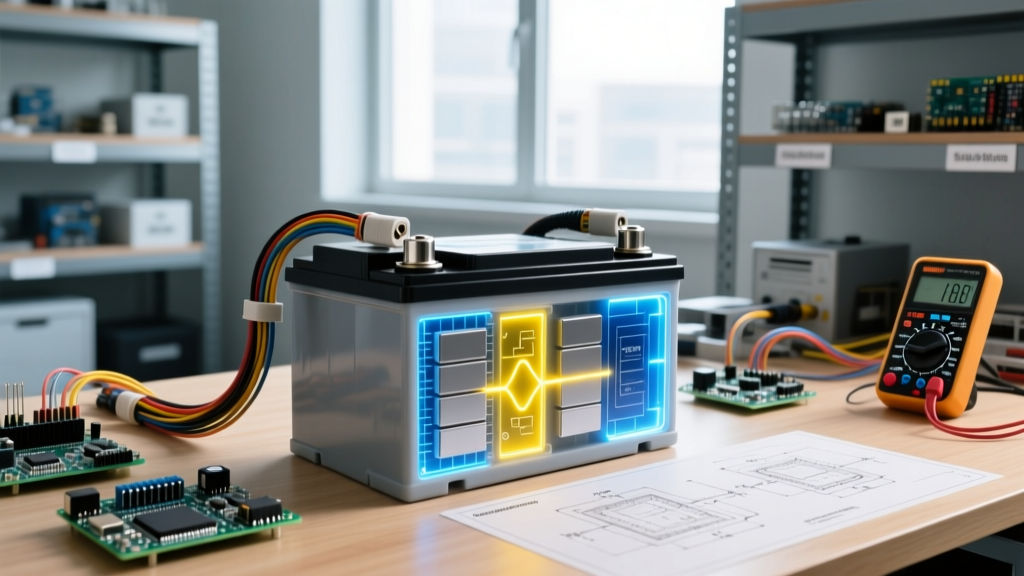

A 12V lead-acid battery works through a reversible electrochemical reaction between lead dioxide (the positive plate), sponge lead (the negative plate), and a sulfuric acid electrolyte. When the battery discharges, both plates convert into lead sulfate, and the electrolyte becomes more water-dense, releasing electrons to the external circuit. A single cell produces a nominal 2.1V; six cells wired in series inside a standard plastic case yield the 12.6V you measure on a fully charged, resting battery. Understanding this chemistry is only the starting point. To actually deploy lead-acid in a solar or backup power system, you must master depth-of-discharge limits, Peukert derating, and exact inverter sizing.
The Electrochemistry, C-Rates, and Discharge Limits
The fundamental discharge equation is straightforward: Pb + PbO2 + 2H2SO4 yields 2PbSO4 + 2H2O. As the battery discharges, the sulfuric acid is consumed. In a flooded lead-acid (FLA) battery, you can physically measure this state of charge using a hydrometer to check the specific gravity of the fluid. A fully charged cell reads about 1.265 specific gravity; a dead cell drops to 1.120.
Unlike lithium-ion chemistries, lead-acid batteries suffer severe capacity penalties when discharged too quickly or too deeply. The maximum safe continuous discharge rate (C-rate) and the allowable Depth of Discharge (DoD) vary strictly by the internal construction of the battery. The table below outlines the hard limits you must respect to avoid permanently sulfating the plates.
| Battery Type | Max Continuous C-Rate | Recommended Max DoD | Cycle Life (at stated DoD) | Internal Resistance (Approx) |
|---|---|---|---|---|
| Flooded Lead-Acid (FLA) | 0.2C (C/5) | 50% | 500 - 800 cycles | 5 - 10 mΩ |
| Absorbent Glass Mat (AGM) | 0.5C (C/2) | 50% - 80% | 600 - 1200 cycles | 3 - 5 mΩ |
| Gel Cell | 0.3C (C/3) | 60% | 800 - 1500 cycles | 4 - 6 mΩ |
| LiFePO4 (Reference) | 1.0C (C/1) | 80% - 100% | 3000 - 5000 cycles | < 1 mΩ |
Source: Battery University and manufacturer datasheets (Trojan, Rolls Surrette).
If you pull 100A from a 100Ah FLA battery (a 1C rate), you are violating the 0.2C maximum limit. The internal resistance will cause severe voltage sag, the plates will heat up, and you will extract barely 40Ah of real capacity before the voltage collapses below the 10.5V inverter cutoff. Always size your FLA bank so that your peak continuous load does not exceed C/5.
Scaling the Bank: Series vs. Parallel Consequences
When a single 12V 100Ah battery cannot meet your system voltage or capacity requirements, you must wire multiple units together. The consequences of series versus parallel wiring dictate your wire sizing, breaker sizing, and system architecture.
Series Wiring: Scaling Voltage
Wiring batteries in series adds their voltages while the Amp-hour (Ah) capacity remains identical to a single battery. If you wire four 12V 100Ah batteries in series, you get a 48V 100Ah bank.
- Consequence: Higher voltage means lower current for the same wattage. A 2000W load on a 12V bank pulls 166A (requiring massive 2/0 AWG or 4/0 AWG copper). That same 2000W load on a 48V bank pulls only 41A, allowing you to use much smaller, cheaper 8 AWG or 6 AWG wire.
- Charging: Your charge controller must support the higher nominal voltage (e.g., a 150V MPPT for a 48V bank).
Parallel Wiring: Scaling Capacity
Wiring batteries in parallel adds their Ah capacity while the voltage remains the same. Four 12V 100Ah batteries in parallel yield a 12V 400Ah bank.
- Consequence: You maintain 12V compatibility with standard RV or marine appliances, but your DC current requirements scale massively. You will need heavy-duty busbars and multiple parallel strings of thick cable.
- The Golden Rule: Never parallel mismatched cells. Mixing old and new batteries, or mixing different capacities (e.g., a 100Ah with a 200Ah), causes the stronger battery to force current into the weaker one, leading to overheating and accelerated failure. Always use identical batteries from the same manufacturing batch.
System Block Sizing: Peukert’s Law and Inverter Matching
A complete off-grid or backup power system follows a strict source-to-load block architecture: Generation Source (Solar/Wind) → MPPT Charge Controller → Battery Bank → DC Disconnect/Breaker → Inverter/Charger → AC Load Panel. Sizing the battery bank and the inverter requires accounting for real-world inefficiencies.
The Sizing Math: A Practical Example
Let us size a 48V FLA battery bank and inverter to run a 1200W continuous AC load (like a well pump and refrigerator combo) for 5 hours.
- Account for Inverter Efficiency: A high-frequency pure sine wave inverter operates at about 90% efficiency.
DC Watts Required = 1200W / 0.90 = 1333W. - Calculate Base DC Amps:
DC Amps = 1333W / 48V nominal = 27.7A. - Calculate Ideal Ah:
27.7A × 5 hours = 138.5Ah. - Apply Peukert’s Derating: The U.S. EIA and battery engineers note that lead-acid capacity shrinks at higher discharge rates. Because 27.7A is a heavy draw relative to standard 100Ah batteries, we apply a 1.25 Peukert derating factor for loads exceeding C/10.
138.5Ah × 1.25 = 173Ah effective required. - Apply DoD Limits: To get 500+ cycles out of FLA, we cannot discharge past 50%.
173Ah / 0.50 = 346Ah minimum bank capacity at 48V.
The Verdict: You need a 48V battery bank rated for at least 350Ah. Since 48V 350Ah monoblocks are rare, you would typically wire four 12V 200Ah AGM/FLA batteries in series to yield 48V 200Ah, and then put two of those strings in parallel to hit 48V 400Ah, giving you a safe buffer above the 346Ah requirement.
Inverter and Charger Sizing
For a 1200W continuous load, do not buy a 1200W inverter. Inductive loads (compressors, pumps) require 2x to 3x surge current to start. You must size the inverter for the surge. A Victron MultiPlus 48V 3000VA inverter/charger is the correct choice here, providing ample continuous headroom and massive surge capability.
For the charging side, lead-acid batteries require a minimum charge current of 10% to 20% of their total Ah capacity to properly mix the electrolyte and prevent stratification. For our 400Ah bank, the MPPT charge controller and inverter/charger combined must be capable of pushing at least 40A to 80A into the bank during the bulk charge phase.
Transitioning to Lithium and Fire-Safety Protocols
While lead-acid remains the cheapest upfront cost per Ah, the usable energy density and cycle life of Lithium Iron Phosphate (LiFePO4) have made it the standard for modern 2026 off-grid builds. However, swapping chemistries requires adjusting your charge profiles and respecting severe safety boundaries.
While LiFePO4 is inherently more thermally stable than NMC or NCA lithium-ion chemistries, any lithium cell operating without a properly rated, functioning Battery Management System (BMS) risks thermal runaway. Never wire raw lithium cells in parallel without matched, balanced capacities and individual cell monitoring. If a BMS fails to disconnect a cell during an over-charge event, the cell can vent toxic gases and ignite. Always install a Class T fuse or DC breaker within 18 inches of the positive battery terminal to protect against catastrophic short circuits, and ensure your battery enclosure is vented to the exterior.
If you upgrade the system above from FLA to a 48V 100Ah server-rack LiFePO4 battery (like a SOK or EG4 PowerPro), you immediately gain access to 80Ah to 100Ah of usable capacity without Peukert penalties, as lithium handles 1C discharge rates with virtually zero voltage sag. However, you must reprogram your MPPT charge controller: disable the equalization (EQ) charge stage, set the absorption voltage to 56.0V (28.0V for 24V systems), and set the float to 53.5V. Applying a lead-acid equalization voltage (often 60V+) to a lithium bank will trip the BMS high-voltage disconnect or permanently damage the cells.
Whether you stick with the low upfront cost of deep-cycle AGM or invest in LiFePO4 for a 10-year lifecycle, the physics remain the same. Respect the C-rates, calculate your Peukert losses, and never undersize your copper. A well-designed 48V system will run quietly for years; a poorly calculated 12V system will leave you buying replacement batteries every 14 months.


