Household electricity voltage is the electrical potential difference—typically 120V or 240V in North America—that pushes alternating current through your home's wiring to deliver power to appliances. If you are wiring a new outlet, sizing a breaker, or troubleshooting a tripped panel, understanding this single metric is the foundation of every decision you will make on the bench or the jobsite.
What Household Electricity Voltage Actually Changes in Your Home
Beginners often confuse voltage with current (amps) or power (watts). To clear this up immediately: voltage is just the push, amps is the flow, and watts is the actual work done. A helpful way to visualize this is with a water system: voltage is the water pressure in the pipes, current is the volume of water flowing, and wattage is the total force of the water hitting a waterwheel.
In a real circuit or installation, voltage dictates the current draw for a given wattage. Because Power (Watts) = Voltage × Current (Amps), a higher voltage means you need less current to deliver the same amount of power. This single mathematical relationship changes three physical realities in your home:
- Wire Gauge (AWG): Lower current allows you to use thinner, cheaper copper wire. Higher current requires thicker wire to prevent the conductor from melting.
- Breaker Sizing: The overcurrent protection device must be matched to the wire's ampacity, which is directly tied to the voltage of the circuit.
- Receptacle Physical Keying: The physical shape of the outlet (NEMA configuration) changes to prevent you from plugging a 120V device into a 240V supply.
Worked Example: Sizing a Circuit for a 4,800W Load
To see how household electricity voltage changes physical materials, let's look at a real-world scenario: installing a 4,800-watt Level 2 EV charger or a large commercial space heater. We will calculate the requirements if we run this load at 240V versus 120V.
Scenario A: The 240V Installation (Standard Practice)
- Calculate Base Current: 4,800W ÷ 240V = 20 Amps.
- Apply NEC Continuous Load Rule: EV chargers and heaters run for 3+ hours, so the National Electrical Code (NEC 210.20(A)) requires sizing the breaker at 125% of the continuous load. 20A × 1.25 = 25 Amps.
- Select Breaker: The next standard breaker size up is 30A (double-pole).
- Select Wire: A 30A breaker requires 10 AWG copper wire (using the 60°C or 75°C ampacity column for NM-B cable).
Scenario B: The 120V Installation (Theoretical)
- Calculate Base Current: 4,800W ÷ 120V = 40 Amps.
- Apply NEC Continuous Load Rule: 40A × 1.25 = 50 Amps.
- Select Breaker: You need a 50A single-pole breaker.
- Select Wire: A 50A breaker requires 6 AWG copper wire.
The Takeaway: By doubling the household electricity voltage from 120V to 240V, we cut the current in half. This allowed us to drop from expensive, stiff 6 AWG wire down to manageable 10 AWG wire, and use a standard 30A breaker instead of a massive 50A breaker. This is exactly why high-draw appliances in your home are wired for 240V.
Where You Meet Household Voltage in Practice
You interact with these voltage tiers every time you plug something in or pull a cable through a stud bay. Here is how household electricity voltage maps to the physical hardware you buy at the supply house.
| System Voltage | Common NEMA Receptacle | Typical Wire (NM-B) | Breaker Type | Common Appliances |
|---|---|---|---|---|
| 120V (15A) | NEMA 5-15R (Standard 3-prong) | 14 AWG (White jacket) | 15A Single-Pole | Lamps, TVs, phone chargers |
| 120V (20A) | NEMA 5-20R (T-slot neutral) | 12 AWG (Yellow jacket) | 20A Single-Pole | Kitchen counter outlets, window ACs |
| 240V (30A) | NEMA 6-30R or 10-30R | 10 AWG (Orange jacket) | 30A Double-Pole | Clothes dryers, water heaters |
| 240V (50A) | NEMA 14-50R (4-prong) | 6 AWG (Black jacket) | 50A Double-Pole | Electric ranges, Level 2 EV chargers |
Note: Always verify the ampacity of your specific wire insulation type. The NEC publishes ampacity tables (like Table 310.16) that vary based on whether you are using THHN in conduit or NM-B inside a wall cavity. For NM-B (Romex), you are generally limited to the 60°C column regardless of the wire's actual thermal rating.
Outside of North America, the standard household electricity voltage is typically 230V nominal (ranging from 220V to 240V depending on the region and grid load), delivered via a single hot leg and a neutral. In these regions, standard wall outlets deliver the full 230V, meaning heavy appliances don't require special high-voltage wiring runs, though they still require appropriately sized breakers and wire gauges based on their current draw.
Frequently Asked Questions
Why does household electricity voltage drop at the end of a long wire run?
Voltage drop occurs because copper wire has inherent electrical resistance. As current flows through the wire, some of the electrical potential is lost as heat, governed by Ohm's Law (Voltage Drop = Current × Resistance). The NEC recommends keeping voltage drop under 3% for branch circuits and 5% total from the utility transformer to the furthest outlet. For a 120V circuit, a 3% drop means the voltage at the receptacle shouldn't fall below 116.4V. If you are running a 120V circuit more than 50 feet for a high-draw tool like a table saw, you must upsize your wire (e.g., using 10 AWG instead of 12 AWG on a 20A breaker) to compensate for the resistance and prevent motor burnout.
Can I plug a 120V appliance into a 240V household outlet?
Physically, no. The National Electrical Manufacturers Association (NEMA) designs plug blades and receptacle slots with specific angles and orientations so that a 120V plug (like a NEMA 5-15) cannot fit into a 240V receptacle (like a NEMA 6-15 or 14-50). If you use a cheater adapter, modify the plug prongs, or hardwire a 120V device directly to a 240V breaker, you will force twice the designed voltage through the appliance's components. This will instantly exceed the dielectric breakdown voltage of the internal capacitors and insulation, resulting in catastrophic failure, arcing, and a high risk of electrical fire. Always match the appliance nameplate voltage to the circuit supply.
How do I measure my household electricity voltage with a multimeter?
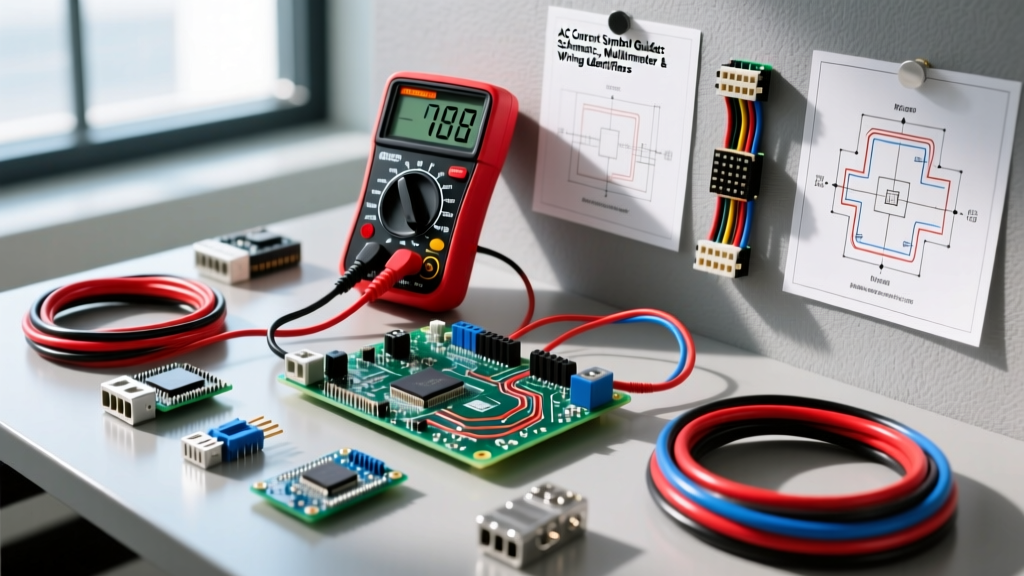
To safely measure household voltage, set your multimeter to AC Voltage (V~ or VAC) and select a range higher than 240V (usually the 600V setting). De-energize the panel and verify your meter works on a known live source before testing dead circuits. When testing a live receptacle:
- Line-to-Neutral (120V): Insert the red probe into the shorter hot slot and the black probe into the longer neutral slot. You should read between 114V and 126V.
- Line-to-Ground (120V): Insert the red probe into the hot slot and the black probe into the U-shaped ground hole. The reading should be nearly identical to Line-to-Neutral.
- Line-to-Line (240V): For a 240V receptacle, insert the probes into the two horizontal hot slots. You should read between 228V and 252V.
If your Line-to-Ground reading is significantly lower than your Line-to-Neutral reading, you likely have a loose or broken ground connection in the circuit, which is a serious shock hazard that requires immediate correction.