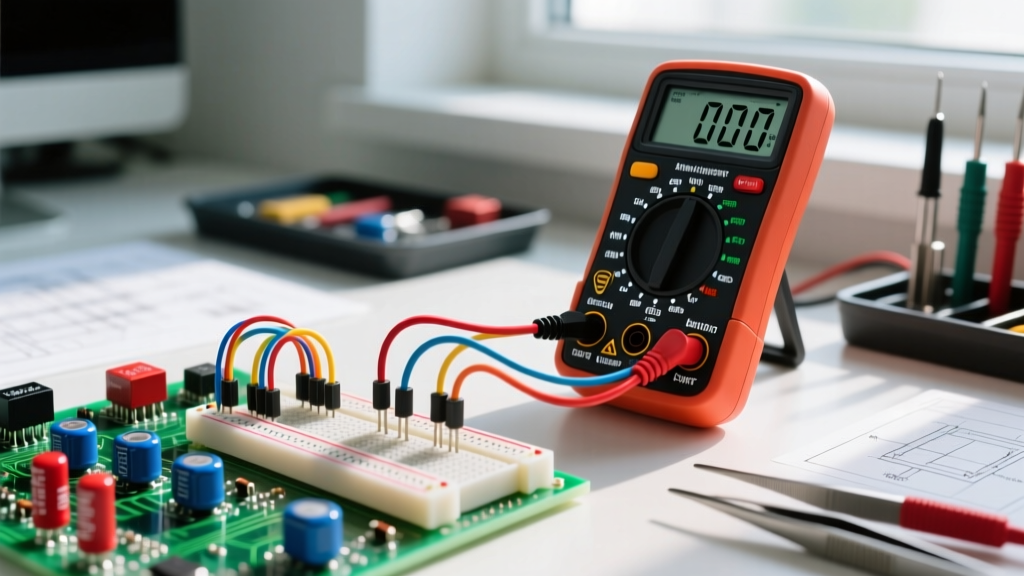
Good Deeds Electronics is the practice of harvesting, electrically validating, and redeploying salvaged components from e-waste into new educational, community, or charitable circuit builds. When you introduce salvaged parts into a fresh PCB, what changes in the real circuit is the baseline parasitic profile—hidden degradation like increased Equivalent Series Resistance (ESR) or gate oxide leakage that alters thermal and switching behavior under load. Beginners commonly confuse this practice with simple visual inspection, assuming that if a component looks physically intact or "worked in the old board," it is electrically sound for a new power supply or logic design.
The Physics of Component Degradation in Salvaged Parts
To successfully practice Good Deeds Electronics, you must understand the solid-state and chemical failure modes of harvested parts. Components do not age in a vacuum; they degrade based on thermal stress, voltage spikes, and ambient humidity.
Electrolytic capacitors are the most common point of failure in salvaged power supplies. The liquid electrolyte inside slowly vaporizes and escapes through the rubber bung at the base of the can. This loss of electrolyte reduces the effective surface area of the anode, which directly increases the Equivalent Series Resistance (ESR). A 5-year-old motherboard capacitor can exhibit a 300% increase in ESR while maintaining 95% of its nominal capacitance. If you only measure capacitance with a standard multimeter, the part will pass, but it will fail catastrophically under high ripple current.
Semiconductors like MOSFETs degrade differently. In power switching applications, repeated thermal cycling and high electric fields cause hot carrier injection. Electrons gain enough kinetic energy to jump the silicon-silicon dioxide barrier and become trapped in the gate oxide. Over thousands of hours, this trapped charge shifts the threshold voltage ($V_{GS(th)}$) and increases gate leakage current. A harvested MOSFET might switch perfectly on a curve tracer at low voltage, but suffer from delayed turn-off and thermal runaway when subjected to the high $dV/dt$ spikes of a modern switching regulator.
Worked Numeric Example: Validating a Harvested Filter Capacitor
Let us look at a real-world scenario where Good Deeds Electronics theory prevents a fire hazard. You are building a 12V DC-DC buck converter for a community robotics kit and want to reuse a harvested 1000µF, 16V, 105°C rated electrolytic capacitor from a scrapped ATX power supply.
According to the original manufacturer datasheet (e.g., Rubycon ZL series), a brand-new capacitor of this specification has a maximum ESR of 0.05 Ω (50 mΩ) at 100kHz. You test your salvaged capacitor with an LCR meter at 100kHz, and it reads an ESR of 0.18 Ω (180 mΩ). The capacitance reads 980µF, which looks fine, but the ESR is the killer.
Your buck converter design requires the output capacitor to handle 2.0 Amps of RMS ripple current. We calculate the internal power dissipation ($P$) using the formula $P = I_{ripple}^2 \times ESR$:
- New Capacitor: $P = (2.0A)^2 \times 0.05\Omega = 4 \times 0.05 = \mathbf{0.20W}$
- Salvaged Capacitor: $P = (2.0A)^2 \times 0.18\Omega = 4 \times 0.18 = \mathbf{0.72W}$
The salvaged capacitor is dissipating 3.6 times more heat internally. Because electrolytic capacitors have poor thermal conductivity to their surroundings, this extra 0.52W of internal heat will raise the core temperature significantly, accelerating the remaining electrolyte evaporation. Think of ESR like a toll booth on a highway; the capacitance is the number of lanes, but the ESR is the delay at the toll plaza. Even if you have eight lanes (high capacitance), a slow toll booth (high ESR) creates a bottleneck (voltage ripple and heat) during rush hour (high ripple current). In a production or educational environment, this salvaged part will vent or bulge within weeks.
Where You Meet This In Practice
You will encounter the principles of Good Deeds Electronics whenever e-waste is diverted from landfills and repurposed for functional hardware. According to the EPA's electronics recycling guidelines, extending the life of electronic components is a critical step in reducing heavy metal contamination. In practice, this looks like:
- Makerspaces and Hackerspaces: Harvesting 16x2 LCD modules, LM7805 linear regulators, and heatsinks from dead desktop PCs to stock free parts bins for hobbyists.
- University Labs: Desoldering DIP logic gates (74HC series) and op-amps from obsolete telecom boards to use in introductory breadboarding courses, where the low frequencies and currents mask minor degradation.
- Humanitarian Engineering: Refurbishing medical or water-testing equipment in developing regions by sourcing replacement power MOSFETs and optocouplers from locally available scrap electronics rather than waiting for international supply chains.
The golden rule in all these environments is matching the harvested component's degradation profile to the new circuit's tolerance. A salvaged 10kΩ pull-up resistor with 5% drift is perfectly fine for an Arduino I2C bus, but a salvaged precision shunt resistor with unknown thermal drift will ruin a DIY multimeter project.
Good Deeds Electronics FAQ
Are salvaged microcontrollers safe for Good Deeds Electronics educational builds?
Generally, yes, provided they were not subjected to overvoltage or extreme heat during desoldering. Microcontrollers (like the ATmega328P or PIC16F series) are solid-state and do not suffer from the chemical degradation that plagues electrolytic capacitors. However, you must verify that the flash memory and EEPROM have not exceeded their write-cycle limits (typically 10,000 to 100,000 cycles). For educational blinky-LED projects, this is rarely an issue, but avoid using salvaged MCUs for critical data-logging applications where EEPROM wear-out could cause silent data corruption.
How do I test harvested MOSFETs for gate leakage in Good Deeds Electronics power supply builds?
To properly validate a salvaged N-channel MOSFET for a power supply, you need to test it under biased conditions, not just with a multimeter continuity check. Connect the source to ground and the drain to a current-limited bench supply set to 80% of the MOSFET's rated $V_{DS}$. Apply a stable 10V to 15V to the gate through a 1kΩ resistor. Measure the voltage drop across the gate resistor or use a picoammeter in series with the gate. A healthy MOSFET will show gate leakage in the nanoamp range (< 100 nA). If you measure leakage in the microamp range (> 1 µA), the gate oxide is compromised, and the part should be discarded to prevent erratic switching and shoot-through currents.
What components should never be reused in Good Deeds Electronics high-voltage builds?
Never reuse safety-critical or high-stress components when dealing with mains voltage (>50V AC). This includes X2 and Y2 EMI suppression capacitors, which are designed to fail short-circuit to protect users from transients; their internal metallized film degrades with every voltage spike they absorb. Additionally, never salvage MOVs (Metal Oxide Varistors), as they degrade invisibly with each clamping event, eventually failing short and causing fires. Finally, avoid reusing optocouplers in isolated feedback loops (like in SMPS designs), as the internal LED luminous efficiency degrades over time, which shifts the current transfer ratio (CTR) and can cause the power supply's feedback loop to become unstable and oscillate. For comprehensive safety standards on component isolation, refer to component testing and safety isolation guidelines.