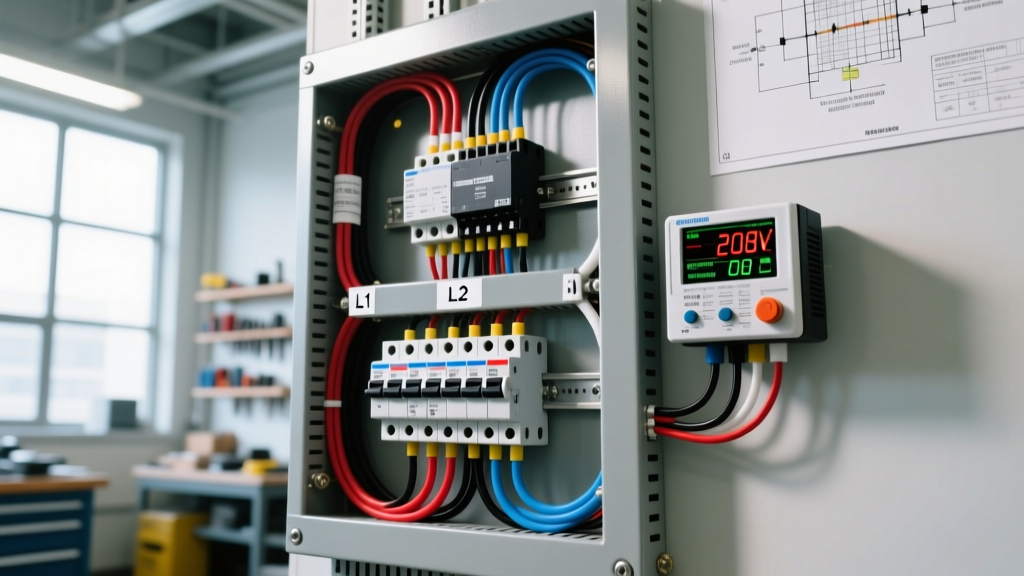

You get 208 volts single phase by connecting a load across any two of the three "hot" legs (L1, L2, or L3) of a 120/208V three-phase wye electrical system. While the power source is three-phase, the circuit itself is single-phase because you are only utilizing the potential difference between two sine waves, resulting in a single 208V alternating current waveform delivered to the load.
This concept trips up many DIYers and junior technicians who assume "single-phase" strictly means a residential split-phase system. In commercial and industrial environments, 208V single-phase is the standard for heavy single-phase loads. Understanding how this voltage is derived, how it behaves under load, and how it impacts wire sizing is critical for safe and code-compliant installations.
The Vector Math: Why Two Phases Make One 208V Wave
In a standard North American commercial 120/208V wye system, the transformer secondary has three windings connected to a common neutral point. The voltage from any single hot leg (L1, L2, or L3) to the neutral is 120V RMS. However, the three sine waves are offset by 120 electrical degrees from one another.
When you measure across two hot legs (for example, L1 and L2), you are not simply adding 120V + 120V to get 240V. Because the waves are peaking at different times, you must use vector addition. The formula for line-to-line voltage in a wye system is the line-to-neutral voltage multiplied by the square root of 3 (1.732).
120V × 1.732 = 207.84V (nominally rounded to 208V).
For a deeper look at the phasor diagrams and transformer winding configurations that create this voltage, the All About Circuits textbook chapter on wye configurations provides excellent visual breakdowns of the vector geometry.
Worked Example: The 10kW Heater Trap (208V vs 240V)
The most common mistake made when wiring 208V single-phase circuits is treating it identically to 240V residential split-phase. This leads to undersized breakers and overheated wires. Let us look at a real-world numeric example involving a 10,000W (10kW) commercial duct heater.
Assume the heater is a purely resistive load and will run continuously for more than three hours, triggering the NEC 125% continuous load multiplier (NEC Article 210.20).
Scenario A: The Heater is Rated for 240V
- Current Draw: 10,000W / 240V = 41.67A
- Continuous Multiplier: 41.67A × 1.25 = 52.08A
- Required Breaker: 60A
- Required Wire: 6 AWG Copper THHN (rated 65A at 75°C terminations)
Scenario B: The Heater is Rated for 208V
- Current Draw: 10,000W / 208V = 48.08A
- Continuous Multiplier: 48.08A × 1.25 = 60.1A
- Required Breaker: 70A (since 60.1A exceeds a 60A breaker)
- Required Wire: 4 AWG Copper THHN (rated 85A at 75°C terminations)
Where You Meet 208V Single Phase in Practice
You will rarely see 208V in a standard single-family home. Instead, you will encounter it in environments supplied by three-phase utility transformers. Common locations include:
- Commercial Strip Malls and Retail: Rooftop HVAC units, commercial water heaters, and heavy point-of-sale server racks.
- High-Rise Apartment Buildings: While individual units get 120V for standard outlets, electric ranges, dryers, and central AC units in the apartments are often fed 208V single phase from the building's main 3-phase switchgear.
- Data Centers and Server Rooms: Many modern Power Distribution Units (PDUs) and UPS systems output 208V single phase to server racks to reduce current draw and allow for smaller PDU whips.
- University Dormitories: High-density living spaces use 3-phase wye systems to balance the massive lighting and appliance loads across the three phases.
To visualize how this compares to residential power, review the structural differences in the table below.
| Feature | 120/208V 3-Phase Wye | 120/240V 1-Phase Split |
|---|---|---|
| Transformer Configuration | Three windings, common neutral (Wye) | Single center-tapped winding |
| Line-to-Neutral Voltage | 120V | 120V |
| Line-to-Line Voltage | 208V | 240V |
| Typical Panel Breaker Layout | L1, L2, L3 alternating vertically | L1, L2 alternating vertically |
| 2-Pole Breaker Voltage | 208V (across different phases) | 240V (across opposite halves of coil) |
What Changes in a Real Installation
When transitioning from residential 240V wiring to commercial 208V single-phase wiring, several physical and code-level parameters change on the jobsite.
Breaker Selection and Phasing: In a 3-phase panelboard (like a Square D NF or Eaton PRL), a 2-pole breaker will span two adjacent busbars. Because the busbars alternate L1, L2, L3, L1, L2, L3, any two adjacent breakers will connect to two different phases, yielding 208V. However, if you are using a tandem or handle-tied breaker setup, you must verify with a multimeter that you are spanning two distinct phases, not the same phase twice (which would yield 0V).
Motor Derating and Nameplates: Single-phase AC motors designed strictly for 240V will run hotter and produce less starting torque on 208V. According to Fluke's electrical measurement guidelines, a voltage drop of more than 10% from the motor nameplate rating can severely reduce the lifespan of the insulation. A 240V motor running on 208V is experiencing a 13.3% drop. You must use motors explicitly rated for 208V or 208-240V.
Neutral Sizing: If your 208V single-phase circuit also requires 120V for control circuits (like a gas furnace blower or a range clock), you will pull a neutral wire. In a 3-phase wye system, the neutral carries the unbalanced current. For a pure 208V single-phase line-to-line load with no 120V taps, no neutral is required, and the equipment grounding conductor (EGC) serves solely as the fault path.
FAQ: Common 208V Single-Phase Questions
Can I run a 240V appliance on 208V single phase?
It depends entirely on the appliance's internal components and nameplate rating. If the nameplate explicitly states "208-240V," the manufacturer has designed the motors, control boards, and heating elements to tolerate the lower voltage. If the nameplate strictly says "240V," you should not run it on 208V. Resistive heating elements will output roughly 25% less heat (since power drops with the square of the voltage), and single-phase induction motors will draw higher amperage to compensate for the lower voltage, leading to overheated windings and tripped thermal overloads.
Is 208V single phase the same as two-phase power?
No. This is a very common terminology error. "Two-phase" refers to an obsolete, early 20th-century power system that used two sine waves offset by 90 degrees, requiring four or five wires. What we call 208V single phase is simply a single-phase circuit derived from a modern three-phase system. You are using two wires (or two hot legs), but the resulting waveform is a single, continuous sine wave. Therefore, it is strictly single-phase.
How do I get 120V from a 208V single-phase circuit?
You cannot derive 120V directly from two 208V hot legs without a neutral. If you are at a disconnect switch or a piece of equipment that only has L1, L2, and Ground, you must install a step-down transformer (208V primary to 120V secondary) to create a new, locally derived 120V circuit. Alternatively, if the equipment nameplate allows, a buck-boost transformer can be used to adjust voltages, but for a full 208V to 120V conversion, a standard isolation step-down transformer is the correct, code-compliant solution.


