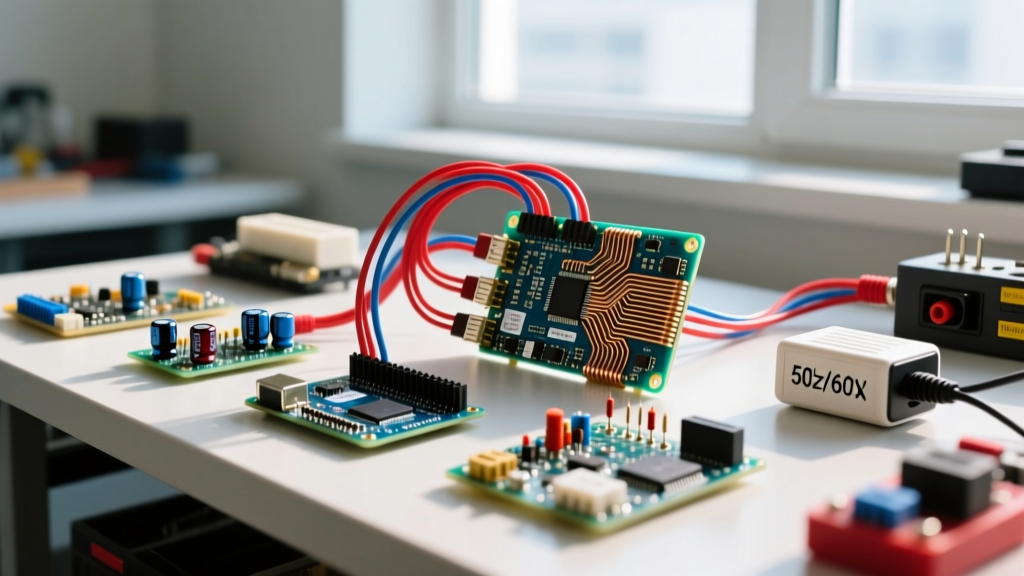

Frequency in AC is the number of complete voltage and current cycles that occur per second, measured in Hertz (Hz). While voltage gets all the attention in safety warnings, it is the frequency that dictates the fundamental timing of alternating current systems, governing everything from the rotational speed of industrial motors to the physical size of the transformers on your utility pole. In North America, the grid hums at 60Hz, while most of Europe, Asia, and Africa operate at 50Hz. Understanding this parameter is non-negotiable when sizing inductive loads, designing power supplies, or troubleshooting imported machinery.
What Frequency in AC Actually Changes in a Circuit
In a purely resistive DC circuit, frequency is irrelevant. But in AC, frequency directly alters the opposition to current flow (impedance) in reactive components. Specifically, it changes:
- Inductive Reactance ($X_L$): Higher frequency increases the impedance of coils, chokes, and motor windings, restricting current flow.
- Capacitive Reactance ($X_C$): Higher frequency decreases the impedance of capacitors, allowing more AC current to pass through.
- Synchronous Speed: The physical RPM of an AC motor is locked to the grid frequency and the number of magnetic poles.
- Transformer Core Sizing: Lower frequencies require larger, heavier iron cores to prevent magnetic saturation.
The most common mistake DIYers and junior technicians make is confusing voltage with frequency. People assume that because Europe uses 230V and the US uses 120V, the voltage is the only difference. They buy a simple step-down voltage transformer to run a US 120V/60Hz appliance on a European 230V/50Hz grid. The voltage is now correct, but the appliance is still receiving 50Hz instead of 60Hz. If that appliance contains an AC motor (like a stand mixer or a clock), it will run 17% slower, draw excessive current due to lowered inductive reactance, and eventually overheat and fail. Always check the Hz rating on the nameplate, not just the V.
Worked Numeric Example: Inductive Reactance and Motor Current
To see why a 10Hz difference matters on the workbench, let us calculate the inductive reactance of a typical 100mH (0.1 Henry) motor winding or choke coil when subjected to both 50Hz and 60Hz grids. We use the formula $X_L = 2\pi f L$.
Scenario A: Connected to a 60Hz Grid (North America)
- $X_L = 2 \times \pi \times 60 \text{ Hz} \times 0.1 \text{ H}$
- $X_L = 37.7 \Omega$
- If we apply 120V AC, the current is $I = V / X_L = 120 / 37.7 = $ 3.18 Amps.
Scenario B: Connected to a 50Hz Grid (Europe) via a step-down transformer
- $X_L = 2 \times \pi \times 50 \text{ Hz} \times 0.1 \text{ H}$
- $X_L = 31.4 \Omega$
- If we apply 120V AC, the current is $I = V / X_L = 120 / 31.4 = $ 3.82 Amps.
By simply dropping the frequency from 60Hz to 50Hz while maintaining the exact same voltage, the current spiked by over 20%. In a continuous-duty motor, that extra 0.64A translates directly into $I^2R$ heat losses in the copper windings. This is exactly why a 60Hz motor operated on a 50Hz grid without a Variable Frequency Drive (VFD) will eventually melt its insulation. For a deeper look at how this ties into synchronous motor speeds, the Engineering ToolBox synchronous speed charts provide the exact RPM matrices for different pole configurations.
Where You Meet AC Frequency in Practice
You will encounter frequency constraints in several specific real-world scenarios:
1. Transformer Sizing and Weight
A 50Hz transformer must be physically larger and heavier than a 60Hz transformer of the exact same VA rating. Because the frequency is lower, the magnetic flux in the core changes more slowly, requiring a larger cross-sectional area of iron to avoid saturation. If you are salvaging transformers from scrap, a 50Hz unit will work fine on a 60Hz grid (it will just run slightly cooler), but a 60Hz-only unit will overheat and hum loudly on a 50Hz grid.
2. Generator Engine RPM
In backup generators, frequency is mechanically locked to the engine speed. A standard 4-pole alternator requires exactly 1800 RPM to produce 60Hz, but only 1500 RPM to produce 50Hz. If your portable generator's governor is slightly out of tune and the engine drops to 1700 RPM, your output frequency drops to 56.6Hz, which can cause sensitive electronics and UPS systems to reject the power and switch to battery.
3. Lighting and Strobe Effects
Magnetic ballasts and simple LED drivers flicker at twice the line frequency (100Hz on a 50Hz grid, 120Hz on a 60Hz grid). While imperceptible to the naked eye, this causes rolling shutter banding when shooting video. If you are building a workshop lighting rig for video recording, you must match your camera's shutter speed to the local AC frequency multiples to avoid flicker.
Decision Tree: Selecting Components for 50Hz or 60Hz Systems
When designing a circuit or buying replacement parts, use this decision matrix to ensure compatibility. Never assume a component is dual-frequency unless explicitly stated on the datasheet.
| Component Type | If Grid is 50Hz | If Grid is 60Hz | Concrete Default Pick / Action |
|---|---|---|---|
| Step-Down Transformer | Must be rated 50Hz or 50/60Hz. Core must be sized for 50Hz flux density. | Can use 60Hz-only or 50/60Hz. Core can be 17% smaller for same VA. | Buy the Hammond Manufacturing 165 Series (explicitly rated 50/60Hz) to guarantee compatibility on any global bench. |
| AC Induction Motor | Motor runs at base speed (e.g., 1500 RPM for 4-pole). Check nameplate for 50Hz current rating. | Motor runs 20% faster (e.g., 1800 RPM for 4-pole). Higher reactance limits current. | If moving between grids, install a VFD (e.g., Invertek Optidrive E3) to synthetically lock the output frequency to the motor's native design. |
| Timing Circuits / Clocks | Use 50Hz zero-crossing detection for timekeeping. 100 pulses per second. | Use 60Hz zero-crossing detection. 120 pulses per second. | Abandon line-frequency timing; use a DS3231 RTC module with a temperature-compensated crystal oscillator for exact timekeeping regardless of grid Hz. |
FAQ: Common Frequency in AC Misconceptions
Can I use a 60Hz hair dryer or space heater on a 50Hz grid with a voltage adapter?
Yes. Heating elements are purely resistive loads. They do not possess inductance or capacitance, meaning their impedance is entirely unaffected by frequency. As long as the voltage is stepped down correctly to match the nameplate, a 60Hz heater will work perfectly on 50Hz. (Note: Devices with universal AC/DC motors, like many power tools, also use internal commutators and are largely frequency agnostic, though they may run slightly hotter).
Does a higher AC frequency mean the grid delivers more power?
No. Real power (Watts) is a product of RMS voltage, RMS current, and the power factor. Frequency does not directly increase the power delivery capacity of a wire. However, higher frequencies do increase the skin effect, forcing AC current to travel only on the outer surface of the conductor, which actually increases effective resistance and reduces the ampacity of thick cables at very high frequencies.
Why do aircraft and military systems use 400Hz instead of 50Hz or 60Hz?
Weight is the enemy of flight. Because inductive reactance increases with frequency, a 400Hz system allows for drastically smaller and lighter transformers, chokes, and motors to handle the same amount of power. A 400Hz aircraft generator and transformer setup can weigh up to 70% less than an equivalent 60Hz setup, which is a critical advantage in aviation design. For more on how frequency is measured and verified in the field, Fluke's electrical measurement guides detail the proper use of multimeters for Hz verification.


