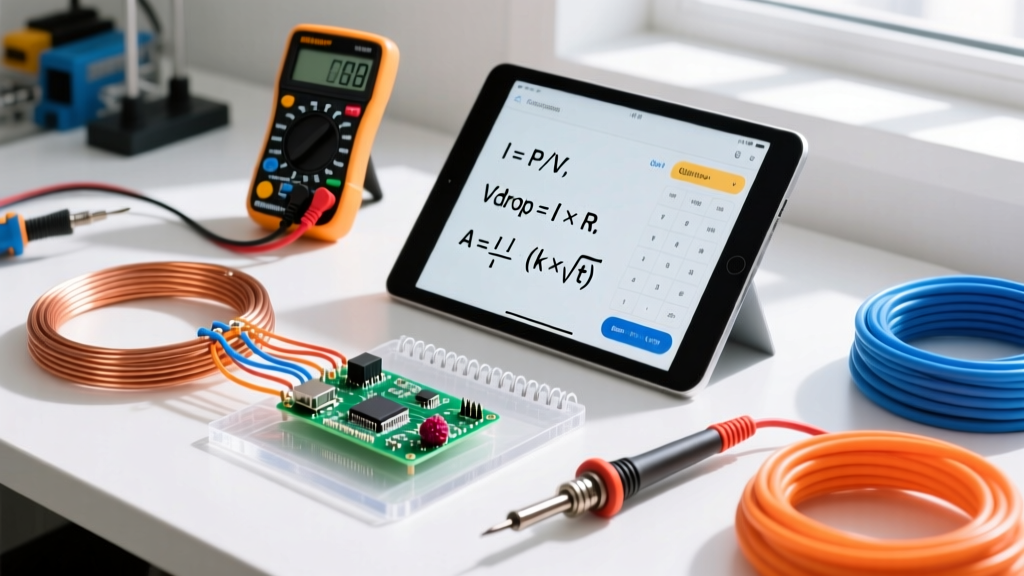

The direct answer: the fundamental formula for power using voltage and current is P = V × I. Power (in Watts) equals Voltage (in Volts) multiplied by Current (in Amperes). While this looks elementary, applying it correctly on the bench or jobsite requires strict unit tracking and a clear understanding of when the formula breaks down in reactive AC systems.
The Core Equation: Defining the Formula for Power Using Voltage and Current
At its core, electrical power is the rate at which electrical energy is transferred by a circuit. The base equation is written as:
P = V × I
Below is the strict definition of every symbol in this formula. Never plug numbers into this equation without first verifying they match these base SI units.
| Symbol | Quantity | Standard Unit | Unit Abbreviation |
|---|---|---|---|
| P | Power (Real Power) | Watts | W |
| V | Voltage (Potential Difference) | Volts | V |
| I | Current | Amperes | A |
Realistic Answer Magnitudes
Before calculating, you should have a mental benchmark of what a realistic answer looks like to catch decimal errors immediately:
- USB-C Phone Charger: 5V × 2A = 10W
- Standard LED Lightbulb: 120V × 0.075A = 9W
- Portable Space Heater: 120V × 12.5A = 1500W (1.5 kW)
- Residential Electric Dryer: 240V × 30A = 7200W (7.2 kW)
- Level 2 EV Charger: 240V × 40A = 9600W (9.6 kW)
If your calculation for a household appliance yields 150,000W or 0.015W, you have a unit conversion error.
Rearranged Forms: Solving for Any Missing Variable
In practical electrical work, you rarely know all three variables. You usually know the system voltage and the appliance wattage, and you need to find the current to size a breaker. Here are the rearranged forms of the formula:
- Solving for Current (I):
I = P / V
Use case: Sizing a fuse, breaker, or wire gauge for a known wattage load (e.g., a 1500W microwave on a 120V circuit). - Solving for Voltage (V):
V = P / I
Use case: Determining the required battery bank voltage to deliver a specific wattage without exceeding the ampacity limits of your wiring (e.g., pushing 2000W through 10 AWG wire).
Worked Examples with Strict Unit Tracking
The most common way this formula fails on the workbench is through prefix blindness—plugging milliamps or kilovolts directly into the equation without converting to base units. I once watched an apprentice size a fuse for a 12V, 500mA LED strip by multiplying 12 × 500, getting 6000, and assuming it meant 6000 Watts. He nearly installed a 60A breaker for a circuit that needed a 1A fuse. Always convert to base SI units first.
Problem 1: DC Solar Array Calculation
Scenario: You are measuring a 48V nominal solar battery bank under load. Your clamp meter reads a current draw of 15.5A. What is the power being delivered?
- Identify knowns: V = 48V, I = 15.5A.
- Check units: Both are in base SI units (Volts and Amperes). No conversion needed.
- Select formula: P = V × I
- Substitute and solve: P = 48 × 15.5
- Calculate: P = 744
- Final Answer: 744 W (or 0.744 kW).
Problem 2: The Unit Trap (Milliamps to Amps)
Scenario: You are designing a power supply for a custom 12V WS2815 LED strip that draws 850 mA per meter. You have a 5-meter strip. What is the total power requirement?
- Identify knowns: V = 12V, I = 850 mA/meter × 5 meters = 4250 mA total.
- Convert to base units (CRITICAL STEP): 4250 mA ÷ 1000 = 4.25 A.
- Select formula: P = V × I
- Substitute and solve: P = 12 × 4.25
- Calculate: P = 51
- Final Answer: 51 W. (You would select a 12V power supply rated for at least 60W to provide a 20% safety headroom).
When This Formula Applies (And When It Fails)
The formula P = V × I calculates real power (measured in Watts) only under specific assumptions. It is perfectly accurate for:
- All DC circuits: Batteries, solar panels, LED drivers, and resistive DC heating elements.
- Purely resistive AC circuits: Incandescent light bulbs, toaster ovens, and resistive space heaters where the voltage and current waveforms are perfectly in phase.
The AC Reactive Load Failure Mode
If you use P = V × I on an AC motor, a transformer, or a switching power supply with poor power factor correction, the formula will give you the wrong answer. In these reactive loads, the voltage and current waveforms shift out of phase. Multiplying RMS voltage by RMS current gives you Apparent Power (measured in Volt-Amperes, or VA), not Real Power (Watts).
According to the U.S. Department of Energy, to find the actual working power (Watts) in a reactive AC circuit, you must introduce the Power Factor (PF):
P (AC) = V × I × PF
Where PF is a decimal between 0 and 1. For example, if a 120V AC compressor draws 10A, the apparent power is 1200 VA. But if the motor has a power factor of 0.8, the real power doing actual mechanical work is only 960W. As detailed in the All About Circuits textbook, ignoring this distinction is why industrial facilities get penalized by utilities for poor power factor, and why hobbyists often trip breakers when sizing generators for inductive motor loads.
Frequently Asked Questions
What is the formula for power using voltage and current in a 3-phase system?
For balanced 3-phase AC systems, the formula expands to account for the phase geometry: P = √3 × V_L × I_L × PF. Here, V_L is the line-to-line voltage (e.g., 208V or 480V), I_L is the line current, and PF is the power factor. The √3 (approximately 1.732) arises from the 120-degree phase shift between the three legs. If you are calculating for a 3-phase industrial motor, never use the standard single-phase P = V × I formula, or you will undersize your conductors by nearly half.
How do I calculate power using voltage and current if I only have resistance?
If you know voltage and resistance, but not current, you combine Ohm's Law (I = V / R) with the power formula. Substituting I yields the derived formula: P = V² / R. Conversely, if you know current and resistance, substitute V = I × R to get P = I² × R. The I²R formula is heavily used in calculating resistive heat losses (I-squared-R losses) in long wire runs and transmission lines.
Why does the formula for power using voltage and current give the wrong answer for my AC motor?
Because AC motors are highly inductive loads. The current waveform lags behind the voltage waveform. When you multiply your multimeter's RMS voltage reading by your clamp meter's RMS current reading, you are calculating Volt-Amperes (VA), not Watts. The motor's nameplate will list a Power Factor (usually between 0.7 and 0.9 for induction motors). You must multiply your V × I result by that Power Factor to find the true mechanical output power and thermal dissipation.
Can I use the formula for power using voltage and current to size a breaker?
Yes, but you must use the rearranged form I = P / V and then apply NEC-style continuous load derating. For example, a 1500W heater on a 120V circuit draws 12.5A (1500 / 120 = 12.5). Because a space heater is considered a continuous load (running for 3 hours or more), the National Electrical Code requires you to multiply the calculated current by 1.25. 12.5A × 1.25 = 15.625A. Therefore, a standard 15A breaker is insufficient and will eventually nuisance-trip; you must upgrade to a 20A breaker and 12 AWG wire. Always check your local AHJ for final code compliance.