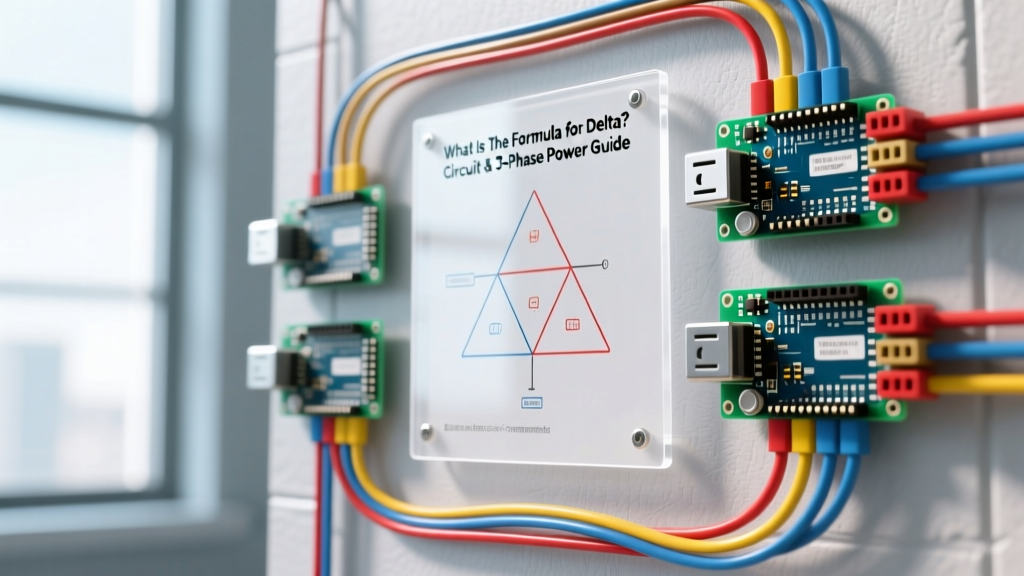

When you search for the "formula for delta" in electrical engineering, you are looking for one of two completely different mathematical models. In DC/AC circuit theory, it refers to the Delta-to-Wye (Δ-Y) resistor network transformation. In power systems, it refers to the 3-Phase Delta configuration line-to-phase relationships. Using the wrong one will either leave you staring at an unsolvable unbalanced bridge circuit or cause you to undersize a motor feeder breaker.
This guide gives you the exact formulas, symbol definitions, and worked examples for both, terminating in a concrete decision path so you know exactly which math to apply to your bench or jobsite project.
The Delta Decision Matrix
Before writing down a single equation, identify your physical system. Use this decision-tree-table to route to the correct formula set.
| If your system is... | And you need to find... | Then use this formula set |
|---|---|---|
| A resistor network with 3 branches forming a triangle (Π or Δ) | Equivalent resistance to simplify an unbalanced bridge | Delta-to-Wye (Δ-Y) Transformation |
| A 3-phase AC motor, transformer, or generator winding | Line current, phase current, or line voltage | 3-Phase Delta Power Formulas |
| A mathematical derivative or change in state | Voltage drop or temperature difference | Standard Calculus Delta (ΔV = V2 - V1) |
The Delta-to-Wye (Δ-Y) Resistor Transformation
The Δ-Y transformation (also called Pi-Tee or Π-T) converts a three-resistor delta network into an electrically equivalent three-resistor wye (star) network. This is mandatory for solving unbalanced Wheatstone bridges or complex resistor grids where standard series/parallel rules fail.
The Core Formula
To find the resistance of a specific Wye branch ($R_1$), multiply the two Delta resistors adjacent to that same node, and divide by the sum of all three Delta resistors.
Formula: $R_1 = \frac{R_b \times R_c}{R_a + R_b + R_c}$
| Symbol | Definition | Standard Unit |
|---|---|---|
| $R_1, R_2, R_3$ | Wye (Y) branch resistors (connected to a central common node) | Ohms (Ω) |
| $R_a, R_b, R_c$ | Delta (Δ) branch resistors (forming the triangle sides) | Ohms (Ω) |
| $R_b \times R_c$ | Product of the two Delta resistors sharing the same node as $R_1$ | Ω² |
| $\sum R_\Delta$ | Sum of all three Delta resistors ($R_a + R_b + R_c$) | Ohms (Ω) |
Assumptions and Unit Mistakes
This formula assumes linear, bilateral components (standard resistors) operating in DC or AC steady-state (where impedance $Z$ replaces $R$ for AC). It does not apply to non-linear components like diodes.
The #1 Unit Mistake: Mixing kilo-ohms (kΩ) and ohms (Ω) in the numerator and denominator. If $R_b$ is 2 kΩ and $R_c$ is 1000 Ω, your numerator becomes 2,000,000, but if your denominator is in kΩ (e.g., 4), your final unit tracking collapses. Rule: Convert all values to base Ohms (Ω) before plugging them into the formula.
Worked Examples: Delta-to-Wye with Unit Tracking
Problem 1: Symmetrical Delta Network
Given: A delta network where $R_a = 300\Omega$, $R_b = 300\Omega$, and $R_c = 300\Omega$. Find the equivalent Wye resistor $R_1$.
- Identify the sum of the Delta: $\sum R_\Delta = 300\Omega + 300\Omega + 300\Omega = 900\Omega$.
- Identify the adjacent product for Node 1: $R_b \times R_c = 300\Omega \times 300\Omega = 90,000 \Omega^2$.
- Divide: $R_1 = 90,000 \Omega^2 / 900\Omega$.
- Result: $R_1 = 100\Omega$. (Notice that $300 / 3 = 100$, confirming the symmetrical shortcut).
Problem 2: Asymmetrical Delta Network
Given: An unbalanced bridge circuit with $R_a = 100\Omega$, $R_b = 220\Omega$, and $R_c = 470\Omega$. Find all three Wye equivalents ($R_1, R_2, R_3$).
- Calculate the denominator (Sum): $100 + 220 + 470 = 790\Omega$.
- Calculate $R_1$ (opposite $R_a$, adjacent to $R_b, R_c$): $R_1 = (220 \times 470) / 790 = 103,400 / 790 = \mathbf{130.89\Omega}$.
- Calculate $R_2$ (opposite $R_b$, adjacent to $R_a, R_c$): $R_2 = (100 \times 470) / 790 = 47,000 / 790 = \mathbf{59.49\Omega}$.
- Calculate $R_3$ (opposite $R_c$, adjacent to $R_a, R_b$): $R_3 = (100 \times 220) / 790 = 22,000 / 790 = \mathbf{27.85\Omega}$.
Verification: All resulting Wye resistors are smaller than the smallest Delta resistor (100Ω). The math holds.
Rearranged Forms: The Wye-to-Delta (Y-Δ) Inverse
Sometimes you are designing a PCB and need to replace a Wye network with a Delta network to avoid routing traces to a central ground via. To solve for the Delta variables, the formula rearranges to: Delta Resistor = (Sum of all Wye cross-products) / (Opposite Wye Resistor).
- Solving for $R_a$: $R_a = \frac{(R_1 R_2) + (R_2 R_3) + (R_3 R_1)}{R_1}$
- Solving for $R_b$: $R_b = \frac{(R_1 R_2) + (R_2 R_3) + (R_3 R_1)}{R_2}$
- Solving for $R_c$: $R_c = \frac{(R_1 R_2) + (R_2 R_3) + (R_3 R_1)}{R_3}$
Note the numerator is identical for all three equations. Calculate the sum of the cross-products once, then divide by the opposite Wye leg. For deeper circuit topology theory, refer to the Electronics Tutorials Delta-Star guide.
3-Phase Delta Power System Formulas
If you are wiring a commercial shop, sizing a VFD for a 2026 IE4 premium-efficiency motor, or troubleshooting a 3-phase transformer, the "Delta" formula refers to the relationship between Line (what you measure at the breaker) and Phase (what the motor winding actually sees) values.
| Parameter | Delta (Δ) Formula | Wye (Y) Formula (for contrast) |
|---|---|---|
| Voltage | $V_{Line} = V_{Phase}$ | $V_{Line} = \sqrt{3} \times V_{Phase}$ |
| Current | $I_{Line} = \sqrt{3} \times I_{Phase}$ | $I_{Line} = I_{Phase}$ |
Worked Problem: 3-Phase Delta Motor Sizing
Given: A 480V AC 3-phase Delta-connected induction motor. The internal winding (Phase) current is measured at 15A using a clamp meter on the internal winding lead (or derived from nameplate data). What is the Line Current drawn from the panel?
- Identify the formula: $I_{Line} = \sqrt{3} \times I_{Phase}$.
- Substitute the values: $I_{Line} = 1.732 \times 15A$.
- Calculate: $I_{Line} = 25.98A$.
- Actionable Pick: You must size your branch circuit conductors and breaker for ~26A. Per NEC 75°C ampacity tables, 10 AWG THHN copper (rated 35A) is the minimum safe pick, protected by a 30A or 35A inverse-time breaker (subject to local AHJ and specific motor starting multipliers).
Final Decision Path & Default Recommendations
Do not leave your project to guesswork. Follow this terminal decision path to lock in your next step.
- IF you are analyzing an unbalanced bridge circuit on a breadboard or PCB → Default to the Δ-Y Resistor Transformation. Use 1% tolerance metal film resistors to ensure your physical build matches your calculated Wye equivalents. Bench Tip: When verifying a physical delta network with a Fluke 87V, you must desolder one leg of each resistor; otherwise, your meter will read the parallel equivalent, not the isolated branch resistance.
- IF you are replacing a resistor network with standard E12/E24 values and the exact calculated Wye value isn't available → Default to combining two standard resistors in series to hit the exact target, as parallel combinations introduce unnecessary thermal drift.
- IF you are sizing conductors for a 3-phase Delta motor or heater → Default to the Line Current formula ($I_L = \sqrt{3} I_P$). Multiply the phase current by 1.732, then multiply by 1.25 (125% NEC continuous load rule) to select your final wire gauge from the 75°C column.
- IF you are measuring a 3-phase Delta system with a multimeter → Default to trusting your Line-to-Line voltage reading. In a 480V Delta system, there is no neutral. Do not attempt to measure phase-to-ground expecting 277V (that is a Wye system); you will read phantom voltages or trigger a ground fault.