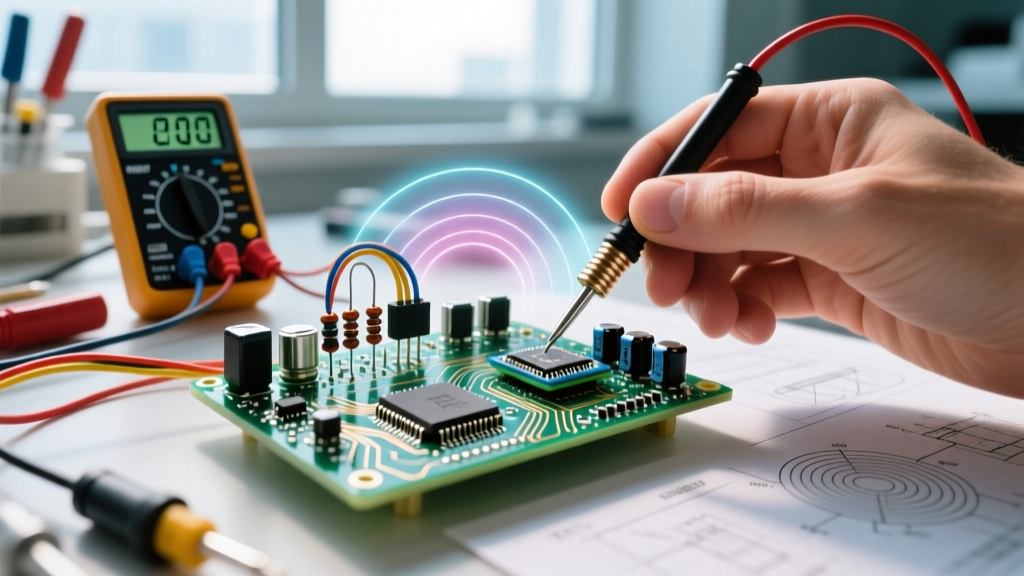

The force that makes electricity flow is voltage, technically known as electromotive force (EMF) or potential difference, which acts as the electrical pressure pushing electrons through a conductive path. When you place a multimeter across a battery terminal or a wall outlet, you are not measuring the electrons themselves; you are measuring the difference in electrical potential energy between those two points. This potential difference is the fundamental driver of all circuit behavior, dictating exactly how much current will flow for a given resistance.
What Voltage Actually Changes in a Real Circuit
Voltage does not just exist passively; it actively dictates the physical requirements of your installation. According to Ohm's Law (I = V / R), the voltage applied across a fixed resistance determines the current draw. More importantly for DIY builders and electricians, the power equation (P = V × I) reveals that for a fixed power requirement, increasing the system voltage drastically reduces the current.
This reduction in current changes everything about your physical build:
- Wire Gauge (AWG): Lower current means you can use thinner, cheaper, and more flexible copper wire.
- Breaker and Fuse Sizing: Overcurrent protection devices can be rated lower, reducing the cost and physical footprint of your panel or fuse block.
- I²R Heating Losses: Because resistive heat loss scales with the square of the current, doubling your voltage halves your current and reduces wire heating losses by 75%.
Worked Example: Sizing Wire for a 2400W Inverter
To see how the force that makes electricity flow is voltage in action, let's size the DC battery cables for a 2400W continuous AC load running through an inverter. We will look at three common DC system voltages, applying the NEC 125% continuous load rule and referencing the 75°C column of NEC Table 310.16 for copper THHN wire in a raceway.
| System Voltage | DC Current Draw (I = P/V) | NEC 125% Sizing Target | Required Copper Wire Size |
|---|---|---|---|
| 12V Nominal | 200 Amps | 250 Amps | 250 kcmil |
| 24V Nominal | 100 Amps | 125 Amps | 1 AWG |
| 48V Nominal | 50 Amps | 62.5 Amps | 4 AWG (for safety margin) |
At 12V, pushing 2400W requires massive 250 kcmil cable, which is incredibly stiff, expensive (roughly $15-$20 per foot in 2026), and difficult to crimp without hydraulic tools. By simply changing the system architecture to 24V, the required wire drops to 1 AWG, which is manageable by hand and costs a fraction of the price. The voltage did the heavy lifting by suppressing the current.
Where You Meet Potential Difference in Practice
You will encounter the practical limits of EMF and potential difference in three common scenarios on the bench or in the field:
1. Mains Split-Phase Wiring (120V vs 240V)
In North American residential wiring, your panel receives 240V from the utility transformer, split into two 120V legs. High-draw appliances like electric dryers, ranges, and EV chargers are wired across both legs to utilize the full 240V potential difference. This halves the current compared to running them on 120V, allowing a 50A breaker and 6 AWG wire to safely deliver 12,000W to an EV charger.
2. Addressable LED Strip Voltage Drop
When wiring WS2812B (5V) addressable LEDs, the low system voltage means the copper traces on the strip suffer severe voltage drop. After just 2 meters, the potential difference at the far end drops below the 3.5V logic threshold, causing color shifting and flickering. Switching to WS2815 (12V) strips increases the baseline EMF, allowing you to run 5 to 10 meters before needing to re-inject power.
3. Lithium Battery Resting vs Charging Voltage
A '12V' LiFePO4 battery is a nominal label. The actual electromotive force ranges from 12.0V (empty) to 14.6V (fully charged and resting). If you set your solar charge controller's low-voltage disconnect to 12.0V, you will drain the cells to absolute zero, triggering the BMS low-voltage cutoff and potentially bricking the pack. You must set your disconnect to 12.8V to respect the chemistry's actual potential curve.
Decision Tree: Picking Your DC System Voltage
When designing an off-grid solar, marine, or camper battery bank, choosing the right baseline EMF is the most critical architectural decision you will make. Use this decision path to lock in your system voltage.
| IF your total continuous AC load is... | AND your wire runs are... | THEN choose this DC Voltage |
|---|---|---|
| Under 1,000W (Lights, phones, small fridge) | Short (under 10 feet) | 12V (Standard auto/marine parts available everywhere) |
| 1,000W to 3,000W (Microwave, coffee maker, laptops) | Moderate (10-20 feet) | 24V (The sweet spot for efficiency and part availability) |
| Over 3,000W (AC units, induction cooktops, well pumps) | Long (20+ feet) | 48V (Mandatory to keep DC current under 100A) |
Common Confusions: EMF, Voltage Drop, and Current
Even experienced hobbyists mix up the terminology surrounding electrical pressure. Here is how to keep them straight.
The Water Analogy (Use It Once, Then Move On)
Think of a water pump pushing water through a hose. Voltage is the water pressure (PSI) created by the pump. Current (Amps) is the actual volume of water flowing through the hose (Gallons Per Minute). Resistance (Ohms) is the diameter of the hose. If you increase the pressure (voltage), more water flows (current), assuming the hose size stays the same. But remember: pressure is not the water itself. You can have high pressure in a closed valve (voltage with zero current).
EMF vs. Voltage Drop
Electromotive Force (EMF) is the total potential difference generated by the source (the battery or transformer). Voltage drop is the portion of that EMF that is 'used up' or lost as heat when current pushes through a resistance, like a long run of undersized wire. If your battery outputs 12.6V (EMF) but your winch only sees 10.5V under load, you have a 2.1V voltage drop caused by inadequate cabling or corroded terminals.
Volts vs. Watts
Voltage is just the potential to do work; Watts are the actual rate of work being done. A static shock from a doorknob can have an EMF of 20,000 volts, but because the current is measured in microamps and lasts for a microsecond, the total power (Watts) and energy (Joules) are negligible. Conversely, a 12V car battery has low voltage, but can deliver 600 Amps to a starter motor, generating massive, dangerous wattage.
Understanding that the force that makes electricity flow is voltage allows you to manipulate that force to your advantage. By intentionally designing around higher system voltages where appropriate, you reduce current, minimize heat, shrink your wire gauges, and build safer, more efficient electrical systems.