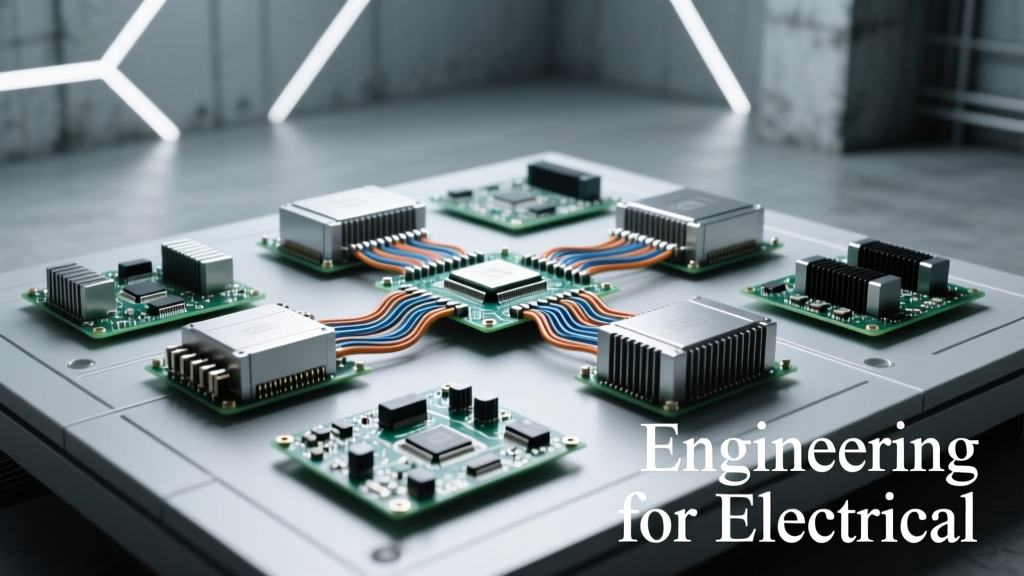
Engineering for Electrical is the disciplined application of physics, mathematics, and materials science to design, analyze, and optimize systems that generate, transmit, distribute, convert, and utilize electrical energy and signals. It spans micro-scale integrated circuits operating at 0.65 V and 3 nm node widths to continent-spanning high-voltage direct current (HVDC) transmission networks carrying ±800 kV across 3,300 km—like China’s Changji–Guangzhou UHVDC line. This field underpins renewable integration, electric mobility, smart grids, and AI-accelerated edge computing. Practitioners rely on standardized test methods (IEC 61000-4-5 for surge immunity), thermal derating curves (e.g., Vishay’s WSHP series resistors at 70°C ambient), and safety-critical certification pathways (UL 61800-5-1 for adjustable speed drives). Unlike generic electronics tinkering, electrical engineering enforces rigorous adherence to electromagnetic compatibility (EMC), fault-current coordination, and lifecycle reliability targets—such as 20-year mean time between failures (MTBF) for Siemens Desiro ML train traction inverters.
Core Disciplines and Foundational Theory
Electrical engineering rests on four interlocking theoretical pillars: circuit theory, electromagnetism, signal processing, and thermodynamics. Circuit theory—governed by Kirchhoff’s laws and Ohm’s law—enables quantitative prediction of current flow, voltage drop, and power dissipation in linear and nonlinear networks. For instance, a 12 V automotive lighting circuit with a 2.4 Ω halogen bulb draws exactly 5 A (I = V/R), dissipating 60 W as heat and light. Electromagnetism, formalized by Maxwell’s equations, explains how time-varying magnetic fields induce voltages (Faraday’s law) and how current-carrying conductors produce magnetic flux (Ampère’s law with Maxwell’s correction). These principles directly govern transformer design: a 50 Hz, 10 kVA distribution transformer from Eaton uses grain-oriented silicon steel laminations (0.23 mm thick) to limit eddy current losses to <0.8% of rated power at full load.
Signal processing bridges analog and digital domains using Laplace and Fourier transforms to model system behavior in s- and frequency-domains. A TI TMS320C6748 DSP executing real-time harmonic analysis on a 400 V AC bus samples at 10.24 kS/s with 16-bit resolution, resolving harmonics up to the 49th order (2.45 kHz) per IEEE 519-2022 limits. Thermodynamics informs thermal management strategies; for example, Infineon’s FF450R12ME4 IGBT module requires a heatsink with ≤0.15 °C/W thermal resistance when operating at 450 A peak current and 1200 V blocking voltage to maintain junction temperature below 150°C.
Mathematical Rigor in Practice
While calculus and differential equations form the language of dynamic systems, practical implementation demands discrete approximations. The state-space representation of a DC motor—dx/dt = Ax + Bu, y = Cx + Du—is solved numerically in real time on ARM Cortex-M7 microcontrollers running at 480 MHz (e.g., STMicroelectronics STM32H743). Here, matrix A encodes armature inductance (2.1 mH), rotor inertia (0.008 kg·m²), and viscous damping (0.012 N·m·s/rad); B reflects torque constant (0.85 N·m/A). Solving this every 50 µs ensures velocity regulation within ±0.3% error band despite load torque disturbances up to 15 N·m.
Power Generation, Transmission, and Distribution
Modern electrical infrastructure begins with generation technologies adhering to strict grid codes. Synchronous generators from GE Vernova (e.g., 7FA.05 gas turbine generator) must provide inertial response within 100 ms of frequency deviation and sustain 1.1 pu terminal voltage for 10 seconds during symmetrical faults. Transmission relies on alternating current (AC) and high-voltage direct current (HVDC) systems. AC lines dominate short-to-medium distances: a typical 345 kV double-circuit overhead line using 4×ACSR-954 kcmil conductors achieves 1,200 MVA capacity over 150 km, with reactive compensation via 120 Mvar shunt reactors at substations. HVDC excels for long-haul and asynchronous interconnections: ABB’s 3,000 MW, ±525 kV HVDC Light link between Norway and Germany uses 24-pulse voltage-source converters with IGCTs switching at 1.2 kHz, achieving 99.3% end-to-end efficiency and reactive power support of ±300 Mvar.
Distribution systems deliver power to end users through radial or looped topologies. In North America, 12.47 kV primary feeders serve neighborhoods with peak loads up to 8 MVA. Utilities deploy automated reclosers—like S&C Electric’s EMAX II—that interrupt fault currents up to 20 kA RMS within 3 cycles (50 ms) and execute three-shot sequences (0.5 s, 2 s, 20 s delays) to isolate transient faults while restoring service. Voltage regulation is maintained within ±5% of nominal (120/240 V) using step-voltage regulators (SVRs) with 32 tap positions and ±10% total range, adjusted via SCADA commands compliant with IEEE 1815 (DNP3) protocol.
Renewable Integration Challenges
Integrating distributed energy resources introduces bidirectional power flow and harmonic distortion. Solar inverters must comply with UL 1741 SA, mandating anti-islanding detection within 2 seconds and THD <3% at rated output. A 250 kW Sungrow SH250RT string inverter injects current with <1.5% THD up to 50% load and maintains power factor >0.99 lagging or leading. Wind turbines face grid code requirements such as low-voltage ride-through (LVRT): Vestas V150-4.2 MW turbines sustain operation during 0% voltage sag for 150 ms and 90% sag for 2,000 ms, injecting reactive current at 100% rated current per unit voltage dip.
Semiconductor Devices and Power Electronics
Power semiconductors act as controllable switches and rectifiers, enabling efficient energy conversion. Silicon (Si) dominates medium-power applications (<10 kW), while silicon carbide (SiC) and gallium nitride (GaN) enable higher-frequency, higher-efficiency designs. Wolfspeed’s C3M0065090D SiC MOSFET operates at 900 V with RDS(on) = 65 mΩ at 25°C and supports 100 kHz switching in a 3.3 kW onboard EV charger, achieving 96.5% peak efficiency—3.2 percentage points higher than equivalent Si IGBT designs. GaN Systems’ GS66508T 650 V e-mode HEMT delivers 80 mΩ RDS(on) and supports 1.5 MHz switching in 1 kW server PSUs, reducing magnetics volume by 65% versus 100 kHz Si solutions.
Thermal design is inseparable from device selection. A 1.7 kV, 1,200 A press-pack IGBT stack from Mitsubishi Electric (CM1200HC-50H) dissipates 4.8 kW at full load; its copper baseplate requires liquid cooling at 0.5 L/min flow rate and inlet temperature ≤45°C to hold junction temperature ≤125°C. Gate drive design follows strict timing constraints: TI’s UCC5870-Q1 isolated gate driver delivers 10 A peak sink/source current with propagation delay <100 ns and channel-to-channel skew <5 ns—critical for paralleling multiple 1,200 V SiC modules without shoot-through.
Protection and Reliability Engineering
Reliability is quantified using failure rate models (e.g., MIL-HDBK-217F) and accelerated life testing. An industrial-grade 100 µF, 450 V aluminum electrolytic capacitor from Nichicon (UPW series) has a rated lifetime of 5,000 hours at 105°C, but derates to 20,000 hours at 65°C ambient—doubling life for every 10°C reduction. Overvoltage protection uses metal-oxide varistors (MOVs) like Littelfuse’s CNR-14D471K (470 V RMS clamping), which absorbs 6 kJ per pulse in 8/20 µs surge tests. Short-circuit protection employs fast-acting fuses: Bussmann’s FWP-300 fuse clears 10× rated current in <0.001 s, limiting I²t let-through to 25,000 A²s to protect downstream SiC MOSFETs rated for 50,000 A²s single-pulse withstand.
Control Systems and Embedded Implementation
Feedback control ensures stability, accuracy, and responsiveness across electrical systems. Proportional-integral-derivative (PID) controllers remain ubiquitous: a Delta Tau PMAC controller regulating a 50 HP servo motor uses Kp = 120, Ki = 1,800 s⁻¹, and Kd = 0.4 s to achieve 10 ms settling time for 10° position steps. Modern implementations leverage model predictive control (MPC) for multi-variable optimization. In a 1 MW solar farm, SMA’s Sunny Central Storage 1000CP inverter applies MPC to coordinate battery charging, PV curtailment, and reactive power dispatch—reducing grid interaction cost by 14% annually while maintaining SoC within 20–90% bounds.
Embedded firmware development follows functional safety standards. Automotive-grade motor controllers certified to ISO 26262 ASIL-D (e.g., NXP S32K144-based designs) implement dual-core lockstep CPUs, memory built-in self-test (BIST), and hardware watchdogs with independent clock sources. Fault injection testing validates recovery from single-event upsets: injecting bit flips in RAM causes automatic rollback to last known-good state within 50 µs, preserving torque command integrity within ±0.5%.
Real-Time Operating Systems and Communication Protocols
Hard real-time deadlines demand deterministic scheduling. FreeRTOS running on a Microchip SAM E70 microcontroller schedules 12 concurrent tasks—including PWM generation (100 µs period), CAN message handling (1 ms deadline), and sensor fusion (5 ms)—with worst-case latency <1.2 µs. Industrial communication relies on time-sensitive networking (TSN): Rockwell Automation’s Stratix 5900 switches implement IEEE 802.1Qbv time-aware shapers to guarantee sub-100 µs jitter for motion control packets across 100-node EtherNet/IP networks. Precision time protocol (PTP) synchronization achieves <±50 ns clock skew between devices—critical for phasor measurement units (PMUs) like SEL-421 relays sampling at 120 samples/cycle (6 kHz) for wide-area monitoring.
Standards, Certification, and Regulatory Compliance
Global interoperability and safety depend on harmonized standards. The International Electrotechnical Commission (IEC) publishes over 10,000 standards; key ones include IEC 61850 for substation automation (defining GOOSE messaging with 4 ms maximum latency), IEC 62109 for PV inverters (mandating 100% isolation resistance test at 1,000 V DC), and IEC 61508 for functional safety (requiring SIL-2 systems to achieve <10⁻⁷ probability of dangerous failure per hour). In North America, UL standards dominate: UL 60950-1 covers IT equipment safety (dielectric strength test at 1,500 V AC for 1 minute), while UL 1741 SB certifies inverters for grid-support functions like ramp rate control (≤10% Pmax/second) and frequency-watt response (−2% Pmax/0.1 Hz).
Certification timelines impact product development cycles. Achieving CE marking for a 400 V AC/DC converter involves EMC testing (EN 55032 Class B radiated emissions <40 dBµV/m at 30–230 MHz), safety testing (IEC 62368-1 clearance/creepage distances ≥4.0 mm), and environmental stress screening (85°C/85% RH for 96 hours). Typical duration: 8–12 weeks at accredited labs like Intertek or TÜV Rheinland. Cost ranges from $25,000 (basic ITE) to $120,000 (ASIL-D automotive), reflecting test complexity and documentation rigor.
Emerging Frontiers and Industry Trends
Three converging trends are reshaping electrical engineering practice: wide-bandgap semiconductors, digital twin modeling, and AI-driven predictive maintenance. SiC adoption in EV traction inverters grew from 5% of global shipments in 2020 to 38% in 2023 (Yole Développement), driven by Tesla’s Model 3 inverter using STMicroelectronics’ 650 V SiC modules—reducing inverter volume by 43% and increasing range by 6%. Digital twins—virtual replicas synchronized with physical assets via IoT sensors—enable real-time simulation. Siemens’ Xcelerator platform models an entire 220 kV substation, predicting thermal hotspots with ±1.2°C accuracy using 240+ temperature and current sensors feeding a physics-based finite-element model updated every 5 seconds.
Predictive maintenance leverages machine learning on waveform data. GE Grid Solutions’ GridIQ software analyzes partial discharge patterns in 138 kV cable terminations, identifying water tree degradation with 92.7% sensitivity and false-positive rate <0.8% using convolutional neural networks trained on 12,000 labeled PD pulse sequences. This extends asset life by 11 years versus calendar-based replacement, saving $1.4M per 100 km of underground cable.
Economic and Environmental Metrics
Engineering decisions increasingly weigh capital expenditure (CAPEX) against operational expenditure (OPEX) and carbon impact. A 10 MW data center UPS using traditional 12-pulse thyristor rectifiers consumes 3.2% more energy annually than an equivalent modular IGBT-based system from Eaton (98.2% vs. 95.0% efficiency at 40% load). Over 15 years, this saves $480,000 in electricity (at $0.08/kWh) and avoids 2,100 metric tons of CO₂. Similarly, replacing legacy 100 W metal-halide streetlights with 32 W LED luminaires from Signify (Philips CoreLine) reduces municipal energy use by 68%, with payback in 3.2 years despite 2.4× higher initial cost.
Life cycle assessment (LCA) quantifies environmental trade-offs. A 2 MW wind turbine blade manufactured with epoxy resin emits 22.4 kg CO₂-eq per kg of material, while bio-based resin alternatives from Arkema reduce this to 14.1 kg CO₂-eq/kg—a 37% decrease—but increase manufacturing energy by 18% due to longer cure times at 80°C. Engineers balance these variables using tools like SimaPro, assigning weighting factors per ISO 14044:2006.
| Component Type | Technology | Key Metric | Value | Source/Model |
|---|---|---|---|---|
| Battery Management IC | Analog Devices | Cell voltage measurement accuracy | ±1.5 mV (0–5 V range) | AD7280A |
| Industrial Ethernet Switch | Hirschmann | Packet loss at 100% load | 0% | RS30-16M2M2 |
| Current Sensor | LEM | Bandwidth (-3 dB) | 200 kHz | LA 55-P |
| Surge Protection Device | Phoenix Contact | Maximum continuous operating voltage | 320 V AC | VAL-MC 350-FM |
| Programmable Logic Controller | Rockwell Automation | Scan time (1,000 logic instructions) | 0.85 ms | ControlLogix 5580 |
Designing for electrical systems demands cross-domain fluency—from quantum tunneling effects in 3 nm FinFETs to the mechanical resonance frequencies of 500 kV transmission towers (typically 0.8–1.2 Hz, requiring dampers tuned to suppress galloping). It requires balancing electromagnetic field simulations (ANSYS Maxwell solving 20 million mesh elements in <4 hours on 32-core workstations) with empirical validation (e.g., measuring skin depth δ = √(ρ / πfμ) = 8.5 mm in copper at 60 Hz). It means specifying a 25 kA, 38 kV vacuum circuit breaker from Schneider Electric’s MasterPact MTZ series—not just for rating, but for its 15,000 mechanical operations endurance and 100-cycle short-circuit withstand capability.
The discipline’s evolution is evident in workforce demands: the U.S. Bureau of Labor Statistics projects 5% growth for electrical engineers (2022–2032), outpacing the 3% average for all occupations, with highest demand in power systems (driven by grid modernization) and embedded systems (fueled by IoT proliferation). Salaries reflect specialization: power systems engineers earn median $112,000/year, while those with FPGA and VHDL expertise in aerospace avionics command $138,000+. Academic programs now mandate courses in cybersecurity (NIST SP 800-82 for industrial control systems) and sustainability (ISO 50001 energy management), recognizing that engineering for electrical is no longer solely about volts and amps—it is about resilience, intelligence, and responsibility across the entire energy value chain.
Material selection criteria have expanded beyond conductivity and tensile strength. Aluminum conductor steel-reinforced (ACSR) cables now incorporate trapezoidal-shaped aluminum wires (e.g., Southwire’s AllAlloy) to increase fill factor by 12%, boosting ampacity by 18% at identical diameter. Printed circuit board substrates have moved from FR-4 (0.35 W/m·K thermal conductivity) to Rogers RO4350B (0.65 W/m·K) for 5G RF front-ends, reducing hotspot temperatures by 22°C at 3.5 GHz. Even solder alloys evolve: lead-free SAC305 (Sn-3.0Ag-0.5Cu) replaced Sn63Pb37 not just for RoHS compliance, but because its higher melting point (217°C vs. 183°C) improves thermal cycling reliability in automotive ECUs—surviving 1,500 cycles between −40°C and 125°C versus 800 for eutectic tin-lead.
Testing methodologies have become equally sophisticated. High-potential (hipot) testing of 35 kV switchgear now uses variable-frequency AC (VLF) at 0.1 Hz instead of DC, reducing insulation damage risk while detecting water trees with 94% reliability (per IEEE 400.2-2013). Partial discharge mapping employs ultra-high-frequency (UHF) sensors (300–1,500 MHz) placed inside GIS compartments, localizing defects to within 15 cm accuracy using time-difference-of-arrival algorithms. Field technicians carry handheld spectrum analyzers like Keysight FieldFox N9912A to verify conducted emissions compliance on-site—measuring 150 kHz–30 MHz noise with ±1.5 dB amplitude accuracy before formal lab testing.
Ultimately, engineering for electrical is defined by precision under constraint: delivering 99.999% grid availability while managing harmonic distortion below IEEE 519 limits, scaling cloud data centers to 100 MW without exceeding local substation capacity, and enabling autonomous vehicles to make safety-critical decisions using 12 V power systems with <50 mV ripple. It is the quiet discipline that powers progress—one calculated volt, one validated ampere, one verified joule at a time.


