
The Verdict: When to Use Electrical vs. Electronic Systems
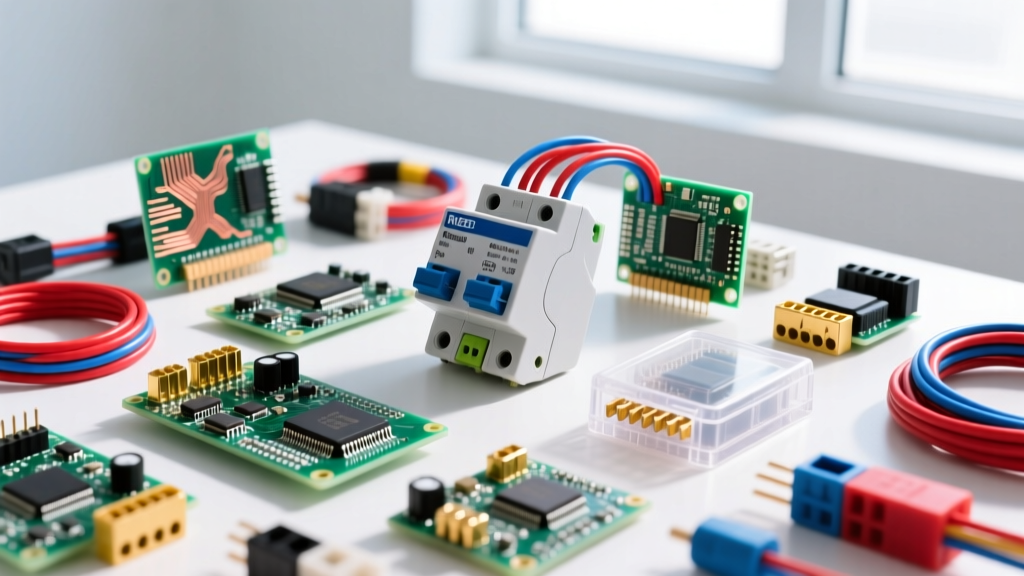
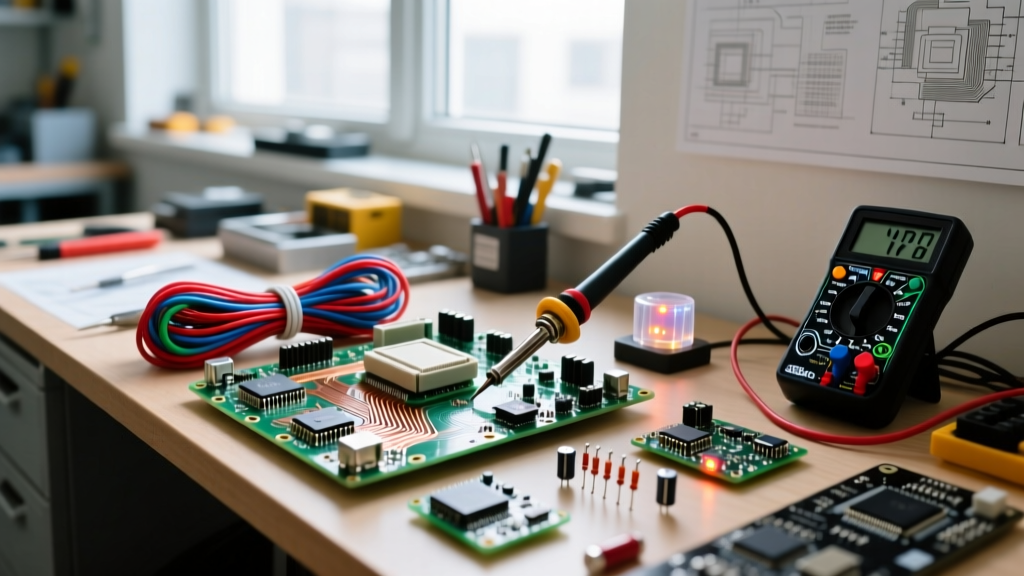
If you are moving raw power from the grid to a heavy load, electrical engineering wins; if you are processing data, reading sensors, or precisely switching signals, electronics wins. The two domains solve fundamentally different problems. Electrical systems are the 'muscle' designed to transport high energy with minimal loss, while electronic systems are the 'brain' designed to manipulate electron flow to compute, measure, and control. You cannot use a microcontroller to carry 200A of service entrance current, and you cannot use a 500 kVA transformer to compute a PID control loop. For high-power delivery, specify copper conductors and electromechanical breakers. For logic and control, specify silicon-based semiconductors and PCBs.
Choose Electrical When:
- Wiring a 240V 50A EV charger or sizing a home subpanel.
- Running 3-phase induction motors or heavy resistive heating elements.
- Your primary constraint is ampacity, voltage drop, and fault-current interruption.
Choose Electronics When:
- Building an MPPT solar charge controller logic board or a custom BMS.
- Programming an ESP32 for MQTT telemetry or reading I2C temperature sensors.
- Your primary constraint is signal integrity, switching speed, and logical state management.
The Single Physical Difference That Drives Everything
The entire electronics and electrical difference boils down to how the materials interact with electron flow. Electrical systems rely on conductors (like copper and aluminum) and insulators (like PVC and XLPE) to move electrons en masse from point A to point B. The goal is macro-level energy transport. According to the IEEE, electrical engineering traditionally focuses on the generation, transmission, and distribution of electrical power.
Electronics, conversely, relies on semiconductors (silicon, gallium nitride, silicon carbide). By doping silicon with specific impurities, we create materials that can dynamically change their conductivity based on an applied voltage or current. This allows electronic components to act as valves, amplifiers, and switches. The goal is micro-level control and information processing. While an electrical wire just lets current flow, a MOSFET decides when, how fast, and how much current flows based on a logic signal.
Head-to-Head Comparison: Electrical vs. Electronic Components
To spec the right parts for your build, you need to look at the physical and operational boundaries of each domain. Here is how they stack up across concrete engineering criteria.
| Criterion | Electrical Domain | Electronics Domain |
|---|---|---|
| Primary Function | Power transmission, distribution, and macro-work (motors, heat). | Signal processing, computation, data transmission, and micro-control. |
| Typical Voltage Range | 120V to 765,000V (AC/DC); >50V is the standard threshold. | 1.2V to 48V (DC); mostly 3.3V or 5V for logic. |
| Core Materials | Copper, aluminum, steel, PVC, XLPE, ceramic. | Silicon, GaN, SiC, FR4 fiberglass, gold, tin. |
| Heat Dissipation | Ambient air, oil baths, massive aluminum heat sinks. | Thermal vias, small extruded heatsinks, active cooling fans. |
| Example Component | Eaton BR250 50A Breaker, 6 AWG THHN Wire. | ESP32-WROOM-32, IRFZ44N MOSFET, 10kΩ Resistor. |
Where They Are Absolutely NOT Interchangeable
Confusing the two domains is the fastest way to destroy hardware or start a fire. The most common mistake hobbyists make is trying to use electronic components for electrical tasks, or vice versa.
Failure Mode 1: Using Electronics for Electrical Loads
An Arduino or ESP32 GPIO pin is rated for an absolute maximum of 40mA (with a recommended continuous limit of 20mA). If you attempt to wire a 12V 2A solenoid valve directly to a microcontroller pin, the silicon trace inside the IC will instantly vaporize. The microcontroller will permanently brick, and the plastic package may literally crack from the thermal shock. You must use an electronic switch (like a 2N2222 transistor or an IRFZ44N MOSFET) to handle the 2A load, driven by the 20mA GPIO signal.
Failure Mode 2: Ignoring Inductive Kickback (The Bridge Hazard)
When using an electronic transistor to switch an electrical inductive load (like a relay coil or a DC motor), turning the transistor off causes the magnetic field to collapse. This induces a massive reverse voltage spike (often hundreds of volts) that will punch through the semiconductor junction of your MOSFET or BJT, destroying it. The fix is strictly electronic: you must place a 1N4007 flyback diode in reverse parallel across the electrical coil to clamp the spike.
Failure Mode 3: Using Electrical Wire for High-Frequency Signals
Standard 14 AWG NM-B Romex is perfect for carrying 15A of 60Hz AC power to an outlet. But if you try to use it to carry a 50MHz SPI clock signal from a Raspberry Pi to an ADC, the unshielded parallel conductors will act as an antenna. The capacitance between the wires will round off the digital square waves, and electromagnetic interference (EMI) will corrupt your data. For high-frequency electronics, you must use controlled-impedance coaxial cables or properly routed PCB traces.
Cost, Sourcing, and Availability in 2026
The economics of these two domains are driven by entirely different global supply chains. Understanding this helps you budget and source parts effectively.
Electrical components are tied to commodity raw materials. The price of a 250-foot spool of 6 AWG THHN copper wire fluctuates directly with the London Metal Exchange copper index. As of early 2026, that spool costs roughly $160 to $210. Electrical gear is heavy, bulky, and expensive to ship. You buy it from local electrical supply houses (like Graybar or CED) or big-box hardware stores because freight costs eat into online savings.
Electronic components are tied to semiconductor fabrication yields. The price of an ESP32-WROOM-32 module is roughly $3.50, and a 500-pack of 0805 SMD resistors costs about $4.00. Electronic parts benefit from economies of scale and Moore's Law-adjacent pricing; the cost per function drops over time. They are lightweight and easily shipped globally via tape-and-reel from distributors like Mouser, Digi-Key, or directly from Shenzhen-based marketplaces.
When budgeting a project, expect the electrical infrastructure (wire, conduit, breakers, contactors) to consume 70% of your hardware budget, while the electronic control system (microcontrollers, sensors, PCBs) will consume the remaining 30%, despite doing the 'smart' work.
Decision Path: Picking the Right Domain for Your Build
Use this decision tree to select the exact component class for your next project step. Follow the logic until you hit a concrete part specification.
| If Your Goal Is... | And The Constraint Is... | Then Specify This Concrete Pick |
|---|---|---|
| Moving >50W of power over >1 meter | Must comply with NEC Article 310 ampacity rules | Electrical: 12 AWG NM-B copper wire on a 20A Eaton BR breaker. |
| Processing sensor data or running logic | Needs WiFi/BLE and operates at <5V DC | Electronics: ESP32-DevKitC V4 (3.3V logic, dual-core 240MHz). |
| Switching a 120VAC 10A heater via a 3.3V logic pin | Requires isolation between high voltage and low voltage | The Bridge: An Omron G3NA-210B Solid State Relay (SSR) with a 3-32VDC input. |
| Switching a 12V 5A DC water pump via a 5V logic pin | Needs fast PWM speed control for flow rate | The Bridge: An IRLB8721 logic-level N-channel MOSFET with a 10kΩ gate pulldown. |
| Stepping down 120VAC mains to 12VDC for a control board | Needs to be compact and efficient (>80%) | The Bridge: A Hi-Link HLK-PM01 5V/12V isolated AC-DC buck converter module. |
By respecting the boundary between power transport and signal control, you ensure your builds are both safe and functional. Always use electrical-rated gear for the heavy lifting, electronic-rated gear for the thinking, and properly spec'd driver circuits to let them talk to each other.