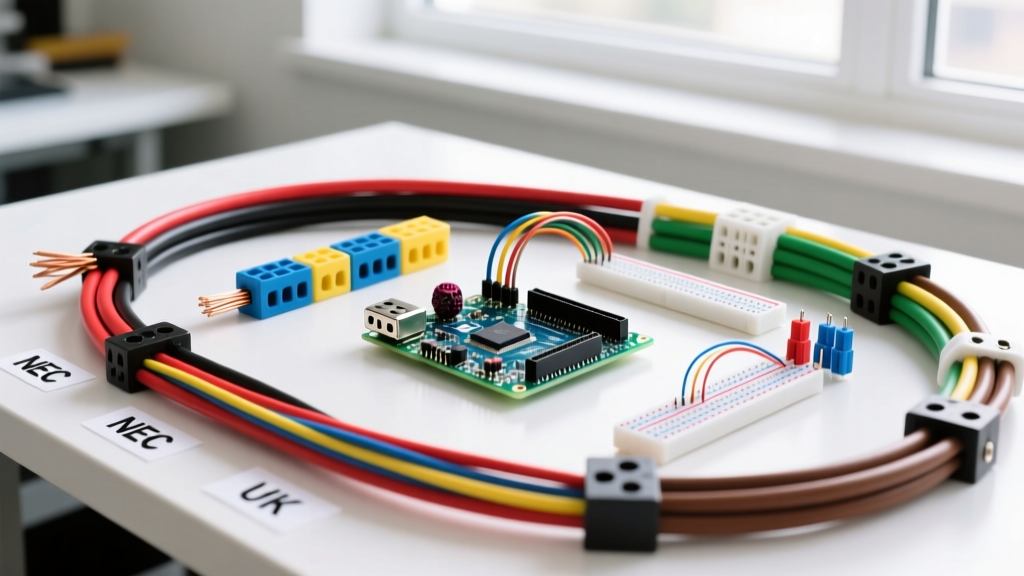

The electricity cable colour code dictates the function of a conductor, but the exact meaning of each colour depends entirely on your region's governing standard. North America follows the National Electrical Code (NEC), while Europe, the UK, and Australia follow IEC 60446 and harmonized regional standards like BS 7671. Below is the master reference chart to identify your wiring safely.
The Master Electricity Cable Colour Code Table
This table maps the primary conductor functions to their required insulation colours across the three most common global standards. Always verify which standard applies to your local Authority Having Jurisdiction (AHJ) before terminating any wires.
| Conductor Function | US & Canada (NEC) | Europe, UK & Aus (IEC 60446) | Old UK (Pre-2004 BS 7671) |
|---|---|---|---|
| Protective Earth (Ground) | Green, Green/Yellow, or Bare | Green/Yellow stripes | Green (or Green/Yellow) |
| Neutral (Grounded) | White or Grey | Light Blue | Black |
| Line 1 (Phase A / Hot) | Black (or Red/Blue in 3-phase) | Brown | Red |
| Line 2 (Phase B / Hot) | Red (or Black/Orange in 3-phase) | Black | Yellow |
| Line 3 (Phase C / Hot) | Blue (or Black/Brown in 3-phase) | Grey | Blue |
Regional Variants and the 'Rows People Get Wrong'
While the table above looks straightforward, jobsite realities and legacy wiring create severe hazards. The NEC (specifically Article 310.12 for grounded conductors and 250.119 for equipment grounding conductors) is strict about white/grey and green, but allows almost any other colour for ungrounded (hot) conductors. The NFPA National Electrical Code provides the baseline for North American inspectors, but local amendments can alter 3-phase colour requirements.
Here are the specific rows and scenarios where DIYers and even apprentice electricians make dangerous mistakes:
1. The Old UK Neutral Trap (Black vs. Blue)
If you are working in the UK or on imported legacy equipment, the pre-2004 colour code is a massive hazard. In the old UK standard, black was the neutral. In the modern IEC standard, black is Line 2 (Phase B). If you connect an old UK black neutral wire to a modern IEC black Phase B busbar, you will create a dead short or energize the neutral return path, risking catastrophic failure and electrocution. Always test UK wiring installed before April 2004 with a meter before trusting the jacket colour. The IET BS 7671 Wiring Regulations mandate clear warning labels at the consumer unit when old and new colours are mixed.
2. White Wire as a Switched Hot
In North American 3-way switch loops or older 2-wire switch drops, a white wire is often used to carry the switched hot back to the light fixture. Under NEC 200.7(C)(1), this is permitted only if the white wire is permanently re-identified with black or red electrical tape (or heat shrink) at every point where the conductor is visible and accessible. If you see a white wire with black tape on it, treat it as an ungrounded hot conductor, not a neutral.
3. Bare Copper in Flexible Cords vs. Fixed Wiring
In fixed building wiring (like NM-B Romex or THHN in conduit), a bare copper wire is universally the equipment grounding conductor. However, in some older imported flexible appliance cords or vintage audio equipment, a bare wire might be used as a shield or a signal return. Never assume a bare wire in a flexible, non-building cord is a safety ground without checking the appliance schematic.
Safe Interpretation for Faded, Unmarked, or Legacy Wiring
Insulation degrades. THHN wire exposed to UV light in an attic, or old cloth-covered wire in a 1950s home, will fade. White turns yellow/brown; black turns grey; red turns pink. When the electricity cable colour code is visually compromised, you must abandon visual identification and switch to electrical testing.
- De-energize and Lock Out: Turn off the breaker supplying the circuit. If you cannot identify the breaker, turn off the main disconnect.
- Verify Dead: Use a non-contact voltage tester (NCVT) to confirm the absence of voltage, then verify the NCVT is working on a known live source.
- Continuity Testing for Ground/Neutral: With the circuit de-energized, set your multimeter to continuity (ohms). Test between the unknown wire and the known grounding busbar in the panel. A reading of less than 1 ohm indicates a ground or neutral. To differentiate between the two, disconnect the main neutral bond (if qualified) or trace the wire physically to its termination.
- Live Testing for Hots: If you must identify a hot wire among several unmarked faded wires, restore power with extreme caution. Use a solenoid voltage tester (wiggy) or a CAT III multimeter. Measure from the unknown wire to a known, verified ground. A reading of ~120V (or ~230V in IEC regions) identifies the hot conductor.
- Re-identify Immediately: Once identified, wrap the faded wire with the correct coloured electrical tape or slip on colour-coded heat shrink tubing at both ends to restore the electricity cable colour code for the next person working on the panel.
Frequently Asked Questions
What is the electricity cable colour code for a 240V split-phase outlet?
In the US and Canada, a standard 240V split-phase circuit (like a dryer or oven receptacle) uses Black and Red for the two ungrounded hot legs (each carrying 120V to ground, 240V line-to-line). If the appliance requires a neutral (for 120V controls), a White wire is used. The equipment ground is Bare or Green. In a 3-wire setup without a neutral (like a baseboard heater), you will only see Black, Red, and Ground.
Can I use a green wire for anything other than ground?
No. NEC Article 250.119 strictly prohibits the use of green, green with yellow stripes, or bare conductors for anything other than the equipment grounding conductor. Using a green wire as a hot or neutral is a severe code violation and creates an immediate shock hazard for anyone who opens the junction box and assumes the green wire is safe to touch.
Why does my appliance cord have a blue wire instead of black?
Manufacturers often use globally harmonized power cords to save on supply chain costs. Even if you buy an appliance in the US, the internal wiring or the detachable IEC power cord (like a standard PC power cable) will likely follow the IEC 60446 standard: Brown for Live, Blue for Neutral, and Green/Yellow for Earth. When hardwiring an imported appliance in a US junction box, connect the Brown to your Black (hot), Blue to your White (neutral), and Green/Yellow to your Bare/Green (ground).
How do I test an unknown electricity cable colour code safely in a 3-phase panel?
In a 3-phase environment, colour codes can vary wildly depending on the facility's age and local amendments (e.g., Brown/Orange/Yellow vs. Black/Red/Blue in the US). Never guess. Put on appropriate arc-flash PPE, use a true-RMS CAT IV multimeter, and measure line-to-ground and line-to-line voltages. Line-to-ground will read ~120V or ~277V (depending on the system), while line-to-line will read ~208V or ~480V. Map the voltages first, then apply phase identification tape (Brown, Orange, Yellow for 120/208V; Brown, Orange, Yellow or Black, Red, Blue for 277/480V depending on local AHJ preference) to establish a consistent site-specific colour code.


