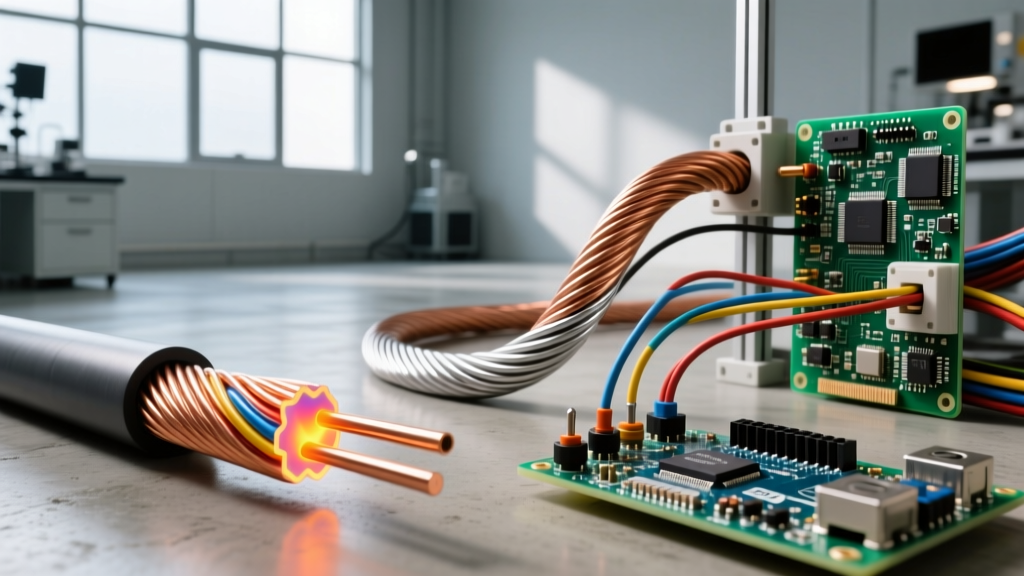

Electrical resistivity of materials is the intrinsic physical property that quantifies how strongly a specific substance opposes the flow of electric current, measured in ohm-meters (Ω·m). It sets the hard baseline for voltage drop and heat generation in any conductor before you even factor in the wire's length or gauge. In a real circuit, resistivity dictates whether your 12V solar feed will deliver usable power to a charge controller or just turn into a space heater. Beginners almost always confuse resistivity with resistance: think of resistivity as the material's "density" (a fixed property of copper or aluminum), while resistance is the "mass" of your specific wire spool (dependent on how much of it you use and how thick it is).
The Core Physics: Calculating the Baseline
To find the actual resistance ($R$) of a wire on your bench, you multiply the material's resistivity ($\rho$) by the length ($L$) and divide by the cross-sectional area ($A$). The formula is $R = \rho (L/A)$.
Let's run a worked numeric example to see how material choice forces your hand in wire sizing. Suppose you need to run a 100-meter feeder for a 30A subpanel and you are debating between 10 AWG copper and 10 AWG aluminum. The cross-sectional area of 10 AWG is 5.26 mm² (or $5.26 \times 10^{-6} m^2$).
- Copper: $\rho \approx 1.68 \times 10^{-8} \Omega\cdot m$. The resistance is $(1.68 \times 10^{-8} \times 100) / 5.26 \times 10^{-6} =$ 0.319 Ω.
- Aluminum: $\rho \approx 2.82 \times 10^{-8} \Omega\cdot m$. The resistance is $(2.82 \times 10^{-8} \times 100) / 5.26 \times 10^{-6} =$ 0.536 Ω.
Where You Meet This in Practice
You don't just deal with copper and aluminum. Depending on what you are building, you will intentionally select materials with high or low resistivity. Here is how the Georgia State University HyperPhysics database breaks down common conductors you will encounter at the hardware store or electronics supplier:
| Material | Resistivity (Ω·m at 20°C) | Where You Use It |
|---|---|---|
| Silver | $1.59 \times 10^{-8}$ | High-end audio switches, RF contacts (too expensive for general wiring). |
| Copper (Annealed) | $1.68 \times 10^{-8}$ | Standard NM-B romex, THHN branch circuits, PCB traces, motor windings. |
| Aluminum | $2.82 \times 10^{-8}$ | Mains service entrance feeders, heavy utility transmission lines. |
| Tungsten | $5.60 \times 10^{-8}$ | Incandescent bulb filaments (chosen specifically to run hot and glow). |
| Constantan | $4.90 \times 10^{-7}$ | Current shunt resistors, thermocouples (resistivity barely changes with heat). |
| Nichrome | $1.10 \times 10^{-6}$ | Toaster elements, 3D printer hotends, DIY foam cutters. |
Real-World Scenario Walkthrough: The Stalled 24V Winch
Ignoring resistivity's role in voltage drop is a classic way to fry low-voltage DC systems. Here is a teardown of a real failure.
- The Setup: A DIY off-road rig uses a 24V DC winch motor that draws 20A under normal load. The battery bank is mounted in the rear, requiring a 50-foot wire run to the front bumper. The builder uses standard 14 AWG copper wire for the positive and negative leads (100 feet total loop length).
- The Numbers: 14 AWG copper has an area of $2.08 \times 10^{-6} m^2$. The total loop length is 30.48 meters. Using copper's resistivity ($1.68 \times 10^{-8} \Omega\cdot m$), the total wire resistance is $0.246 \Omega$. At a 20A draw, the voltage drop is $20A \times 0.246\Omega = 4.92V$.
- The Outcome: The winch motor only receives 19.08V instead of 24V. Because DC motors draw more current when voltage sags and mechanical load remains constant, the motor struggles, slows down, and eventually stalls. At stall, the current spikes to 45A. The voltage drop instantly balloons to $45A \times 0.246\Omega = 11.07V$, and the wire dissipates over 500 watts of heat, melting the PVC insulation.
- What Went Wrong: The builder treated 14 AWG as "plenty thick" because it handles 20A thermally in a short jumper. They failed to calculate how the intrinsic resistivity of copper, multiplied by a 100-foot loop, would cripple a low-voltage system. The fix requires stepping up to 4 AWG wire, or better yet, moving to a 48V winch system to cut the current (and the voltage drop) in half.
How Temperature Derating Compounds the Problem
Resistivity is not a static number; it is highly temperature-dependent. For copper, the temperature coefficient of resistivity is roughly 0.0039 per °C. This means for every degree Celsius the wire heats up above 20°C, its resistivity increases by 0.39%.
If you bundle four 12 AWG THHN wires tightly inside a single conduit in a hot attic (ambient 45°C), the wires cannot shed heat. As current flows, the temperature rises, the resistivity climbs, the resistance increases, and the wire generates even more heat. This positive feedback loop is exactly why NEC Table 310.16 includes strict ampacity derating factors for bundled conductors and high ambient temperatures. You aren't just derating for the insulation melting point; you are derating to prevent the resistivity-induced thermal runaway from causing excessive voltage drop.
Frequently Asked Questions
Does a lower resistivity always mean a better wire?
For power transmission, yes. But for heating elements, fuses, or current-limiting resistors, you specifically want high-resistivity materials like Nichrome or Constantan so you can achieve the required resistance without needing miles of impossibly thin wire.
Why do utility companies use aluminum instead of copper for power lines?
While aluminum has higher electrical resistivity than copper, it is significantly lighter and cheaper. When you calculate the resistance-to-weight ratio, aluminum actually outperforms copper, allowing utilities to span longer distances between towers without the cables snapping under their own weight.
Can I mix copper and aluminum wire in a DC solar setup?
You can, but you must use specific bi-metallic lugs (like AlumiConn or rated MAC blocks). If you simply twist them together, galvanic corrosion will occur. This corrosion creates a high-resistivity oxide layer at the junction, leading to massive localized heating and a severe fire hazard.