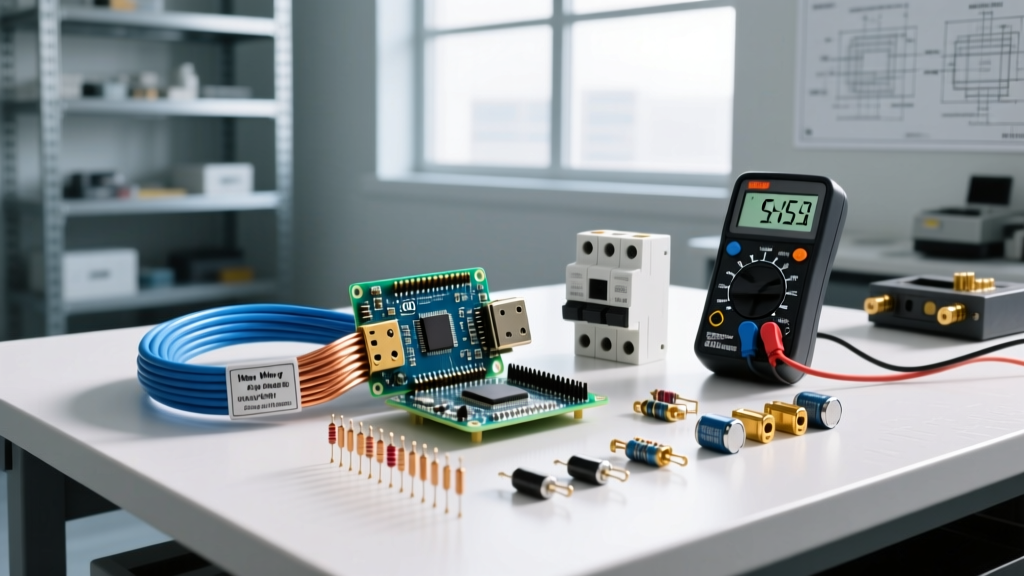
A Distributed Control System (DCS) is an automated control architecture that distributes processing power across localized, dedicated controllers connected via a high-speed network, rather than relying on a single centralized computer. In a real-world installation, this definition translates to a massive physical shift: instead of running thousands of field wires back to a single central control room, you place localized I/O (Input/Output) nodes and controllers directly on the plant floor, communicating back to the operator HMI (Human-Machine Interface) over a digital backbone. This fundamentally changes the installation by slashing copper costs, reducing voltage drop on analog signals, and eliminating single-point-of-failure bottlenecks.
Core Architecture: How Distributed Processing Changes the Installation
To understand the distributed control system definition in practice, you have to look at the hardware topology. A traditional centralized system forces every sensor, valve positioner, and motor starter to wire directly to a central marshalling cabinet. A DCS breaks this into four distinct, networked layers:
- Field Instruments: The physical sensors (thermocouples, pressure transmitters) and actuators (VFDs, control valves).
- Distributed I/O Nodes: Localized termination boards mounted in NEMA 4X or purged cabinets right next to the process equipment. They handle signal conditioning, A/D conversion, and galvanic isolation.
- Area Controllers: Ruggedized processors that execute the PID loops and logic for a specific unit operation (e.g., a single distillation column or boiler). If the network goes down, the area controller keeps the local process running safely.
- Operator Stations & Servers: The central control room HMIs, historians, and alarm servers connected via a redundant, deterministic Ethernet backbone.
By pushing the I/O and logic execution to the edge of the network, a DCS drastically reduces the scan time penalty associated with long analog wire runs and central processor queueing. Modern systems utilize protocols like PROFINET or proprietary deterministic Ethernet (such as Emerson's DeltaV PK) to guarantee packet delivery in under 2 milliseconds, which is critical for fast-acting safety and control loops.
The Math: Centralized vs. Distributed I/O Wiring Example
The strongest argument for a distributed architecture is found in the bill of materials and labor hours. Let’s look at a concrete numeric example involving a chemical batching skid located 150 meters from the main control room.
If we use a Centralized Architecture, we must run every single 4-20mA signal back to the main room. Because 500-pair cables do not exist in standard catalogs, we would pull five separate 100-pair, 16 AWG shielded twisted-pair instrumentation cables.
| Cost Factor | Centralized Architecture | Distributed Architecture |
|---|---|---|
| Field Cabling | 5 x 100-pair 16 AWG cables (750m total @ $15/m) = $11,250 | 1 x Redundant OM3 Multimode Fiber run (150m @ $2/m) = $300 |
| Power Feed | N/A (Powered centrally) | 120VAC local cabinet feed (10 AWG THHN, 150m) = $150 |
| Terminations | 1,000 wire terminations @ $4/ea = $4,000 | Fiber patch panels + local I/O cards = $850 |
| Cable Tray Sizing | Requires 18-inch wide tray (heavy copper load) | Requires 4-inch wide tray (light fiber/power load) |
| Total Estimated Material | $15,250+ | $1,300 |
By placing a local marshalling cabinet with ten 50-point I/O cards on the skid, we reduce the copper material cost by over 90%. More importantly, we eliminate the voltage drop and EMI (Electromagnetic Interference) susceptibility inherent in running 150 meters of low-level analog 4-20mA signals parallel to high-voltage VFD cables. The distributed node converts the analog signal to digital data immediately, rendering the 150-meter network run immune to electrical noise.
Where You Meet This in Practice
You will rarely see a true DCS in residential, commercial, or light-manufacturing settings; the overhead of the engineering database and hardware costs is unjustified for simple discrete logic. You will, however, encounter them in environments where continuous process control, high I/O counts, and absolute fault tolerance are mandatory:
- Oil & Gas Refineries: Managing thousands of temperature, pressure, and flow loops where a single controller failure could result in a catastrophic overpressure event. Systems like the Emerson DeltaV are standard here.
- Power Generation: Boiler turbine controls where sub-millisecond coordination between fuel valves and draft fans is required.
- Pharmaceutical Batch Processing: Where strict adherence to FDA 21 CFR Part 11 electronic signature and audit trail requirements is baked directly into the DCS HMI software.
- Modern Microgrids & Water Treatment: Increasingly, mid-sized municipal water plants and campus microgrids are adopting scaled-down DCS architectures to unify SCADA-level visibility with PLC-level local control in a single pane of glass.
When designing or maintaining these systems, cybersecurity is no longer an afterthought. Modern DCS installations must be hardened according to IEC 62443 standards, requiring strict network segmentation, unidirectional gateways (data diodes), and role-based access controls to prevent IT-network malware from crossing over into the OT (Operational Technology) control layer.
Frequently Asked Questions
What is the difference between a distributed control system and a PLC?
The primary difference lies in architecture, scan time, and integration. A PLC (Programmable Logic Controller) is optimized for high-speed, discrete logic (like packaging machines or assembly lines) with scan times measured in microseconds, and typically relies on a separate, third-party SCADA system for the HMI. A DCS is optimized for continuous, analog process control (like chemical mixing or temperature profiling) with scan times in the 10-100ms range. Crucially, a DCS is delivered as a unified ecosystem where the controller logic, HMI graphics, and alarm databases share a single, centralized engineering environment. If you change a tag name in a DCS controller, it automatically updates on the HMI; in a traditional PLC+SCADA setup, you must update both manually.
How does a distributed control system handle network cable failures?
A true DCS is designed with redundancy at every layer, especially the network backbone. The communication between the operator stations and the area controllers typically runs over a redundant, ring-topology Ethernet network. If a backhoe cuts the primary fiber optic cable, the network switches detect the link loss and automatically reroute traffic over the secondary redundant ring in under 50 milliseconds. Furthermore, the area controllers themselves possess local autonomy; if the connection to the central HMI is completely severed, the local controller continues to execute its PID loops and safety logic based on its last known setpoints, keeping the physical plant running safely until the operator can diagnose the network fault.
When should I choose a distributed control system over SCADA?
Choose a DCS when your process is continuous, highly analog, and carries significant safety or financial risk if a central computer crashes. SCADA is ideal for geographically dispersed, low-I/O-count infrastructure like oil pipelines, municipal water lift stations, or electrical substations, where the primary goal is remote monitoring and supervisory setpoint changes over low-bandwidth cellular or radio links. If your facility has more than 1,000 I/O points concentrated in a single physical plant, requires complex cascade PID tuning, and demands built-in regulatory audit trails, the International Society of Automation (ISA) frameworks heavily lean toward a DCS architecture to ensure deterministic control and integrated safety instrumented systems (SIS).