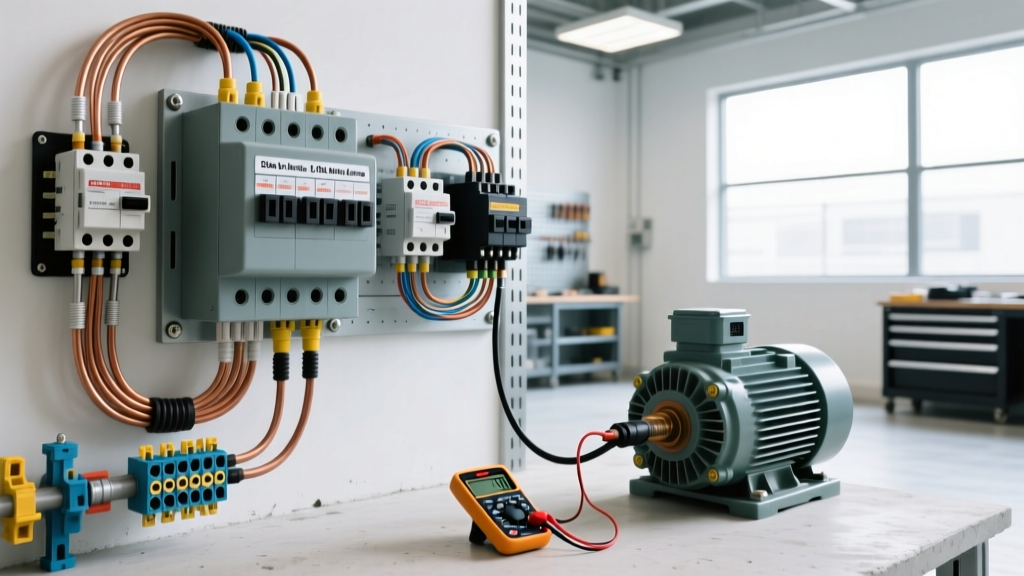
The definition of ampere (often shortened to 'amp' and symbolized as 'A') is the measure of electrical current, representing the flow rate of exactly one coulomb of electrical charge passing a specific point in a circuit per second. When you are sizing wire, selecting a breaker, or debugging a blown fuse, the ampere is the single most critical variable because it directly dictates the thermal stress placed on your conductors, terminals, and protective devices.
The Core Definition and the Math That Matters
Historically, the ampere was defined by the magnetic force between two infinite parallel wires. However, in 2019, the National Institute of Standards and Technology (NIST) and the global scientific community redefined the SI base units. Today, the ampere is defined by fixing the numerical value of the elementary charge (e) to be exactly 1.602176634 × 10⁻¹⁹ coulombs. In practical terms, 1 Ampere equals the flow of approximately 6.242 × 10¹⁸ electrons per second.
While the quantum physics definition is elegant, on the workbench and the jobsite, we rely on macroscopic circuit laws to find the ampere. You will use two primary formulas:
- Ohm's Law: I = V / R (Current equals Voltage divided by Resistance)
- Power Law: I = P / V (Current equals Power in Watts divided by Voltage)
Reference Table: Common Loads, Amp Draw, and Wire Sizing
To understand how the definition of ampere translates into physical hardware, review the table below. This data bridges the gap between theoretical current draw and the physical copper required to carry it safely.
| Device / Load Type | Nominal Voltage | Power (Watts) | Current Draw (Amperes) | Min. Copper Wire (AWG) | Standard Breaker / Fuse |
|---|---|---|---|---|---|
| LED Lighting Circuit (15 fixtures) | 120V AC | 180W | 1.5A | 14 AWG | 15A (AFCI) |
| Kitchen Toaster / Microwave | 120V AC | 1500W | 12.5A | 14 AWG (12 AWG preferred) | 20A |
| Electric Baseboard Heater | 240V AC | 1500W | 6.25A | 14 AWG | 15A (Double Pole) |
| 12V DC Compressor Fridge | 12V DC | 60W | 5.0A | 16 AWG (14 AWG for long runs) | 10A Blade Fuse |
| Off-Grid Solar Inverter | 12V DC | 1000W | 83.3A | 4 AWG (or 2 AWG for distance) | 100A ANL Fuse |
Note: Wire sizing assumes copper conductors in the 60°C to 75°C ampacity column per NEC Table 310.16, with an ambient temperature of 30°C (86°F). Always apply voltage drop calculations for runs exceeding 50 feet.
Worked Example: Sizing Wire for a 12V DC Solar Inverter
Let's look at a scenario where misunderstanding amperes leads to melted hardware. You are installing a 2000W pure sine wave inverter on a 12V LiFePO4 battery bank. A naive application of the Power Law (I = P / V) suggests:
2000W / 12V = 166.6 Amps.
If you size your wire for 167 Amps, you might choose 1/0 AWG copper and a 175A fuse. However, this ignores real-world electrical behavior. Here is what actually changes in the circuit under load:
- Inverter Efficiency: Inverters are not 100% efficient. A typical high-frequency inverter operates at about 90% efficiency under heavy load. The battery must supply 2000W / 0.90 = 2222W.
- Voltage Sag: Under a heavy 2000W load, the battery voltage will not sit at a resting 13.2V. It will sag to the low-voltage disconnect threshold, typically around 11.0V.
- Recalculating Amperage: I = 2222W / 11.0V = 202 Amps.
Where You Meet Amperes in Practice (and What Changes)
Understanding the definition of ampere is only the first step; recognizing how it behaves in physical installations is where the real expertise lies. What the ampere changes in a real installation is the physical scale of your hardware: higher current demands exponentially thicker copper, larger terminal lugs, and wider breaker busbars due to the I²R (current squared times resistance) heating effect.
1. Thermal Limits and Breaker Trip Curves
Circuit breakers do not measure watts; they measure heat generated by amperes. A standard 20A thermal-magnetic breaker will hold 20A indefinitely in a 40°C panel. But if you push 25A through it, the bimetallic strip heats up and bends, tripping the circuit in a few minutes. If a short circuit causes a massive spike to 500A, the magnetic solenoid trips it in milliseconds. The ampere dictates which trip mechanism activates.
2. Battery Management System (BMS) Limits
In DC solar and EV systems, the BMS monitors amperes, not just voltage. A 100Ah LiFePO4 battery might have a BMS rated for 100A continuous discharge. If you connect a 1500W inverter (drawing ~130A at 12V), the BMS will instantly shut off the circuit to protect the internal cells from lithium plating and thermal runaway, regardless of how much capacity the battery holds.
3. Voltage Drop in Long Runs
Every wire has resistance. When high amperes flow through undersized wire over long distances, voltage is lost as heat. For example, pushing 15A through 100 feet of 14 AWG copper results in a 3.7V drop on a 120V circuit. While 3.7V (about 3%) is generally acceptable, pushing that same 15A through 100 feet of 14 AWG on a 12V DC circuit drops 3.7V from your 12V supply, leaving only 8.3V at the load—causing DC motors to stall and LED drivers to flicker.
Frequently Asked Questions: Common Confusions
What is the difference between Amps and Watts?
Amperes measure the rate of flow of electrical charge, while Watts measure the total rate of work or power consumed. To use a single water analogy: Amps represent the flow rate of water through a pipe (gallons per minute), while Watts represent the total power delivered by the water, which is a combination of the flow rate (Amps) multiplied by the water pressure (Volts). A high-voltage, low-amp circuit (like a 240V baseboard heater drawing 6A) can deliver the exact same wattage as a low-voltage, high-amp circuit (like a 12V car headlight drawing 120A).
What is the difference between Amps and Amp-Hours (Ah)?
An Ampere is an instantaneous rate of flow. An Amp-Hour is a measure of total capacity over time. If a circuit draws a steady 5 Amps for 2 hours, it has consumed 10 Amp-Hours. Continuing the water analogy, if Amps are the gallons-per-minute flowing out of a hose, Amp-Hours represent the total gallon capacity of the water tank feeding it. Never confuse a battery's Amp-Hour rating (capacity) with its maximum Ampere discharge rating (flow limit).
Why do we use thicker wires for higher amps if voltage is what pushes the current?
Voltage provides the electromotive force to push electrons, but it is the amperage that generates physical heat in the conductor. The heat generated in a wire is calculated by the formula P = I²R (Power loss equals Current squared multiplied by Resistance). Because the current is squared, doubling the amperage quadruples the heat generated. Therefore, the physical diameter (gauge) of the wire is chosen almost entirely based on the maximum expected amperes to keep the insulation from melting, with voltage primarily dictating the thickness of the insulation jacket rather than the copper inside.