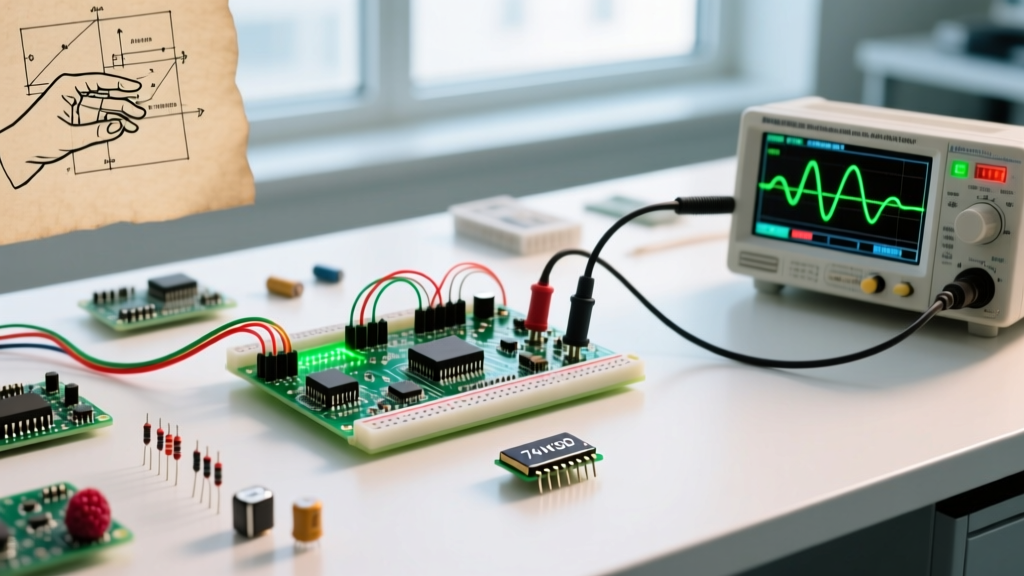
In physics, a harmonic is defined as a wave or signal whose frequency is an exact integer multiple of a fundamental base frequency, which superimposes onto the original wave to alter its overall shape. When we apply this definition of harmonics in physics to electrical engineering and AC power systems, it explains why the clean 60 Hz (or 50 Hz) sine wave from the utility gets chopped, flattened, or distorted by the time it reaches your equipment. People commonly confuse harmonics with voltage transients or spikes; however, transients are sudden, non-periodic microsecond events (like a lightning strike or capacitor switching), whereas harmonics are continuous, periodic distortions locked mathematically to the fundamental frequency.
The Physics and Math Behind Harmonic Frequencies
To understand the definition of harmonics in physics, picture a plucked guitar string. The string vibrates at its fundamental frequency to produce the primary note, but it simultaneously vibrates in halves, thirds, and quarters, producing overtones (harmonics) at 2x, 3x, and 4x the base frequency. In AC power, non-linear loads act like a bow dragging unevenly across that string. Instead of drawing current in a smooth, continuous sine wave, devices like switch-mode power supplies and variable frequency drives (VFDs) draw current in abrupt, high-amplitude pulses near the peak of the voltage waveform. This non-linear current draw creates harmonic frequencies that propagate back into the electrical system.
Let us look at a concrete numeric example to see how these integer multiples combine and alter the true power delivery in a circuit.
Assume a standard 120V, 60 Hz single-phase circuit powering a heavily non-linear load (like a bank of LED drivers). Your power quality analyzer reads the following voltage components:
- Fundamental (V1): 120.0 V at 60 Hz
- 3rd Harmonic (V3): 15.0 V at 180 Hz
- 5th Harmonic (V5): 8.0 V at 300 Hz
To find the True RMS voltage, we use the root-sum-square formula:
Vrms = √(V1² + V3² + V5²)
Vrms = √(120² + 15² + 8²)
Vrms = √(14400 + 225 + 64)
Vrms = √(14689) = 121.2V
Even though the fundamental is 120V, the True RMS is 121.2V. The Total Harmonic Distortion (THD) is calculated as:
THD = (√(V3² + V5²) / V1) × 100
THD = (√(225 + 64) / 120) × 100
THD = (17 / 120) × 100 = 14.16% THD
Note: The latest IEEE 519-2022 standard recommends keeping voltage THD below 8% for general distribution systems to prevent equipment malfunction.
What Harmonics Change in a Real Electrical Installation
Harmonics are not just a theoretical physics concept; they fundamentally change how current flows and how heat dissipates in a real electrical installation. The most severe impacts occur in three specific areas:
1. Neutral Conductor Overheating (Triplen Harmonics)
In a balanced 3-phase wye system, the fundamental 60 Hz currents are 120 degrees out of phase and cancel each other out on the neutral wire, resulting in near-zero neutral current. However, 'triplen' harmonics (3rd, 9th, 15th) are in-phase with each other. Instead of canceling, they add up arithmetically on the neutral conductor. A neutral wire can end up carrying up to 1.73 times the phase current, leading to melted insulation and fire hazards if the neutral was not sized at 200% capacity.
2. Transformer Derating and Eddy Currents
Harmonic currents induce eddy currents in transformer cores and windings. The physics of electromagnetic induction dictates that eddy current losses scale with the square of the harmonic frequency (h²). Therefore, a 5th harmonic current (300 Hz) generates 25 times more eddy current heating than the same amplitude of fundamental current (60 Hz). This forces facilities to use specialized 'K-factor' transformers or severely derate standard transformers.
3. Motor Vibration and Insulation Breakdown
Negative sequence harmonics (like the 5th and 11th) create a reverse-rotating magnetic field in AC induction motors. This fights the fundamental forward-rotating field, causing severe mechanical vibration, bearing wear, and localized overheating in the stator windings.
| Harmonic Order | Frequency | Phase Sequence | Primary Physical Effect |
|---|---|---|---|
| 1st (Fundamental) | 60 Hz | Positive | Useful work / torque |
| 3rd | 180 Hz | Zero (Triplen) | Neutral wire overheating |
| 5th | 300 Hz | Negative | Motor vibration / reverse torque |
| 7th | 420 Hz | Positive | Motor overheating |
| 9th | 540 Hz | Zero (Triplen) | Neutral wire overheating |
Where You Meet Harmonics in Practice (and How to Mitigate Them)
You will rarely encounter harmonics from the utility grid itself; they are almost entirely generated on the customer side of the meter by non-linear loads. Here is where you meet this in practice on the jobsite or in the workshop:
- Variable Frequency Drives (VFDs): Standard 6-pulse VFDs (like the ABB ACS580 series) use diode rectifiers that chop the AC waveform into DC. This process inherently generates heavy 5th and 7th harmonic currents. Fix: Install a 3% to 5% impedance line reactor on the input side of the drive, or specify an 18-pulse drive or Active Front End (AFE) for large motors.
- Data Center UPS and Switch-Mode Power Supplies (SMPS): Thousands of servers drawing current only at the peak of the voltage wave create massive 3rd harmonic accumulation. Fix: Use K-13 or K-20 rated transformers and oversize the neutral busbars in the PDU (Power Distribution Unit).
- Commercial LED Lighting: Cheap, uncorrected LED drivers are notorious for poor power factor and high THD. Fix: Specify LED drivers with active power factor correction (PFC) that guarantee less than 20% THD at the circuit level.
- Solar Inverters: While modern string inverters are highly filtered, failing or degraded DC-link capacitors inside the inverter can cause harmonic leakage back into the grid. Fix: Routine power quality logging using a tool like the Fluke 435 Series II analyzer to catch degradation before the utility issues a penalty.
Frequently Asked Questions About Harmonics in Physics
What is the difference between harmonics and interharmonics in physics?
By the strict definition of harmonics in physics, a harmonic must be an exact integer multiple of the fundamental frequency (e.g., 120 Hz, 180 Hz). Interharmonics, on the other hand, are frequencies that are non-integer multiples of the fundamental (e.g., 95 Hz or 210 Hz). Interharmonics are typically caused by cycloconverters, arc furnaces, and induction motors during startup, and they are much harder to filter out because they do not align with the zero-crossings of the fundamental wave, often causing severe light flicker and sub-synchronous resonance.
Why do triplen harmonics overload the neutral wire in a 3-phase system?
In a 3-phase system, the fundamental currents (1st, 7th, 13th) are separated by 120 electrical degrees. When they return through the neutral, their vector sum is zero. However, triplen harmonics (3rd, 9th, 15th) have a phase shift that is a multiple of 360 degrees (3 × 120° = 360°). This means the 3rd harmonic currents from Phase A, Phase B, and Phase C are perfectly in-phase with one another. Instead of canceling out, they add together arithmetically, forcing the neutral conductor to carry the sum of all three phase harmonic currents.
How do you measure the total harmonic distortion (THD) of a circuit?
You cannot measure THD accurately with a standard digital multimeter, as standard meters only read the fundamental frequency or use an averaging method that misses high-frequency distortion. You must use a True-RMS Power Quality Analyzer (such as a Fluke 434 or 435). These devices sample the waveform at high speeds (e.g., 256 samples per cycle), perform a Fast Fourier Transform (FFT) to break the wave down into its individual harmonic frequencies, and calculate the ratio of the sum of the harmonic energies to the fundamental energy.
Can harmonics in physics cause a circuit breaker to trip?
Yes, but usually indirectly through thermal accumulation rather than instantaneous magnetic tripping. Harmonics increase the True RMS current flowing through the circuit. If the True RMS current exceeds the breaker's continuous thermal rating, the bimetallic strip inside a thermal-magnetic breaker will heat up and trip the circuit over time. Additionally, harmonics can cause 'nuisance tripping' in sensitive electronic trip units (LSIG breakers) if the high-frequency peaks confuse the breaker's microprocessor sampling circuit, causing it to misinterpret the peak current as a short-circuit event.