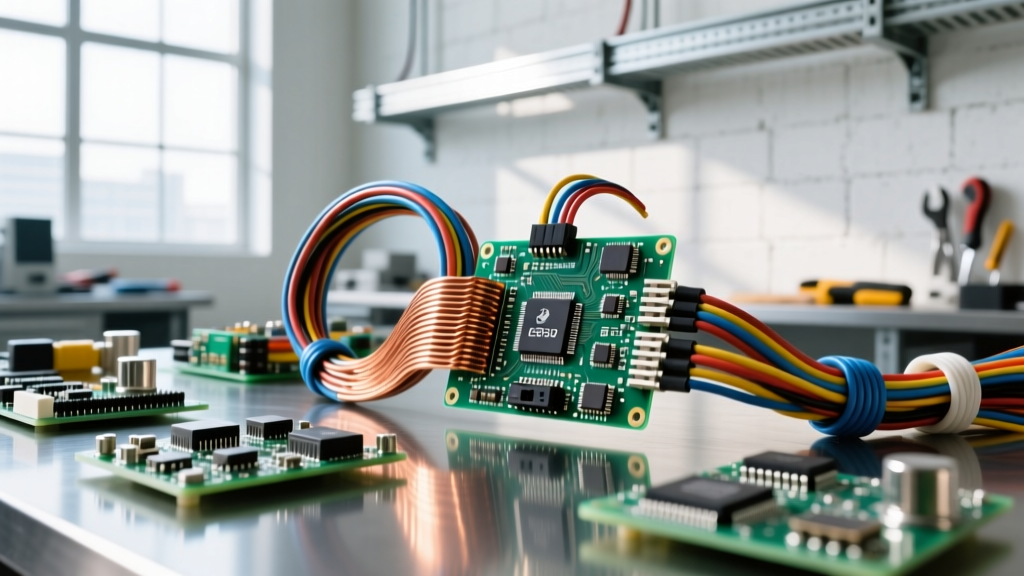
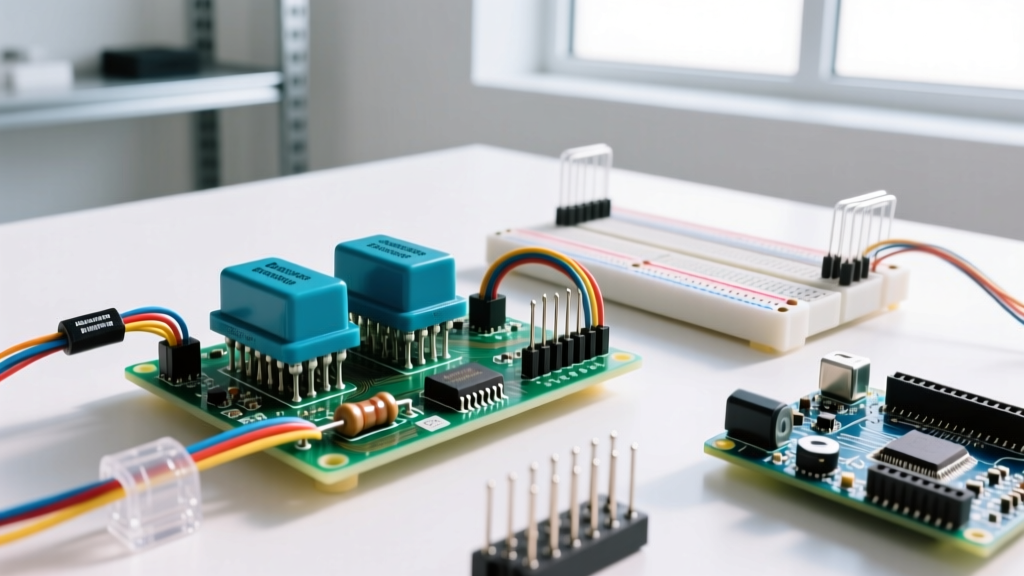
When deciding between conductive and insulating materials for a circuit, the "winner" depends entirely on your goal: use conductors (like oxygen-free copper or aluminum) when you need to move electrical current with minimal loss, and use insulators (like PTFE/Teflon or XLPE) when you need to contain that current, prevent short circuits, and protect users from shock. There is no middle ground in standard wiring; a material is either chosen to carry the load or to block it, and attempting to use a poor conductor as a wire or a leaky insulator as a dielectric will result in immediate thermal failure or fire.
The Single Physical Difference That Drives Everything
The single physical difference that dictates whether a material acts as a conductor or an insulator is the energy bandgap between its valence band (where electrons are bound to atoms) and its conduction band (where electrons are free to move and carry current).
In conductors, these two bands overlap. There is zero energy barrier, meaning valence electrons easily detach and form a "sea of electrons" that drift when a voltage is applied. In insulators, there is a massive bandgap (typically greater than 3 to 4 electron volts). The electrons are tightly locked to their parent atoms, and standard electrical forces cannot rip them free to create a current. This atomic architecture dictates every other property we measure on the bench, from resistivity to thermal behavior.
Below is a data-dense breakdown of common bench and jobsite materials. Notice the exponential leap in resistivity once we cross from conductors into insulators.
| Material | Classification | Electrical Resistivity (Ω·m) | Energy Bandgap (eV) |
|---|---|---|---|
| Silver (Ag) | Conductor | 1.59 × 10⁻⁸ | 0 (Overlapping bands) |
| Copper (Cu) | Conductor | 1.68 × 10⁻⁸ | 0 (Overlapping bands) |
| Aluminum (Al) | Conductor | 2.82 × 10⁻⁸ | 0 (Overlapping bands) |
| Silicon (Si) | Semiconductor | ~6.4 × 10² | 1.1 |
| PVC (Polyvinyl Chloride) | Insulator | 10¹³ to 10¹⁵ | ~4.5 to 5.0 |
| PTFE (Teflon) | Insulator | > 10¹⁸ | ~8.0 |
| Borosilicate Glass | Insulator | 10¹⁰ to 10¹⁴ | ~5.0 to 9.0 |
Source: Georgia State University HyperPhysics material property tables.
Head-to-Head Comparison: Conductors vs. Insulators
While the bandgap is the root cause, the macroscopic behaviors of these materials differ drastically under real-world electrical and thermal stress. Here is how they compare across five concrete criteria.
| Criteria | Conductors | Insulators |
|---|---|---|
| Primary Function | Transport charge carriers (current) from source to load. | Block charge carriers; confine electric fields and prevent leakage. |
| Resistivity Range | Less than 10⁻⁵ Ω·m | Greater than 10⁸ Ω·m |
| Temperature Coefficient | Positive: Resistance increases as temperature rises (due to lattice scattering). | Negative: Resistance drops as temperature rises (thermal energy excites electrons across the bandgap). |
| Failure Mode Under Overload | Melts, vaporizes, or anneals, typically tripping a breaker or blowing a fuse first. | Dielectric breakdown, carbon tracking, and arc flash; often catastrophic and irreversible. |
| Cost & Availability | High material cost (Copper is ~$4.00-$5.00/lb in 2026); subject to global commodities trading. | Low material cost for standard polymers (PVC/PE); extruded continuously. Specialty insulators (PTFE) are expensive. |
When to Choose Which
- Choose Conductors when: You are building busbars, winding motor coils, routing branch circuits (like pulling THHN through conduit), designing PCB traces, or creating low-resistance shunt resistors for current measurement.
- Choose Insulators when: You are extruding wire jackets (like the sheath on NM-B Romex), building capacitor dielectrics to store energy in an electric field, isolating high-voltage transformer windings, or mounting components on a fiberglass (FR4) breadboard.
Where They Are NOT Interchangeable (And Failure Modes)
A common beginner mistake is assuming that a "poor conductor" can be used as a high-resistance wire, or a "weak insulator" can be used for low-voltage isolation. In practice, they are strictly not interchangeable outside of highly engineered edge cases like semiconductors.
The Danger of Dielectric Breakdown
Insulators do not just "leak" when pushed too hard; they fail catastrophically. Every insulator has a dielectric strength, measured in kilovolts per millimeter (kV/mm). Standard PVC insulation breaks down at roughly 40 kV/mm. If you apply a voltage gradient that exceeds this threshold, the electric field physically rips electrons from their atoms, ionizing the material.
This creates a conductive plasma channel—an arc. More importantly, the intense heat of the arc carbonizes the polymer. Carbon is a conductor. Once an insulator carbon-tracks, it permanently becomes a conductor, even after the voltage is removed. This is why a GFCI or AFCI breaker that has experienced a severe internal arc fault must be replaced; the internal plastic housing has likely carbonized and lost its insulating properties.
Cost and Commodity Dynamics
You cannot substitute materials based purely on price without respecting their physics. Copper accounts for roughly 80% of the cost of a standard spool of THHN wire. It is tempting to use aluminum to save money, and for feeder cables larger than 2 AWG, aluminum (like XHHW-2) is standard practice. However, you cannot simply swap aluminum for copper on a 15A or 20A branch circuit without upsizing the wire and ensuring your termination lugs are rated for aluminum (CO/ALR). Aluminum creeps under pressure and oxidizes rapidly, which is a mechanical and chemical failure mode that copper does not share. For more on proper termination and wire sizing, refer to the NFPA 70 (National Electrical Code) guidelines on conductor ampacity and termination provisions.
Real-World Material Selection & Cost Breakdown
On the workbench and the jobsite, you rarely buy raw "conductors" or "insulators." You buy engineered composites where the two are permanently bonded. Here is how to select the right combination for your project.
Standard Jobsite Wiring (NM-B and THHN)
- Conductor: Soft-drawn, uncoated copper. Excellent conductivity, easy to bend, and holds screw terminations tightly.
- Insulator: PVC (Polyvinyl Chloride) with a nylon jacket for THHN, or bare PVC for NM-B. Rated for 90°C in dry locations. A 500-foot spool of 12 AWG THHN costs around $160 to $190 in 2026. The PVC insulation adds less than $5 to the total manufacturing cost of that spool.
High-Temperature and Aerospace (PTFE / Teflon)
- Conductor: Silver-plated copper. The silver prevents the copper from oxidizing at high temperatures and leverages the skin effect at high frequencies.
- Insulator: PTFE (Teflon). With an 8.0 eV bandgap and a melting point of 327°C, PTFE will not melt when you touch a 400°C soldering iron to the wire. It is highly resistant to chemical solvents and flux. The trade-off is cost: PTFE-insulated hook-up wire can cost 5x to 10x more than standard PVC wire per foot.
Underground and Wet Locations (XLPE)
- Conductor: Copper or Aluminum.
- Insulator: Cross-Linked Polyethylene (XLPE). Standard PVC becomes brittle and absorbs moisture over time when buried. XLPE is chemically cross-linked, giving it superior dielectric strength in wet environments and allowing it to handle higher short-circuit temperatures (up to 250°C for short durations) without melting. This is the standard insulation for USE-2 and XHHW-2 cables.
Understanding what the difference between conductors and insulators is at the atomic level prevents costly mistakes on the bench. Always respect the bandgap: let the copper carry the current, and let the polymer take the heat and voltage stress. For deeper reading on how these materials behave in direct current circuits, All About Circuits provides an excellent foundational breakdown of electron flow and atomic structure.