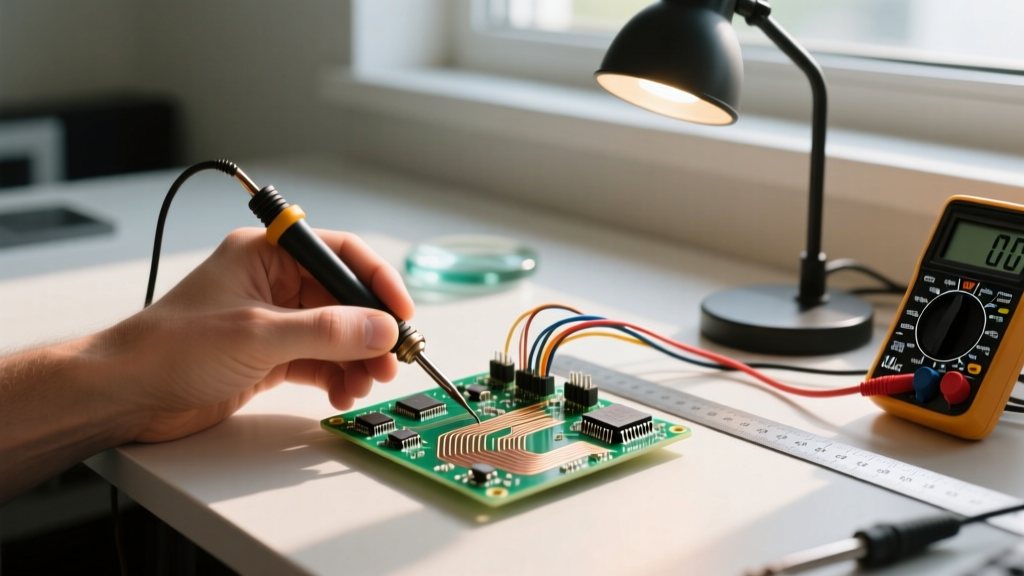
Conductors allow electrons to flow freely due to overlapping energy bands, semiconductors require a specific energy threshold to conduct, and insulators tightly bind their electrons to block current flow. This fundamental trio dictates every design choice in electrical and electronic systems, from the 10 AWG copper feeding your subpanel to the silicon die inside your ESP32-S3 and the PVC jacket keeping you from getting shocked.
Common confusion: Makers often mistake high-value resistors or 'poor conductors' (like carbon) for semiconductors. Semiconductors are defined by their tunable bandgap and non-linear voltage-current relationship, not just high resistance.
The Bandgap Divide: How Materials Control Current
To understand why materials behave differently, you have to look at band theory. Electrons in a solid occupy specific energy levels. The 'valence band' is where electrons are bound to atoms, and the 'conduction band' is where they are free to move and carry current. The gap between them is the bandgap.
- Conductors: The valence and conduction bands overlap. There is zero bandgap (0 eV). Electrons move freely with almost any applied voltage.
- Semiconductors: There is a small, specific bandgap (typically 0.5 to 3.0 eV). At absolute zero, they act like insulators. At room temperature, or when doped with impurities, thermal or electrical energy pushes electrons across the gap.
- Insulators: The bandgap is massive (typically >5 eV). Normal circuit voltages cannot provide enough energy to push electrons into the conduction band.
| Material | Classification | Bandgap (eV) | Resistivity (Ω·m at 20°C) |
|---|---|---|---|
| Copper (Cu) | Conductor | 0 (Overlap) | 1.68 × 10⁻⁸ |
| Aluminum (Al) | Conductor | 0 (Overlap) | 2.65 × 10⁻⁸ |
| Silicon (Si) | Semiconductor | 1.11 | 6.40 × 10² |
| Silicon Carbide (SiC) | Wide-Bandgap Semi | 3.26 | Varies by doping |
| PVC (Polyvinyl Chloride) | Insulator | ~8.0 | 1.00 × 10¹³ |
| Glass | Insulator | ~9.0 | 1.00 × 10¹² |
Worked Example: Conductor Voltage Drop vs. Insulator Leakage
Let's put real numbers to these material properties to see how they behave in a standard 600V, 30A branch circuit using 50 feet of 10 AWG THHN copper wire.
The Conductor (Copper):
10 AWG copper has a resistance of approximately 1.0 ohm per 1,000 feet. For a 50-foot run, the total loop length (out and back) is 100 feet, giving a total wire resistance of 0.1 ohms.
Using Ohm's Law (V = I × R), the voltage drop at 30A is:
V_drop = 30A × 0.1Ω = 3.0V
The power dissipated as heat in the conductor is P = I²R = 90W. This is why NEC ampacity tables limit 10 AWG to 30A or 35A depending on the temperature column; the conductor's low resistivity still generates heat at high currents.
The Insulator (PVC Jacket):
The PVC insulation is 1mm thick (0.001m). The surface area of the insulation on a 50-foot (15.24m) wire with a roughly 5mm diameter is about 0.024 m².
Using the resistivity formula R = ρ(L/A), where ρ is 1.0 × 10¹³ Ω·m:
R_insulator = (1.0 × 10¹³ × 0.001) / 0.024 = 4.16 × 10¹¹ ohms
At a maximum circuit voltage of 600V, the leakage current through the insulation is I = V/R:
I_leakage = 600V / 4.16 × 10¹¹Ω = 1.44 × 10⁻⁹ A
This yields a leakage current of just 1.44 nanoamps. This negligible current is what keeps the circuit safe and prevents the breaker from tripping due to ground faults.
Where You Meet Conductors, Semiconductors, and Insulators in Practice
Understanding the energy bands of these materials translates directly to the components on your workbench.
Conductors: The Arteries of the Circuit
You use conductors whenever you need to move power or signals from point A to point B with minimal loss. In home wiring, this is your NM-B (Romex) and THHN copper. In electronics, it's the copper traces on your PCB, the gold-plated pins on your ESP32 headers, and the aluminum electrolytic capacitor foils. When sizing conductors, you are always managing the trade-off between the material's natural resistivity and the physical cross-sectional area (AWG) required to keep voltage drop under 3%.
Semiconductors: The Active Controllers
Think of a semiconductor like a highway toll booth. In a conductor, the gates are always open and traffic (electrons) flows freely. In an insulator, the toll plaza is abandoned and the road is blocked. In a semiconductor, the gates are closed by default, but if you pay the exact toll (apply the correct forward bias voltage, like 0.7V for a silicon diode or the threshold voltage for a MOSFET gate), the gates open and traffic flows.
You meet semiconductors in every active component: the PN junctions in your 1N4007 rectifier diodes, the N-channel MOSFETs (like the IRFZ44N) switching your high-current LED strips, and the billions of microscopic transistors inside a Raspberry Pi 5's BCM2712 processor. Modern power electronics increasingly rely on wide-bandgap semiconductors like Silicon Carbide (SiC) and Gallium Nitride (GaN) to handle higher voltages and switch faster than traditional silicon.
Insulators: The Safety and Isolation Boundaries
Insulators do the critical job of keeping current exactly where you want it. You meet them in the PVC or XLPE jackets on wire, the FR-4 fiberglass substrate of your PCBs, the ceramic standoffs holding your busbars, and the plastic housing of your relays. In high-voltage or sensitive analog circuits, insulators also provide galvanic isolation, such as the glass or air gap inside an optocoupler that allows a 3.3V microcontroller to safely switch a 240V AC contactor without sharing a ground reference.
Common Confusions and Edge Cases
When working at the bench, the lines between these three categories can sometimes blur due to environmental factors or material quirks.
- Carbon (Graphite) is a non-metal conductor: Many hobbyists assume all non-metals are insulators or semiconductors. Graphite, however, has a unique crystal structure that gives it overlapping bands, making it a true conductor. This is why carbon track potentiometers work and why carbon dust can cause short circuits in motor brushes.
- Dielectric Breakdown: Insulators are not absolute barriers. If the electric field exceeds the material's dielectric strength (measured in kV/mm), it will violently rip electrons from their atoms, turning the insulator into a plasma conductor. This is how spark plugs fire and why a 15kV static shock can jump a 5mm air gap (air is normally an insulator).
- Temperature Inversion: Conductors get more resistive as they heat up (positive temperature coefficient) because atomic lattice vibrations scatter electrons. Semiconductors get less resistive as they heat up (negative temperature coefficient) because thermal energy excites more electrons across the bandgap. This thermal runaway is a primary failure mode in paralleled MOSFETs if not properly managed with source resistors.
Frequently Asked Questions
Why do semiconductors conduct better when they get hot, while conductors conduct worse?
In conductors like copper, heat causes the atomic lattice to vibrate more violently, which physically scatters the free-flowing electrons and increases resistance. In semiconductors, the primary bottleneck isn't scattering; it's the lack of free electrons. Heat provides the thermal energy needed to push more valence electrons across the bandgap into the conduction band, exponentially increasing the number of charge carriers and lowering the overall resistance.
Can an insulator ever become a conductor in a home wiring system?
Yes, through dielectric breakdown or thermal degradation. If a wire is overloaded and the breaker fails to trip, the heat can melt and carbonize the PVC insulation. Carbon is a conductor, so the degraded insulation will begin to leak current, potentially causing an arc fault. Additionally, if voltage spikes (like a nearby lightning strike) exceed the insulation's dielectric strength, it will puncture the material, creating a permanent conductive path.
What is the difference between a semiconductor and a resistor?
A resistor is a passive component designed to provide a specific, linear resistance to current flow, usually made from carbon film or metal oxide. Its resistance remains relatively constant regardless of the voltage applied. A semiconductor is an active material whose conductivity is highly non-linear and can be dynamically controlled by external factors like applied voltage (in a MOSFET), light (in a photodiode), or temperature. Resistors limit current; semiconductors switch, amplify, and rectify it.
Why is silicon used for semiconductors instead of germanium in modern power electronics?
Germanium was used in early transistors, but it has a very small bandgap (0.67 eV). This means it starts to leak significant current and lose its semiconducting properties at relatively low temperatures (around 85°C). Silicon has a wider bandgap (1.11 eV), allowing it to operate reliably up to 150°C or higher. For modern high-power and high-temperature applications, wide-bandgap materials like Silicon Carbide (SiC, 3.26 eV) are replacing silicon because they can handle even higher voltages and temperatures with lower switching losses.