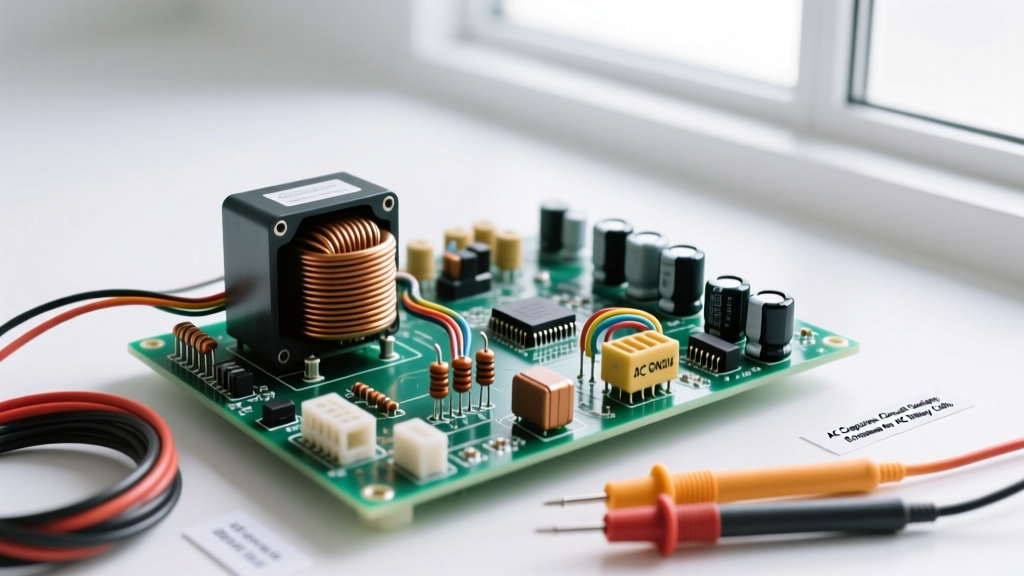
If you are designing a high-voltage DC energy storage system, you must answer a fundamental physics question first: is charge across capacitors in series the same? The short answer is yes. In a series capacitor string, the electrical charge ($Q$, measured in Coulombs) on every individual capacitor is identical ($Q_{total} = Q_1 = Q_2 = Q_3$). Because $Q = C \times V$, the voltage across each capacitor divides inversely proportional to its capacitance.
While this is a basic textbook rule for ceramic capacitors on a breadboard, it becomes a critical engineering constraint when wiring 300F supercapacitors (ultracapacitors) into a 48V energy storage bank. If your cells are mismatched by even 5%, the smaller cell will absorb a higher voltage share, exceed its 2.7V maximum, and violently vent electrolyte. In this guide, we will contrast the physics of series/parallel supercapacitor banks against LiFePO4 lithium battery banks, run the sizing math for a 3000W off-grid load, and give you a concrete decision path for your next build.
Series vs. Parallel Consequences: Capacitors vs. Lithium Cells
When scaling up to 48V nominal systems, the rules for manipulating voltage and capacity differ drastically between electrochemical batteries and electrostatic capacitors. Batteries are rated in Amp-hours (Ah); capacitors are rated in Farads (F) and maximum voltage.
| Metric | LiFePO4 Battery String (16S) | Supercapacitor String (18S) |
|---|---|---|
| Base Cell Spec | 3.2V, 100Ah, 280W Prismatic | 2.7V, 300F, 35mΩ ESR Cylindrical |
| Series Consequence | Voltage multiplies (51.2V). Ah remains 100Ah. | Voltage multiplies (48.6V max). Capacitance divides (16.6F total). |
| Parallel Consequence | Voltage stays 51.2V. Ah multiplies. | Voltage stays 2.7V. Capacitance multiplies. |
| Charge Equality | Current (A) is identical in series; Ah balances via BMS. | Charge (Q) is identical in series; Voltage balances via resistors/active ICs. |
Sizing Math: Peukert’s Law, C-Rates, and Efficiency Factors
Let’s size a storage bank for a 3000W continuous AC load. We must account for inverter efficiency, depth-of-discharge (DoD), and discharge rate limits.
1. The Inverter DC Draw
Assuming a high-frequency 48V inverter with 93% peak efficiency:
$DC Current = \frac{3000W}{48V \times 0.93} = 67.2A$
2. LiFePO4 Battery Sizing (with Peukert and DoD)
Lithium iron phosphate cells are highly efficient, but they are not immune to Peukert’s Law, which describes how usable capacity drops at higher discharge rates. The formula is $t = H \times (C/I)^k$. For LiFePO4, the Peukert exponent ($k$) is typically ~1.05 (compared to 1.3 for lead-acid).
- Target Run Time: 2 hours (6000Wh AC).
- DC Energy Required: $6000Wh / 0.93 = 6451Wh$.
- Required Ah at 48V: $6451Wh / 48V = 134.4Ah$.
- DoD Limit: To achieve 4000+ cycles, we limit DoD to 80%. $134.4Ah / 0.80 = 168Ah$ minimum rated capacity.
- C-Rate Check: A 67.2A draw on a 168Ah bank is a 0.4C discharge rate. This is well within the safe 1C continuous discharge limit for quality prismatic LiFePO4 cells.
3. Supercapacitor Sizing (Energy vs. Power)
Capacitors do not use Peukert's law; their energy delivery is governed by $E = \frac{1}{2} C (V_{high}^2 - V_{low}^2)$. Supercaps are useless for 2-hour runtimes due to massive self-discharge and low energy density, but they excel at sub-second high-C-rate pulse loads (e.g., motor starting surges). A 48V supercap bank can easily deliver 100C+ discharge rates without voltage sag, limited only by the ESR (Equivalent Series Resistance) and the thermal limits of the busbars.
System Block Architecture and Inverter Sizing
A robust 48V DC microgrid follows a strict source-to-load block architecture. Here is the validated topology for a 3000W cabin or workshop system:
- Source: 2000W Solar Array (4 strings of 500W panels, ~40V Vmp each).
- Charge Controller: MPPT rated for 48V nominal / 60A output (e.g., Victron SmartSolar 150/60). The MPPT acts as a current-regulated source to the DC bus.
- DC Bus & Storage: 48V LiFePO4 Server Rack Battery (with internal BMS) OR 48V Supercapacitor Module (with active balancer). Connected via 2/0 AWG copper with a 150A Class T fuse within 6 inches of the positive terminal.
- Inverter/Charger: 48V DC to 120/240V AC Split-Phase Inverter. Sized at 3000W continuous / 6000W surge. Must feature a low-voltage disconnect (LVD) set to 44.0V to prevent BMS cutoff under load.
- Load Panel: AC distribution with standard thermal-magnetic breakers.
Charge/Discharge Limits and Balancing Realities
Understanding the charge/discharge limits is where the theoretical physics of series charge meets jobsite reality.
- LiFePO4 Limits: Charge at 0.5C max (50A for a 100Ah cell) to prevent lithium plating on the anode. Discharge at 1C max. The BMS monitors individual cell voltages and opens the main MOSFET contactor if any cell hits 3.65V (overvolt) or 2.50V (undervolt).
- Supercapacitor Limits: Charge current is limited only by your power supply and the ESR of the wiring ($I = V / R_{ESR}$). Discharge can be instantaneous. However, because the charge across capacitors in series is the same, the cell with the lowest actual capacitance (due to manufacturing tolerance or aging) will hit the 2.7V absolute maximum voltage first. According to Eaton's supercapacitor application notes, failing to use an active balancer will reduce the lifespan of a series string from 10 years to mere months due to accelerated electrolyte decomposition in the overvolted cells.
Decision Path: Which Storage Chemistry Wins?
Do not guess which technology to use. Follow this decision tree to select the exact right component for your 48V architecture.
| Your Primary Load Profile | Required Runtime | Acceptable Weight/Volume | Winner |
|---|---|---|---|
| Daily solar cycling, continuous AC appliances | 2 to 12 hours | High (100+ lbs) | LiFePO4 Battery Bank |
| Regenerative braking, elevator descent, UPS bridge | 1 to 30 seconds | Medium (40 lbs) | Supercapacitor Bank |
| High-surge motor starting (e.g., well pumps, compressors) | 1 to 5 seconds (surge) | Low (Hybrid system) | Supercap + LiFePO4 Hybrid |
The Concrete Pick
For 95% of DIY off-grid, solar, and home backup applications, LiFePO4 is the mandatory choice. Supercapacitors simply cannot store enough Watt-hours to justify their cost for continuous loads.
Default Recommendation: Buy the SOK 48V 100Ah Server Rack LiFePO4 Battery (approx. $1,199). It features a robust 100A BMS, standard 19-inch rack form factor, and RS485/CAN communication to talk directly to Victron or Growatt inverters. If your specific application requires absorbing massive 200A+ regenerative braking pulses that would trip a battery BMS, add a single Maxwell/BMX 48V 166F Super capacitor Module (approx. $450 on the surplus market) directly to the DC bus to act as a high-C-rate shock absorber, protecting your lithium cells from micro-cycling degradation.