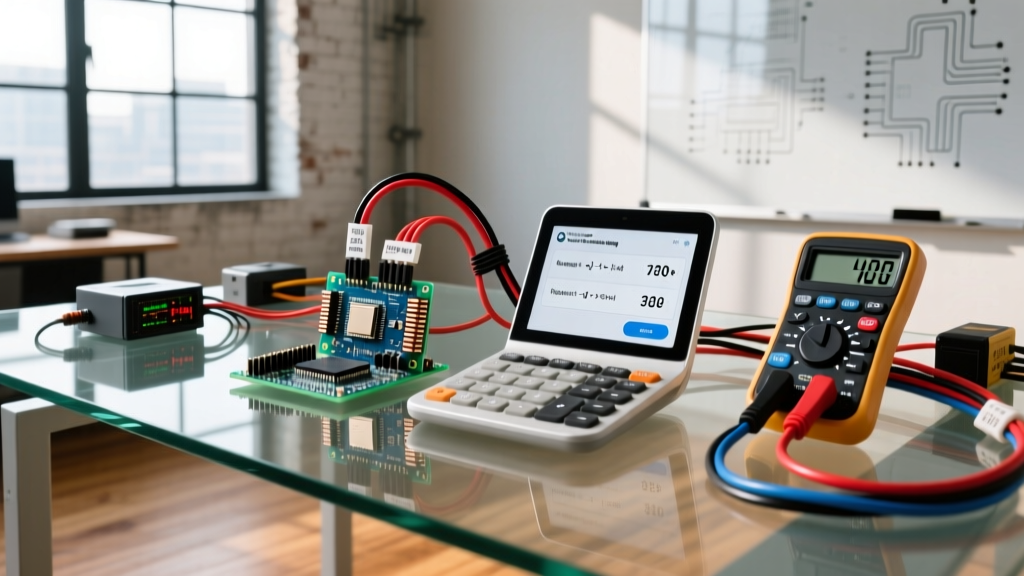
Capacitance SI units measure a component's ability to store electrical charge, with the base unit being the farad (F), defined as one coulomb of charge per one volt of potential difference. In a real circuit, changing the capacitance value directly alters timing constants, filters specific AC frequencies, and determines how much instantaneous current a decoupling network can supply to a microcontroller during switching spikes. When you select a capacitor, you are essentially choosing how much electrical 'slack' your circuit has to handle transient loads or smooth out voltage ripples.
The Base Unit and Its Practical Submultiples
While the farad is the official SI base unit for capacitance, a one-farad capacitor is physically massive in standard electronics. For context, a 1F 5.5V supercapacitor is roughly the size of a coin cell battery, while a standard ceramic decoupling capacitor is a fraction of a millimeter across. Because of this massive scale difference, we almost exclusively use SI prefixes on the bench and in schematics.
According to the National Institute of Standards and Technology (NIST), SI prefixes scale by factors of 1,000. However, electronics conventions sometimes skip the 'millifarad' (mF) step, jumping straight from microfarads to farads, which causes frequent misreads for beginners.
| Unit Name | Symbol | Multiplier (Farads) | Typical Component & Use Case |
|---|---|---|---|
| Picofarad | pF | 10-12 | Ceramic (e.g., 22pF). Used in RF tuning, crystal oscillator load matching, and high-frequency filtering. |
| Nanofarad | nF | 10-9 | Ceramic/Film (e.g., 100nF). The universal standard for IC decoupling and audio signal coupling. |
| Microfarad | µF or uF | 10-6 | Electrolytic/Tantalum (e.g., 470µF). Power supply bulk filtering, motor run capacitors, and timing circuits. |
| Millifarad | mF | 10-3 | Rarely used in print. A 4.7mF capacitor is almost always written as 4700µF on schematics and physical labels. |
| Farad | F | 100 | Supercapacitors / EDLCs (e.g., 5F). Memory backup, energy harvesting, and short-term ride-through power. |
Worked Numeric Example: Sizing a Filter Capacitor
To understand how capacitance SI units translate to physical circuit behavior, let us look at a common problem: preventing brownouts on a microcontroller. Imagine you are powering an ESP32-WROOM-32 from a 5V linear regulator (like an LM7805). During a WiFi transmission burst, the ESP32 draws a peak current of 250mA for roughly 2 milliseconds. If the regulator cannot respond fast enough, the voltage will droop.
We want to limit the voltage droop ($\Delta V$) to no more than 0.5V during this 2ms ($\Delta t$) window. We can calculate the required bulk capacitance ($C$) using the fundamental current-capacitance relationship:
Formula: $C = \frac{I \cdot \Delta t}{\Delta V}$
Plugging in our real-world values:
- $I$ (Peak Current) = 0.25 A
- $\Delta t$ (Time) = 0.002 s
- $\Delta V$ (Allowable Droop) = 0.5 V
Calculation:
$C = \frac{0.25 \cdot 0.002}{0.5}$
$C = \frac{0.0005}{0.5}$
$C = 0.001 \text{ Farads}$
Converting 0.001 F into practical SI units gives us 1,000 µF (or 1 mF). To build this reliably, you would place a 1000µF or 2200µF low-ESR aluminum electrolytic capacitor near the regulator output to handle this low-frequency bulk energy demand. However, electrolytics have high Equivalent Series Inductance (ESL), meaning they cannot react to nanosecond switching spikes. Therefore, you must parallel it with a 100nF (0.1µF) ceramic capacitor placed as physically close to the ESP32 VCC pin as possible to handle the high-frequency transients.
Where You Meet This in Practice
Understanding these units is critical because selecting the wrong magnitude by a single SI prefix (e.g., grabbing a 100pF instead of a 100nF) will completely break a circuit's functionality. Here is where specific capacitance ranges live in practical installations:
- Picofarads (1pF - 999pF): You will find these in radio frequency (RF) front-ends, impedance matching networks, and crystal oscillator circuits. A 433MHz RF transmitter module relies on precise pF values to tune its antenna trace; substituting a 22pF with a 22nF will detune the antenna and kill the transmission range entirely.
- Nanofarads (1nF - 999nF): The workhorse of signal integrity. Every digital IC requires a 100nF bypass capacitor to shunt high-frequency switching noise to ground. In audio circuits, nF values dictate the cutoff frequencies of active filters and tone controls.
- Microfarads (1µF - 9999µF): The domain of power and motors. Switch-mode power supplies use 470µF to 2200µF electrolytics to smooth rectified AC ripple. HVAC systems use 5µF to 50µF AC-rated film capacitors to create the phase shift needed to start single-phase compressor motors.
- Farads (0.1F - 3000F): Supercapacitors bridge the gap between traditional capacitors and batteries. A 5F 2.7V supercapacitor is often used to keep a Real-Time Clock (RTC) chip running for weeks after main power is lost, or in regenerative braking systems to absorb massive current spikes that would destroy chemical batteries.
Common Confusions: Capacitance vs. Related Metrics
When discussing capacitance theory, beginners frequently confuse the physical property of capacitance with other electrical metrics. Clearing up these distinctions prevents costly design errors.
Capacitance (Farads) vs. Battery Capacity (Amp-hours):
People often assume a 1 Farad supercapacitor can replace a 1 Amp-hour (Ah) battery. This is fundamentally false. Battery capacity measures total energy delivered over time at a relatively steady voltage. Capacitance measures charge storage where voltage drops linearly as charge is depleted. Mathematically, 1 Ah equals 3,600 Coulombs of charge. A 1F capacitor charged to 3.6V holds only 3.6 Coulombs ($Q = C \times V$). A chemical battery holds roughly 1,000 times more total energy than a supercapacitor of the same physical volume.
Capacitance vs. Capacitive Reactance (Impedance):
Capacitance ($C$) is a fixed physical property of the component, determined by its plate area, distance, and dielectric material. Capacitive reactance ($X_C$), measured in Ohms, is how much the capacitor resists AC current flow at a specific frequency. The formula is $X_C = \frac{1}{2\pi fC}$. A 100nF capacitor always has a capacitance of 100nF, but its impedance drops from 159 Ohms at 10kHz to just 1.59 Ohms at 1MHz.
Frequently Asked Questions About Capacitance SI Units
How do you convert microfarads to picofarads when reading schematics?
To convert microfarads (µF) to picofarads (pF), you multiply by 1,000,000 (or move the decimal point six places to the right). For example, a 0.01µF capacitor is equal to 10,000pF. In schematic notation, you will often see this written as '10nF' to avoid the long string of zeros, but older Russian or vintage US schematics might label it as '103' (meaning 10 followed by 3 zeros of picofarads, which equals 10,000pF).
Why do schematics sometimes use nanofarads and sometimes microfarads for the exact same value?
This is purely a regional and generational drafting convention, not a difference in physics. A 0.1µF capacitor and a 100nF capacitor are identical. US-based engineers and older textbooks heavily favor the microfarad (writing 0.1µF, 0.01µF), while modern European datasheets, IEC standards, and RF engineers prefer nanofarads (writing 100nF, 10nF) to avoid leading zeros and decimal points that can be misread if a schematic is photocopied or printed poorly.
Does the physical size of a capacitor change its SI unit value?
No, the physical size does not dictate the capacitance value, but it does dictate the voltage rating and the dielectric type. You can buy a 10µF capacitor in a massive radial electrolytic package rated for 450V, or in a microscopic 0402 surface-mount ceramic package rated for 6.3V. Both have the exact same capacitance (10µF) and will store the same amount of charge at 5V, but the physically larger one can survive much higher voltages and ripple currents without overheating or suffering dielectric breakdown.
What is the exact difference between a farad and a coulomb?
A coulomb (C) is the SI unit of electrical charge, representing a specific quantity of electrons (approximately $6.242 \times 10^{18}$ electrons). A farad (F) is the SI unit of capacitance, which is the ratio of charge to voltage. The relationship is defined by the equation $C = \frac{Q}{V}$. Therefore, one farad is the capacitance when one coulomb of charge causes a potential difference of one volt. Charge is the 'stuff' being stored; capacitance is the 'capacity' of the container holding that stuff at a given pressure.