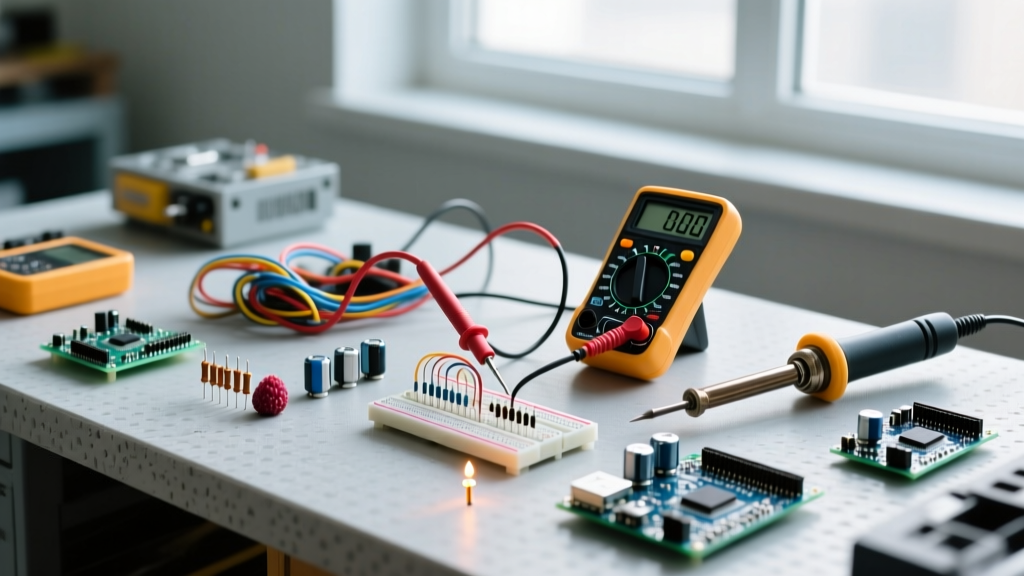

Voltage is the electrical potential difference pushing electrons through a conductor, current is the physical flow rate of those electrons, and power is the total rate of work they accomplish together per second. People commonly confuse voltage with energy capacity (assuming a 24V battery inherently holds more energy than a 12V battery of the same Amp-hours) and mistakenly believe that power supplies "push" a fixed amount of current into a circuit, rather than the load "pulling" only the current it needs based on its resistance.
The One-Sentence Definition and the Core Triangle
To make decisions on the bench or at the panel, you need to internalize Watt's Law: Power (Watts) = Voltage (Volts) × Current (Amps). This relationship forms an unbreakable triangle. If you know any two values, you can calculate the third. When you measure current, power, and voltage in a real system, you are essentially looking at the same physical phenomenon from three different angles: the pressure (V), the flow (I), and the resulting work (P).
What Changes in a Real Circuit When You Shift These Values
When you alter one variable in a circuit, the physical realities of the installation change dramatically, specifically regarding heat generation and wire sizing.
If you double the system voltage while keeping the power requirement identical, the required current is cut in half. This is why power transmission lines use hundreds of thousands of volts, and why 24V DC solar systems are preferred over 12V for loads exceeding 1000W. Halving the current doesn't just halve the wire gauge requirement; because resistive heat loss is calculated as I²R (current squared times resistance), halving the current reduces wire heat losses to one-quarter of the original value.
Conversely, if you increase the current draw on a fixed-voltage system (like plugging a second vacuum into the same 120V branch circuit), the voltage drop across the copper wire increases. This reduces the actual voltage reaching the load, which can cause motors to run hot, stall, or trigger thermal overloads.
Worked Numeric Example: 120V AC Heater vs. 12V DC Fridge
Let's look at how calculating current power and voltage limits dictates hardware selection in two completely different environments.
Scenario A: 120V AC Workshop Space Heater
- Power: 1500W
- Voltage: 120V nominal
- Base Current: 1500W / 120V = 12.5 Amps
The Trap: Many DIYers see 12.5A and assume a standard 15A breaker is fine. However, if this heater runs for more than 3 hours, the National Electrical Code (NEC 210.20) classifies it as a "continuous load." Continuous loads require the circuit to be sized at 125% of the base current.
The Fix: 12.5A × 1.25 = 15.625A. You must step up to a 20A breaker and use 12 AWG wire.
Scenario B: 12V DC Off-Grid Compressor Fridge
- Power: 60W running
- Voltage: 12V nominal (actually ~12.8V from a LiFePO4 battery)
- Running Current: 60W / 12.8V = 4.68 Amps
The Trap: Sizing the wire for 5A using thin 18 AWG speaker wire. When the compressor kicks on, the Locked Rotor Amps (LRA) startup surge can hit 15A for a fraction of a second. Thin wire will cause a massive voltage drop, stalling the compressor and potentially burning out the motor.
The Fix: Size the wire for the surge and distance. For a 10-foot run, 12 AWG copper wire keeps the voltage drop under 3% during the 15A startup spike, ensuring reliable operation.
Where You Meet Current, Power, and Voltage in Practice
You will run into the friction between these three values constantly in both embedded electronics and heavy wiring.
- ESP32 Brownouts: When an ESP32-WROOM-32 transmits on WiFi, it pulls a sudden spike of ~500mA. If you are powering it from a standard AMS1117-3.3 LDO voltage regulator rated for only 200mA, the regulator cannot supply the instantaneous current required. The result? The voltage sags from 3.3V down to 2.1V, the ESP32 detects a brownout, and the microcontroller resets. The power demand exceeded the component's ability to maintain voltage.
- Solar MPPT Charge Controllers: An MPPT controller is essentially a buck converter. It takes high voltage and low current from a solar panel string (e.g., 40V at 5A = 200W) and converts it to low voltage and high current for a 12V battery bank (e.g., 14.4V at ~13.8A = 200W). Power is conserved (minus efficiency losses), while voltage and current are traded inversely.
- Home Wiring Voltage Drop: Running a 14 AWG extension cord 50 feet to a 12A table saw. The resistance of the long, thin wire causes a voltage drop of about 6V. The saw only sees 114V instead of 120V, causing it to draw more current to maintain its mechanical power output, which further heats the cord.
Decision Path: Picking the Right Wire and Breaker for Your Load
Use this decision-tree-table to terminate your math into a concrete hardware pick for standard 120V AC branch circuits.
| Step | Action | Example (1500W Continuous Heater) |
|---|---|---|
| 1. Calculate Base Current | Divide Watts by Volts (P/V) | 1500W / 120V = 12.5A |
| 2. Apply Continuous Load Factor | If load runs >3 hrs, multiply by 1.25 | 12.5A × 1.25 = 15.625A |
| 3. Select Breaker Size | Round UP to next standard NEC size (15, 20, 30) | Next size up from 15.625A is 20A |
| 4. Select Wire Gauge (Copper) | Match ampacity to breaker (NEC 240.4) | 20A breaker requires minimum 12 AWG |
| 5. Final Hardware Pick | Buy specific parts | 12 AWG THHN + Eaton BR220 Breaker |
Common Confusions and Troubleshooting FAQs
Does a higher voltage battery always last longer?
No. Voltage is pressure, not capacity. A 24V 50Ah battery bank holds 1200 Watt-hours of energy. A 12V 100Ah battery bank also holds 1200 Watt-hours. They will run the exact same 100W load for the exact same amount of time (12 hours). The 24V system is often preferred because it pulls half the current (4.1A vs 8.3A), allowing for thinner wires, but the total runtime is identical.
Why did my 5V 2A power supply fry my 5V 0.5A Arduino?
It didn't. This is the most common myth in electronics. A 5V 2A power supply simply means it has the capacity to provide up to 2A if asked. If your Arduino only has a resistance that pulls 0.5A at 5V, it will only pull 0.5A. The power supply will happily sit there providing 5V, and the Arduino will only take the 0.5A it needs. If your board fried, you likely accidentally fed 5V into a 3.3V GPIO pin, or the power supply had a faulty regulation loop and spiked above 5V.
How do I measure all three values at once?
To accurately evaluate current power and voltage simultaneously on a DC bench project, use a digital inline wattmeter (like the MakerHawk DC 120V/150A meter) placed between the power supply and the load. For AC mains, use a true-RMS clamp meter with a voltage lead (like the Fluke 375) to read voltage at the receptacle and clamp the hot wire for current, then multiply them to find apparent power (VA).
Mastering the relationship between these three values removes the guesswork from electrical design. Always calculate the worst-case current, apply the appropriate safety derating, and let the math dictate your wire gauge and breaker size. When in doubt, step up to the next wire size; copper is cheap, but melted insulation is not.


