
When you input your parameters into a cable size calculator UK wiring regulations (BS 7671) dictate the underlying math. It is not simply plugging current and distance into Ohm's Law. A proper UK-specific calculator applies a nominal 230V single-phase baseline, enforces strict voltage drop limits (3% for lighting, 5% for power circuits), and factors in the specific ambient temperature derating values required by the IET. If you are sizing wire for a mixed-voltage workshop, importing 60Hz machinery, or troubleshooting a cross-border installation, understanding the regional voltage standards and frequency tolerances is critical to preventing overheated conductors and tripped breakers.
Global Voltage Tolerances & Equipment Compatibility
Before sizing a cable, you must establish the exact voltage and frequency your equipment will see at the terminal. Mains voltage is never a perfect, static number; it fluctuates based on grid load and transformer tap settings. The table below outlines the nominal parameters and legal tolerance bands for major regions, which directly impacts how much current a device will draw and, consequently, what wire gauge you need.
| Region | Nominal Voltage | Tolerance Range (Legal Limits) | Frequency | Standard Plug Type |
|---|---|---|---|---|
| United Kingdom | 230V | +10% / -6% (216.2V to 253.0V) | 50Hz | BS 1363 (Type G) |
| Continental EU | 230V | +10% / -10% (207.0V to 253.0V) | 50Hz | CEE 7/7 (Type E/F) |
| United States | 120V / 240V | +5% / -5% (114V-126V / 228V-252V) | 60Hz | NEMA 5-15 / 14-50 (Type A/B) |
| Australia / NZ | 230V | +10% / -6% (216.2V to 253.0V) | 50Hz | AS/NZS 3112 (Type I) |
What your device must tolerate: Modern switch-mode power supplies (SMPS) found in laptops, phone chargers, and LED drivers are designed to tolerate a wide input range, typically 100V–240V at 50/60Hz. For these devices, a simple physical travel adapter is sufficient. However, resistive loads (like electric kettles or hair dryers) and inductive loads (like compressors) are fixed to their nameplate voltage.
Transformer vs. Converter necessity: If you plug a US 120V resistive appliance into a 230V UK outlet using only a physical pin adapter, it will draw four times its rated power ($P = V^2/R$) and instantly fail or catch fire. You must use a step-down transformer (often colloquially called a voltage converter in retail spaces) to drop the 230V to 120V. When sizing the cable feeding this transformer, you must calculate the primary side current based on the 230V UK supply, not the 120V secondary side.
BS 7671 Conductor Colors & Voltage Drop Limits
A core function of any reliable calculator is enforcing voltage drop limits to ensure equipment operates within its tolerance band. Under BS 7671 (IET Wiring Regulations), the maximum permissible voltage drop from the origin of the installation to the furthest point is 3% (6.9V) for lighting circuits and 5% (11.5V) for all other power circuits. The calculator uses the formula $V_d = (mV/A/m imes I_b imes L) / 1000$, where the millivolt drop per amp per meter is pulled directly from the BS 7671 cable specification tables based on your chosen insulation type (e.g., 70°C thermoplastic vs. 90°C thermosetting).
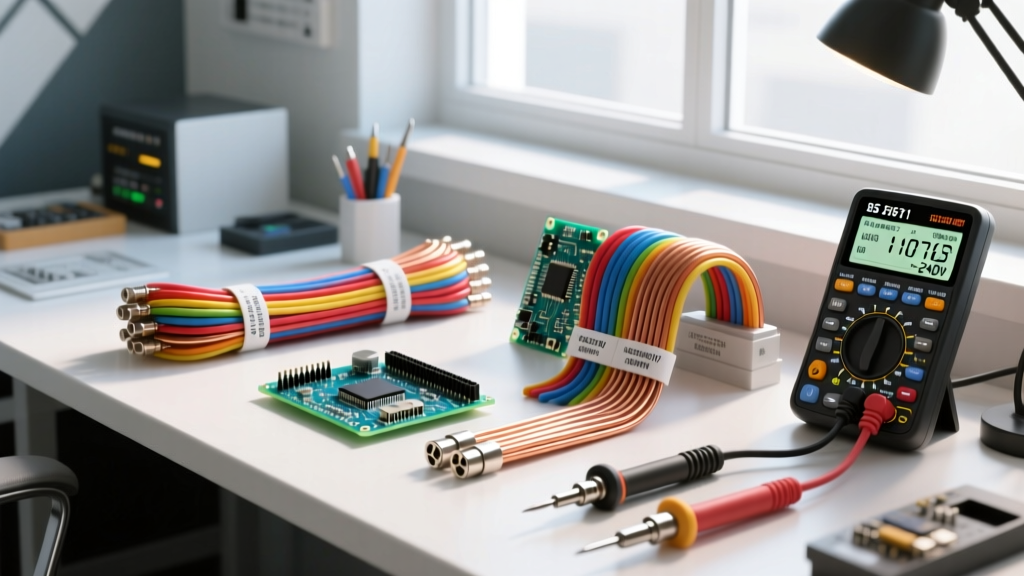
Equally important is identifying the correct conductors. The UK harmonized its fixed wiring colors with the European IEC 60446 standard in 2004 (fully enforced by 2006). If you are extending an older circuit, you will encounter the legacy UK color code.
| Function | Current UK/EU Standard (Post-2006) | Old UK Standard (Pre-2004) |
|---|---|---|
| Line (Phase) | Brown | Red |
| Neutral | Blue | Black |
| Earth (Ground) | Green & Yellow | Green (or bare copper) |
If you are working on a property with a mix of old (Red/Black) and new (Brown/Blue) wiring, BS 7671 mandates that the entire installation must be safe and compliant at the distribution board. You are permitted to mix old and new cable colors on the same circuit, but you must apply clear, durable warning labels at the consumer unit and at every junction box where the colors change. Never assume the old black wire is neutral without testing it; in some legacy 3-phase or switch-wire configurations, black was used as a switched line or a phase conductor.
The 50Hz vs 60Hz Trap: Motor Loads and Imported Equipment
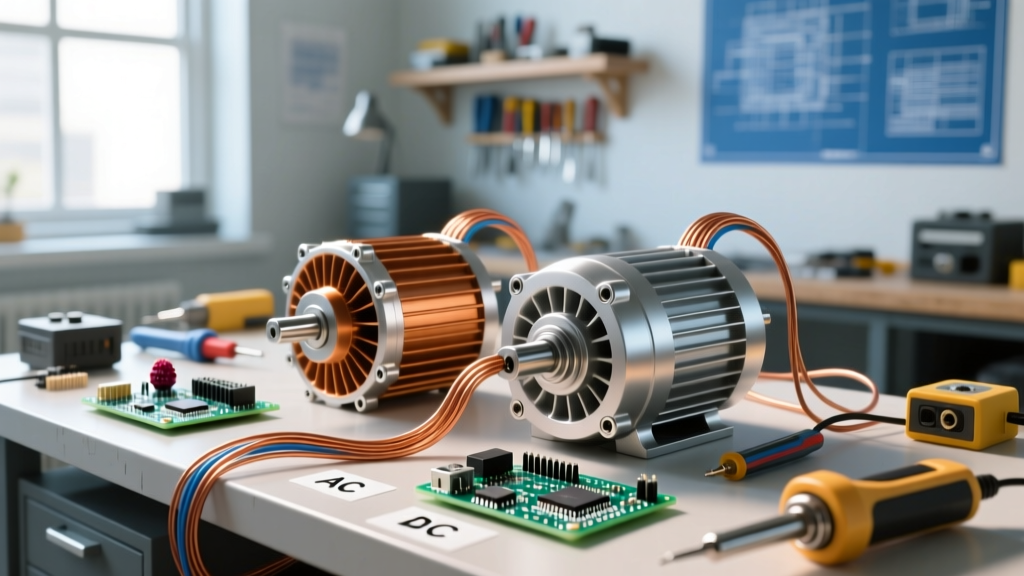
The most common failure point when using a generic, region-agnostic cable sizing tool is ignoring frequency effects on motor loads. If you import a US-manufactured 60Hz industrial motor (such as a table saw, lathe, or HVAC compressor) and run it on the UK 50Hz grid via a step-down transformer, the cable size calculator's output based purely on the nameplate amperage will be dangerously undersized.
Here is the physics of why this happens. The synchronous speed of an AC motor is directly proportional to frequency ($N_s = 120f / P$). A 60Hz motor running on 50Hz will spin 16.7% slower. More critically, the inductive reactance of the motor windings ($X_L = 2\pi fL$) drops proportionally with the frequency. Because the impedance is lower, the motor will draw significantly more current to produce the same mechanical torque.
Furthermore, the motor's internal cooling fan is also spinning 16.7% slower, reducing its ability to shed heat. The combination of higher current draw and reduced cooling means the motor windings will overheat, eventually breaking down the insulation and causing a short circuit. If your cable and breaker were sized only for the 60Hz nameplate amps, the continuous overcurrent on the 50Hz supply will cause the cable to operate above its thermal rating, potentially melting the insulation inside the conduit before the breaker trips.
The Fix: When sizing cables for imported 60Hz motors running on a 50Hz supply, you must derate the motor's expected power output by roughly 20%, or measure the actual running current with a clamp meter under full mechanical load. Always size the cable and the overcurrent protective device (OCPD) based on the measured 50Hz running amps, not the manufacturer's 60Hz nameplate stamp. For critical imported machinery, the safest route is replacing the 60Hz motor with a 50Hz equivalent or installing a Variable Frequency Drive (VFD) that can accept 50Hz input and synthesize a 60Hz output for the motor. For deeper guidance on safe installations, refer to the Electrical Safety First guidelines on imported equipment and domestic wiring compliance.