
Brake horsepower (BHP) is the actual, usable mechanical power delivered by a motor or engine at its output shaft, measured after subtracting all internal friction, windage, and parasitic losses. Think of it like your net paycheck: while your employer might budget $5,000 a month for you (the electrical input power), taxes and deductions mean you only take home $4,000 to actually spend (the brake horsepower). In electrical installations, confusing the money the company spends with the money you actually have to spend leads to undersized components, tripped breakers, and burnt windings.
What Brake Horsepower Changes in a Real Installation
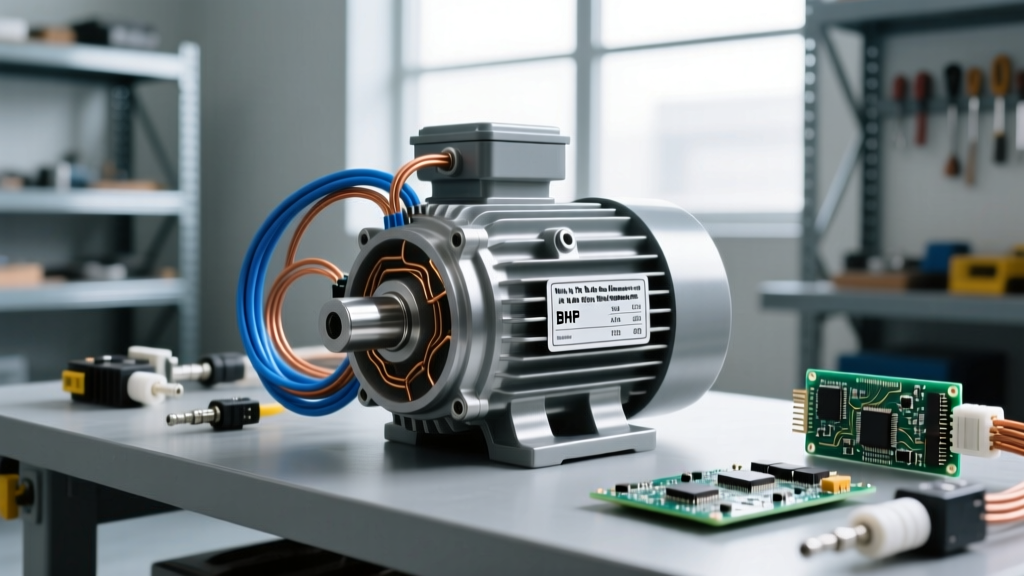
When you read the 'HP' value on a standard NEMA motor nameplate, you are looking at the brake horsepower rating. This number represents the mechanical work the motor is guaranteed to deliver to the load (like a pump impeller or a conveyor belt) at its rated temperature rise.
But here is where BHP fundamentally changes your electrical design: you cannot use BHP to directly calculate your wire size or breaker size. Because a motor is not 100% efficient, it must draw more electrical power from the grid than the mechanical BHP it outputs. If you simply convert 5 BHP to watts (3,728.5W) and use Ohm's law to find the current, you will severely undersize your circuit.
BHP dictates the mechanical coupling and the physical frame size of the motor. However, to size your THHN wire, conduit, and inverse-time circuit breakers, you must convert BHP back into electrical input power by factoring in the motor's efficiency ($\eta$) and power factor (PF), or simply rely on the Full Load Amps (FLA) printed on the nameplate as mandated by NEC Article 430.
The Math: Converting BHP to Electrical Load (Worked Example)
Let's walk through a real-world scenario. You are wiring a new 230V, single-phase water pump in a barn. The pump manufacturer specifies a 5 BHP requirement to push the required GPM at the needed head pressure. You've purchased a standard 5 HP, 230V capacitor-start motor. Here is how BHP dictates the electrical numbers.
Step 1: Convert BHP to Mechanical Watts
One standard mechanical horsepower equals exactly 745.7 watts.
5 BHP × 745.7 W/HP = 3,728.5 Watts (Mechanical Output)
Step 2: Calculate Electrical Input Power
Check the motor nameplate. Let's assume an efficiency ($\eta$) of 85% (0.85). The motor must draw more power than it outputs to overcome internal heat and friction.
Input Power = 3,728.5W / 0.85 = 4,386 Watts (Electrical Input)
Step 3: Calculate Full Load Amps (FLA)
AC motors also suffer from reactive power, meaning we must factor in the Power Factor (PF). Let's assume a typical single-phase PF of 0.85.
Current (I) = Input Power / (Voltage × PF)
I = 4,386W / (230V × 0.85) = 22.4 Amps
Where You Meet BHP in Practice
You will encounter brake horsepower in three specific areas on the jobsite or at the workbench:
- Motor Nameplates: The 'HP' field is always BHP. As noted by Fluke's motor diagnostics guides, this is the baseline for all subsequent thermal and electrical calculations.
- VFD Parameter Setup: When programming a Variable Frequency Drive (VFD), the 'Motor Rated Power' parameter expects the shaft output (BHP or kW), not the electrical input. Entering the wrong value will cause the VFD's internal thermal overload model to miscalculate, leading to premature trips or, worse, a burnt motor.
- Pump and Fan Affinity Laws: In fluid dynamics, the BHP required by a centrifugal pump increases by the cube of the speed. If you use a VFD to speed up a 5 BHP pump by just 10%, the new BHP requirement jumps to 6.65 BHP, instantly overloading a 5 HP motor.
BHP vs. The Rest: Clearing Up Common Confusions
One of the most common mistakes DIYers and junior technicians make is assuming all 'horsepower' ratings are created equal. They are not. Here is how BHP stacks up against the other metrics you will see in datasheets and catalogs.
| Metric | Definition | Watt Equivalent | Where It's Used |
|---|---|---|---|
| Brake HP (BHP) | Usable mechanical power at the output shaft. | 745.7 W | US/UK motor nameplates, mechanical load sizing. |
| Electrical HP | Power input to an electrical motor (often used in older texts). | 746.0 W | Theoretical circuit analysis, utility billing. |
| Metric HP (PS / cv) | Pferdestärke; the European standard for mechanical power. | 735.5 W | IEC motor nameplates, European automotive specs. |
| Indicated HP (IHP) | Theoretical power generated inside the cylinders/stator before losses. | Varies | Engine dyno testing, internal combustion design. |
Motor and VFD Sizing Decision Tree
When selecting a motor and a corresponding VFD for a specific mechanical load, use this decision path to ensure you don't under-spec the drive. VFDs are rated by both 'Normal Duty' (ND - fans/pumps) and 'Heavy Duty' (HD - conveyors/crushers).
| If Your Load Requires... | And The Application Is... | Select This Motor HP | Concrete VFD Pick (230V 3-Phase) |
|---|---|---|---|
| 3 BHP Continuous | Centrifugal Pump (Normal Duty) | 3 HP | Allen-Bradley PowerFlex 525 (3 HP ND) |
| 5 BHP Continuous | Conveyor Belt (Heavy Duty) | 5 HP | Yaskawa V1000 (7.5 HP ND / 5 HP HD) - Always size VFD one step up for HD. |
| 10 BHP Intermittent | Punch Press (High Shock) | 10 HP | ABB ACS580 (15 HP HD) - Oversized to handle 150% shock overloads. |
The Default Recommendation: If you are sizing a VFD for a continuous heavy-duty mechanical load, always select a VFD rated one standard NEMA size larger than your motor's BHP. For a 5 BHP heavy-duty load, buy the 7.5 HP Normal Duty drive (which shares the same physical hardware and amperage rating as a 5 HP Heavy Duty drive). This guarantees the drive's IGBTs can handle the thermal mass of the starting inrush without throwing an overcurrent fault.
Frequently Asked Questions
Can I measure brake horsepower directly with a multimeter?
No. A multimeter measures electrical input (volts and amps). BHP is a mechanical output. To find the actual BHP being delivered in real-time, you must measure the electrical input power (using a wattmeter or power analyzer), and then multiply that wattage by the motor's efficiency curve at that specific load point. Alternatively, mechanical BHP is measured on a test bench using a dynamometer or a Prony brake, which applies physical friction to the shaft and measures the torque.
Why do small hobby motors list 'stall torque' instead of BHP?
Brushed DC motors used in robotics and RC applications (like the 775 or 550 size motors) are rarely run at their peak efficiency point. Manufacturers list stall torque and no-load RPM because hobbyists use gearboxes to manipulate the torque curve. You can calculate the peak BHP of a DC motor by multiplying the torque at 50% of stall by the RPM at 50% of no-load speed, but for sizing ESCs (Electronic Speed Controllers), you only care about the stall current, which is purely an electrical metric.
Does a higher BHP motor always draw more electricity?
Not necessarily. A 10 BHP motor driving a 2 BHP water pump will only draw enough electrical power to satisfy the 2 BHP mechanical load (plus a slight penalty for running the larger motor at a low, inefficient point on its curve). The BHP rating on the nameplate is the maximum safe continuous capacity, not the mandatory electrical draw. However, running a massively oversized motor at 10% load will result in a terrible power factor, which can trigger utility penalty fees on commercial meters.