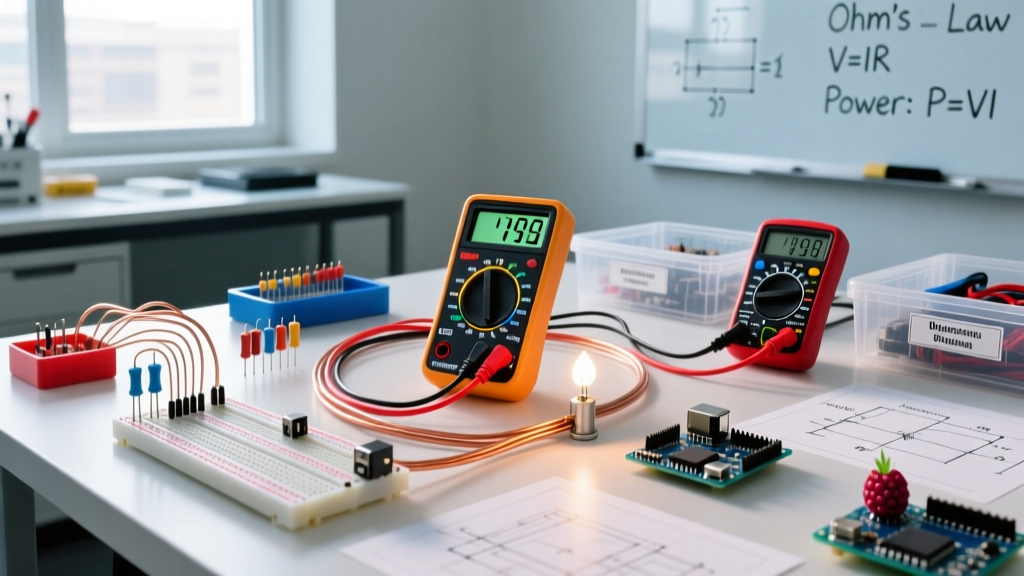

The Core Basic Electricity Formulas: Ohm's and Watt's Laws
If you only memorize two equations for your entire time on the workbench, make them Ohm’s Law and the DC Power Law (often called Watt’s Law). These two basic electricity formulas govern 95% of the DC and purely resistive AC calculations you will perform, from sizing a current-limiting resistor for an LED to calculating the voltage drop on a long feeder wire.
The foundational equations are:
- Ohm's Law: V = I × R
- Power Law: P = V × I
Symbol Definition and SI Units
Every variable in these formulas represents a specific physical property. Mixing up the units is the most common reason calculations fail on the bench.
| Symbol | Property | SI Unit | Unit Abbreviation | Physical Analogy |
|---|---|---|---|---|
| V (or E) | Voltage (Electromotive Force) | Volts | V | Water pressure in a pipe |
| I | Current | Amperes | A | Flow rate (gallons per minute) |
| R | Resistance | Ohms | Ω | Pipe diameter / friction |
| P | Power | Watts | W | Total work done by the water |
Real-World Baseline Data
Before deriving new numbers, you need a mental baseline for what realistic answer magnitudes look like. If your calculation tells you a 5V Arduino draws 50 Amps, you have missed a decimal point. The table below provides measured baseline values for common loads to calibrate your expectations.
| Device / Load | Nominal Voltage (V) | Typical Current (I) | Effective Resistance (R) | Power Consumed (P) |
|---|---|---|---|---|
| Arduino Nano (Idle) | 5.0 V | 0.045 A (45 mA) | 111.1 Ω | 0.225 W |
| 12V Automotive LED Strip (1m) | 12.0 V | 1.20 A | 10.0 Ω | 14.4 W |
| 60W Incandescent Bulb | 120.0 V | 0.50 A | 240.0 Ω | 60.0 W |
| 1500W Baseboard Heater | 240.0 V | 6.25 A | 38.4 Ω | 1500.0 W |
| Standard USB-C Phone Charger | 120.0 V (AC) | 0.16 A (AC RMS) | 750.0 Ω (Apparent) | 20.0 W (DC out) |
Rearranged Forms and Unit Traps
By substituting Ohm's Law into the Power Law, we can derive the "Power Wheel"—a set of 12 equations that allow you to solve for any single variable if you know the other two. According to All About Circuits, mastering these rearrangements eliminates the need to memorize the wheel; you just need to know the two root formulas and basic algebra.
The Rearranged Forms List
- Solving for Voltage (V): V = I × R | V = P / I | V = √(P × R)
- Solving for Current (I): I = V / R | I = P / V | I = √(P / R)
- Solving for Resistance (R): R = V / I | R = V² / P | R = P / I²
- Solving for Power (P): P = V × I | P = I² × R | P = V² / R
Which Unit Mistakes Break the Math?
The formulas only work if you use base SI units: Volts, Amperes, Ohms, and Watts. The most frequent errors occur when components are rated in sub-units:
- The Milliamp Trap: Datasheets list LED current in milliamps (mA). 20 mA is 0.020 A, not 20. If you calculate R = 5V / 20, you get 0.25 Ω (a dead short) instead of the correct 250 Ω.
- The Kilowatt Trap: Appliances are rated in kW. A 1.5 kW heater is 1500 W. Using 1.5 in the I = P / V formula will yield a current 1000 times smaller than reality, leading you to undersize your breaker and start a fire.
- The Microfarad/Micro-ohm Confusion: While less common in basic DC power, ensure wire resistance is in Ohms, not milliohms (mΩ), when calculating voltage drop.
Worked Examples: From Bench to Jobsite
Let's apply these basic electricity formulas to two real-world scenarios. Notice how every step tracks the units to ensure the final magnitude makes sense.
Problem 1: Sizing a Current-Limiting Resistor for a 12V System
Scenario: You are wiring a Cree 5mm indicator LED to a motorcycle's 12V electrical system. The LED datasheet specifies a forward voltage (Vf) of 3.2V and a target forward current (If) of 20 mA. What resistor do you need, and what wattage rating should it have?
Step 1: Identify knowns and convert to base units.
- Source Voltage (Vs) = 13.8V (A motorcycle alternator outputs ~13.8V when running, not 12V).
- LED Voltage Drop (Vf) = 3.2V
- Target Current (I) = 20 mA = 0.020 A
Step 2: Calculate the voltage the resistor must drop.
- VR = Vs - Vf
- VR = 13.8V - 3.2V = 10.6V
Step 3: Calculate Resistance using Ohm's Law.
- R = VR / I
- R = 10.6V / 0.020A = 530 Ω
- Practical application: 530 Ω is not a standard E12/E24 resistor value. We round up to the next standard size to protect the LED: 560 Ω.
Step 4: Calculate Power Dissipation using the Power Law.
- P = I² × R (using the actual 560 Ω resistor)
- P = (0.020A)² × 560Ω
- P = 0.0004A² × 560Ω = 0.224 W
- Practical application: A standard 1/4W (0.25W) resistor is technically sufficient, but running it at 90% capacity will make it hot and shorten its lifespan. Upgrade to a 1/2W (0.5W) resistor for a safe thermal margin.
Problem 2: Calculating Voltage Drop on a Long Wire Run
Scenario: You are powering a 12V, 3A magnetic door lock using 50 feet of 18 AWG copper wire. Will the lock receive enough voltage to engage reliably?
Step 1: Determine total wire resistance.
- Current (I) = 3A
- Distance = 50 feet out, 50 feet back = 100 feet total loop.
- According to copper wire reference data, 18 AWG solid copper has a resistance of approximately 6.385 Ω per 1,000 feet at 20°C.
- Rwire = (6.385 Ω / 1000 ft) × 100 ft = 0.6385 Ω
Step 2: Calculate Voltage Drop.
- Vdrop = I × Rwire
- Vdrop = 3A × 0.6385Ω = 1.9155V
Step 3: Calculate Voltage at the Load.
- Vload = Vsource - Vdrop
- Vload = 12.0V - 1.9155V = 10.08V
Step 4: Evaluate and Calculate Power Lost.
- Most 12V solenoids require a minimum of 10.5V to pull in reliably. At 10.08V, the lock may chatter or fail to engage.
- Power lost as heat in the wire: P = I² × R = (3A)² × 0.6385Ω = 9 × 0.6385 = 5.74W.
- Fix: Step up to 14 AWG wire to halve the resistance and keep the voltage above 11V.
Assumptions, Limits, and When the Math Fails
Basic electricity formulas are incredibly powerful, but they are built on strict physics assumptions. As noted by Georgia State University's HyperPhysics, treating non-linear systems as ohmic conductors will yield dangerously incorrect results.
When the Formulas Apply
- Linear, Ohmic Materials: The resistance (R) must remain constant regardless of the applied voltage. Standard resistors, copper wire, and heating elements fit this criteria.
- Steady-State DC or Purely Resistive AC: For AC circuits, these formulas only work if the load is purely resistive (like a toaster or incandescent bulb) and you use RMS (Root Mean Square) voltage and current values. If the circuit has motors, transformers, or large capacitor banks, you must introduce Impedance (Z) and Power Factor (PF) into the math.
When the Formulas Break Down
- Semiconductors and Diodes: LEDs, diodes, and transistors are non-linear. Their resistance changes dynamically with voltage. You cannot use R = V / I to find the "resistance" of an LED; you must use the forward voltage drop (Vf) as a fixed constant in your Kirchhoff's Voltage Law equations.
- Temperature Coefficients (Inrush Current): The formulas assume a constant temperature. A 60W incandescent bulb has a hot resistance of 240 Ω (drawing 0.5A). However, its cold resistance is only about 15 Ω. When you first flip the switch, Ohm's law dictates an inrush current of I = 120V / 15Ω = 8 Amps. This is why lightbulbs usually blow the moment they are turned on, and why you must size fuses for inrush, not just steady-state.
- Battery Internal Resistance: A 12V lead-acid battery is not a perfect 12V source. It has internal resistance. If you short-circuit it, the current isn't infinite; it is limited by the internal resistance of the electrolyte and plates. Always model real-world power supplies as an ideal voltage source in series with a small internal resistor.