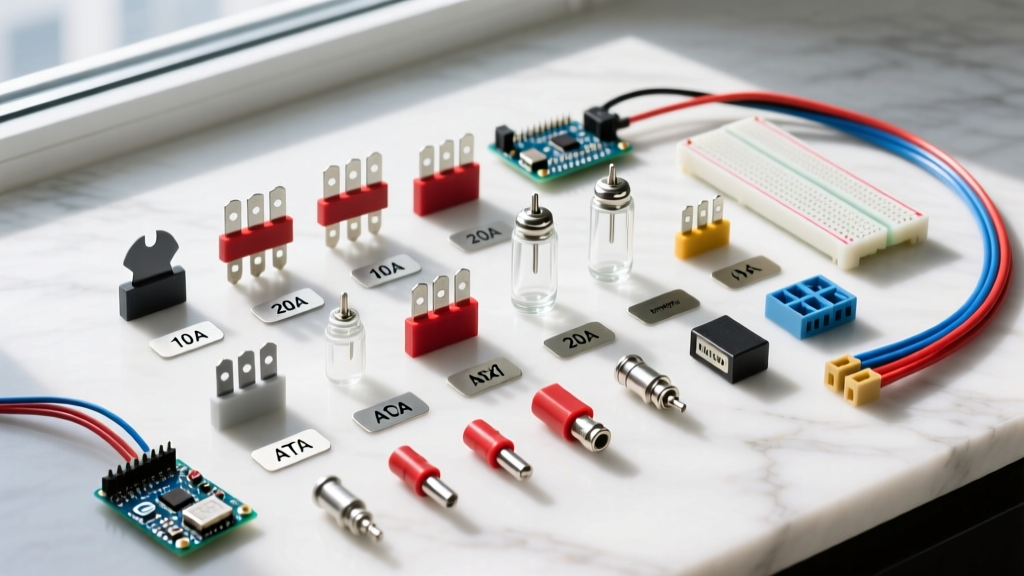

When you are wiring a 12V accessory, replacing a blown circuit protector, or building a custom fuse block, guessing the right component is a fast track to melted harnesses or nuisance blows. The most common automotive fuse globally is the ATO/ATC standard blade fuse (typically 15A or 20A), but modern vehicles and aftermarket builds rely on a highly specific ecosystem of micro, mini, and high-amp formats.
This reference guide provides the definitive automotive fuse types chart, anchored to SAE and ISO standards, with exact physical dimensions, color codes, and the derating math required to select the correct part number for your specific load.
How to Read the Automotive Fuse Types Chart
Before jumping to the table, understand how the columns dictate your selection. The Standard column references the governing engineering document (e.g., SAE J1284 or ISO 8820), which guarantees the physical footprint and testing criteria. The Max Ampacity column shows the absolute maximum rating manufactured for that physical size, not necessarily what you should use. The Voltage Rating is critical: while most passenger vehicles operate at 14.4V nominal, 24V commercial systems or 48V mild-hybrids require fuses explicitly rated for higher DC voltages to prevent internal arcing when the element melts.
Bookmark tip: The most queried rows (ATO, Mini, Maxi) are tagged with anchor IDs below for quick reference.
The Master Automotive Fuse Types Chart
| Fuse Type | Governing Standard | Amp Range | Max Voltage | Physical Footprint (mm) | Common Color Code (Example) |
|---|---|---|---|---|---|
| Micro2 | ISO 8820-7 | 5A - 30A | 32V DC | 9.1 x 15.3 x 3.6 | Clear (25A) |
| Micro3 | ISO 8820-7 | 5A - 15A | 32V DC | 14.0 x 18.1 x 4.0 | Blue (15A) |
| Mini (FK1) | ISO 8820-3 | 2A - 30A | 32V DC | 10.9 x 16.3 x 3.6 | Yellow (20A) |
| ATO / ATC | SAE J1284 / ISO 8820-1 | 1A - 40A | 32V DC | 19.1 x 18.5 x 5.1 | Green (30A) |
| Maxi | SAE J1284 | 20A - 120A | 32V DC | 29.2 x 34.3 x 5.1 | Orange (40A) / Clear (120A) |
| Mega / ANL | SAE J1113 / OEM Spec | 80A - 500A | 32V / 58V DC | 68.0 x 19.0 (bolt down) | Silver/Brass (No color code) |
| Bosch (Torpedo) | SAE J554 / DIN 72581 | 5A - 30A | 32V DC | 25.0 x 6.0 (cylindrical) | Yellow (25A) |
Derating Rules: Which Column Actually Applies?
The amp rating stamped on the fuse is its nominal opening threshold under ideal laboratory conditions (typically 20°C ambient). In a real vehicle, you must apply derating rules to determine which column and rating actually apply to your installation.
The 80% Continuous Load Rule
If your circuit will draw current for more than 3 to 5 minutes continuously (e.g., fuel pumps, heated seats, LED light bars, audio amplifiers), you must derate the fuse by 80%.
- Formula: Required Fuse Rating = Continuous Load Amps / 0.80
- Example: A 12A continuous fuel pump requires a 15A fuse (12 / 0.8 = 15). If you use a 12A fuse, the internal element will experience thermal fatigue and eventually blow prematurely.
Ambient Temperature Derating
Under-hood fuse blocks routinely see 85°C to 105°C ambient temperatures. Standard blade fuses are calibrated for roughly 20°C to 40°C. As ambient heat rises, the fuse element requires less electrical current to reach its melting point.
- At 85°C ambient: A 20A ATO fuse will actually blow at approximately 18A to 19A.
- At 120°C ambient: That same 20A fuse may blow at just 16A.
- The Fix: If routing a fuse block near exhaust headers or in a sealed engine bay with poor airflow, step up one physical size (e.g., use Maxi instead of ATO) or source high-temperature rated fuses specifically designed for under-hood OEM blocks.
Decision Path: Picking the Exact Fuse for Your Circuit
Use this decision tree to terminate your selection process with a single, concrete part format.
| Circuit Condition | Decision / Action | Concrete Pick |
|---|---|---|
| Load is under 10A, space is extremely tight (e.g., modern dash cluster, ECU power feed) | Select Micro format for high-density PCB or mini-block mounting. | Micro2 (e.g., Littelfuse 0297 series) |
| Load is 10A - 30A, standard aftermarket accessory (e.g., dash cam, auxiliary 12V socket) | Select the industry standard for maximum availability and holder compatibility. | ATO/ATC (e.g., Bussmann ATC-20) |
| Load is 20A - 60A, high-power continuous (e.g., winch solenoid, inverter feed, off-road light bar) | Select large blade format to dissipate heat and handle higher gauge wire terminals. | Maxi (e.g., Littelfuse 0299 series) |
| Load exceeds 80A (e.g., main battery feed, massive audio system, EV conversion) | Blade fuses cannot handle the mechanical stress of high fault currents; use bolt-down. | Mega / ANL (e.g., Bussmann ANL-250) |
What the Chart Cannot Tell You
While the automotive fuse types chart dictates the physical component, it leaves two critical engineering variables to the installer: wire sizing and interrupting capacity (AIC).
1. Wire Sizing and the Weakest Link Rule
A fuse is only as good as the wire it protects. The chart does not tell you what AWG wire to run. A 30A ATO fuse will perfectly protect a 10 AWG wire, but if you wire it with 18 AWG speaker wire, the wire will catch fire long before the 30A fuse blows. Always size the wire for the load and voltage drop, then size the fuse to protect the wire.
- 10A Fuse: Minimum 16 AWG (THHN/MTW)
- 20A Fuse: Minimum 14 AWG (12 AWG preferred for runs over 10 feet)
- 30A Fuse: Minimum 12 AWG
- 40A Maxi: Minimum 10 AWG
2. Ampere Interrupting Capacity (AIC)
The chart lists maximum operating amps, not fault-current breaking capacity. A standard ATO fuse has an AIC rating of roughly 1,000 Amps at 32V. If you are wiring directly to a massive 200Ah LiFePO4 battery bank capable of delivering 4,000A+ during a dead short, a standard blade fuse may violently arc and fail to clear the fault. For high-capacity lithium setups, always use high-interrupting capacity fuses like Class T or properly rated ANL/Mega fuses placed immediately at the battery positive terminal.
For further reading on standardizing your vehicle's electrical architecture, consult the SAE J1284 standard documentation for blade-type fuse testing parameters, or reference your specific vehicle's OEM wiring schematic for factory circuit grouping logic.


