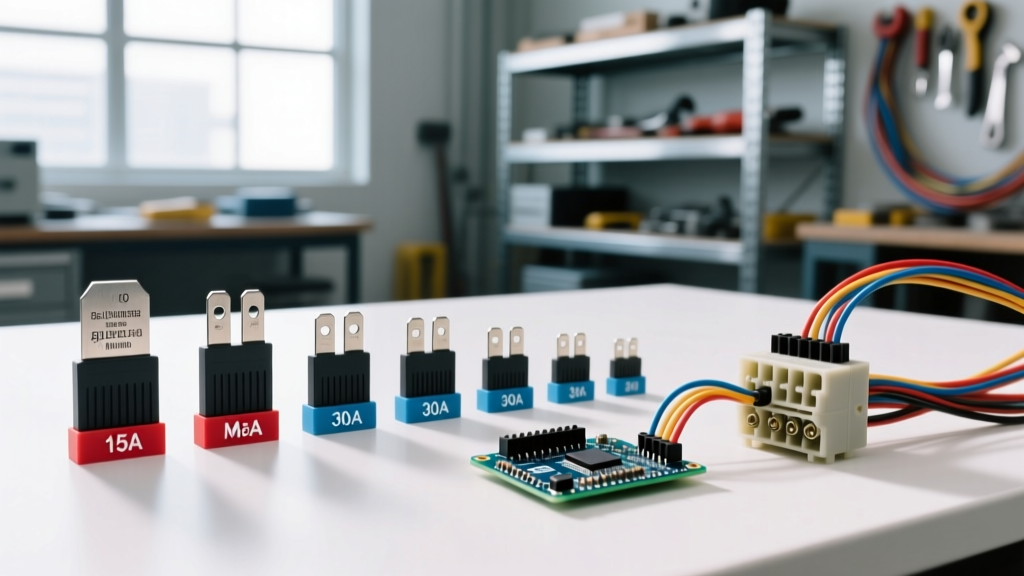

Standard automotive blade fuses (ATO/ATC) handle 1A to 40A, Mini fuses handle 2A to 30A, and Maxi fuses handle 20A to 120A. The correct fuse size is dictated strictly by the wire gauge's ampacity and the continuous load of the circuit, governed by SAE J1284 and SAE J554 standards. A fuse protects the wire from melting, not the device from failing. If you are wiring a 12A fuel pump using 12 AWG wire (rated for 20A), you use a 15A fuse—not a 20A fuse—to provide a safety margin below the wire's thermal limit.
How to Read This Auto Fuse Size Chart
This reference chart is built on the Littelfuse Automotive Fuse Catalog and Eaton Bussmann specifications, which align with SAE J1284 (Blade Type Fuses). Before picking a row, understand the columns:
- Form Factor: The physical footprint (LP-Mini, Mini, ATO/ATC, Maxi). ATO (Auto) and ATC (Auto Compact) are physically interchangeable in standard fuse blocks, though ATC has a sealed moisture barrier.
- Amp Rating: The continuous current the fuse will carry indefinitely at a 20°C (68°F) ambient temperature without blowing.
- Standard Color Code: Mandated by SAE to prevent misidentification. Never substitute a fuse with the wrong color, even if the physical blade fits.
- Max Wire Gauge (AWG): The thinnest wire (highest AWG number) this fuse can safely protect based on standard automotive primary wire (SAE J1128) ampacity.
The Master Auto Fuse Size Chart
| Form Factor | Amp Rating | Standard Color Code | Typical Max Wire Gauge | Common Application |
|---|---|---|---|---|
| LP-Mini / Micro2 | 5A | Tan / Orange | 18 AWG | Airbag modules, low-draw sensors |
| LP-Mini / Micro2 | 7.5A | Brown | 18 AWG | Interior mirrors, clock memory |
| Mini / Micro2 | 10A | Red | 16 AWG | Dome lights, radio memory, ECU keep-alive |
| Mini / Micro2 | 15A | Blue | 14 AWG | Brake lights, turn signals, horn relay coil |
| Mini / Micro2 | 20A | Yellow | 12 AWG | Power windows, sunroof motors |
| Mini / Micro2 | 30A | Green | 10 AWG | High-draw cooling fans, ABS pump relays |
| ATO / ATC | 1A - 4A | Black / Grey | 18 AWG | Rare OEM use, custom low-draw LED circuits |
| ATO / ATC | 5A | Tan | 18 AWG | Radio main power, tail lights |
| ATO / ATC | 7.5A | Brown | 18 AWG | Hazard flashers, instrument cluster |
| ATO / ATC | 10A | Red | 16 AWG | ECU ignition feed, fuel injectors |
| ATO / ATC | 15A | Blue | 14 AWG | Cigarette lighter, accessory sockets, fuel pump |
| ATO / ATC | 20A | Yellow | 12 AWG | Headlight circuits, power door locks, amplifiers |
| ATO / ATC | 25A | Natural (Clear) | 12 AWG | Wiper motors, HVAC blower motors (low speed) |
| ATO / ATC | 30A | Green | 10 AWG | HVAC blower (high), trailer tow modules |
| ATO / ATC | 40A | Orange | 10 AWG | Main accessory feeds, high-draw cooling fans |
| Maxi | 20A - 30A | Yellow / Green | 10 AWG | Sub-panel feeds, heavy lighting relays |
| Maxi | 40A | Orange | 8 AWG | Main ignition switch feeds, high-power inverters |
| Maxi | 50A - 60A | Red / Blue | 8 AWG / 6 AWG | ABS main power, high-output alternator feeds |
| Maxi | 70A - 80A | Tan / Clear | 6 AWG / 4 AWG | High-power car audio amplifiers, winch relays |
| Maxi | 100A - 120A | Purple / White | 4 AWG / 2 AWG | Main battery distribution blocks, EV auxiliary systems |
Matching Fuse Size to Wire Gauge (AWG)
The most critical rule in automotive wiring is that the fuse must blow before the wire melts. Wire ampacity in a vehicle is governed by SAE J1128 (TXL/GXL/SGX wire), which has thinner insulation and operates in hotter environments than household THHN wire. Use this decision-tree-table to lock in your wire and fuse pairing.
| Wire Gauge (AWG) | SAE J1128 Max Ampacity | Maximum Safe Fuse Size | Rule of Thumb |
|---|---|---|---|
| 18 AWG | 10A | 7.5A | Never fuse 18 AWG at 10A; use 5A or 7.5A to account for voltage drop and heat. |
| 16 AWG | 13A | 10A | Standard for low-draw lighting and sensor circuits. |
| 14 AWG | 15A | 15A | The baseline for most 10A-12A continuous loads (e.g., fuel pumps). |
| 12 AWG | 20A | 20A | Required for 15A continuous loads like accessory sockets. |
| 10 AWG | 30A | 30A | Used for high-draw relays and main distribution pigtails. |
| 8 AWG | 45A | 40A | Standard for 40A Maxi fuses and heavy inverter feeds. |
| 4 AWG | 100A+ | 80A - 100A | Use ANL or Mega fuses rather than Maxi for main battery cables. |
Derating and Ambient Temperature Modifiers
Base ampacity ratings assume a comfortable 20°C (68°F) ambient temperature. Engine bays routinely exceed 85°C (185°F). Heat increases the resistance of the fuse element, causing it to blow prematurely. If you install a standard blade fuse in an under-hood fuse block, you must apply derating modifiers to the base value.
Here is how derating rows modify the base value, based on standard zinc-alloy blade fuse thermal characteristics:
- 20°C (68°F): 100% of rated capacity (A 20A fuse blows at 20A+).
- 65°C (149°F): 88% of rated capacity (A 20A fuse effectively acts like a 17.6A fuse).
- 85°C (185°F): 82% of rated capacity (A 20A fuse effectively acts like a 16.4A fuse).
- 105°C (221°F): 77% of rated capacity (A 20A fuse effectively acts like a 15.4A fuse).
What This Chart Cannot Tell You
A reference chart provides steady-state thermal limits, but it cannot account for dynamic electrical behaviors. Specifically, this chart will not protect you from:
- Inrush Current: DC motors (like fuel pumps, winches, and radiator fans) draw 3x to 5x their continuous rating for the first 500 milliseconds of startup. A 10A fuel pump might pull 40A on startup. If you use a standard fast-blow 10A fuse, it will snap instantly. You must use a time-delay (slow-blow) fuse or size the fast-blow fuse 150% higher than the continuous draw, provided the wire gauge is upgraded to match.
- Voltage Limits: Automotive blade fuses are rated for 32VDC or 58VDC maximum. They lack the internal arc-quenching geometry to safely interrupt 120VAC or 240VAC household currents. Never use an auto blade fuse in a home AC panel or solar inverter AC output.
- Short-Circuit Let-Through Energy: Blade fuses have a breaking capacity (interrupting rating) of roughly 1,000A at 14VDC. If a dead short occurs directly at the battery terminal, the available fault current can exceed 3,000A, potentially welding the fuse element shut or shattering the plastic housing. Main battery feeds require High-Amp (ANL/Mega) or Class T fuses with 20,000A+ interrupting ratings.
Quick Decision Path: Which Fuse Do I Need Right Now?
Stop guessing. Follow these if-then scenarios to terminate your decision with a concrete part number and wire size.
- Scenario A: Adding LED rock lights or interior accent strips.
Load: 3A continuous. Wire: 18 AWG. Location: Cabin (20°C).
Pick: 5A LP-Mini or Mini (Tan/Orange). Do not use a 10A fuse; 18 AWG wire will overheat before a 10A fuse blows if a short occurs. - Scenario B: Aftermarket fuel pump or air compressor.
Load: 12A continuous, high inrush. Wire: 12 AWG. Location: Engine bay (85°C).
Pick: 20A ATO/ATC (Yellow). The 12A load requires a 15A fuse at room temp, but engine bay derating drops a 15A fuse to 12.3A, causing nuisance trips. The 20A fuse derates to 16.4A, safely carrying the load while protecting the 12 AWG wire (20A limit). - Scenario C: High-power car audio amplifier or winch solenoid.
Load: 75A continuous. Wire: 4 AWG. Location: Near battery.
Pick: 80A ANL or Mega Fuse. While an 80A Maxi fuse physically exists, standard Maxi fuse blocks and blade terminals cannot reliably handle 75A continuous without thermal creep. Step out of the blade form factor and use a bolted ANL/Mega fuse for high-current DC loads.