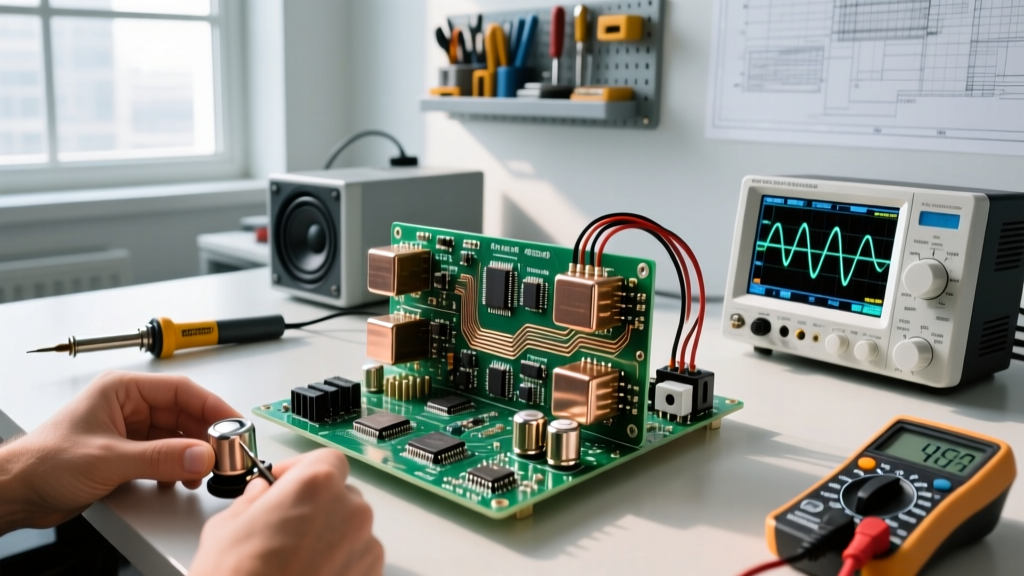

An audio power amplifier is an electronic circuit designed to take a low-level audio signal and increase both its voltage and current to drive a low-impedance load, like a loudspeaker, without distorting the original waveform. While a standard operational amplifier might output a few milliamps at high impedance, a power amp delivers the raw amperage required to physically move a speaker cone back and forth.
The Core Function: Voltage vs. Power Amplification
What a power amplifier fundamentally changes in a real circuit is the output impedance and current delivery capability. A standard voltage amplifier (like an op-amp used in a tone stack) has a relatively high output impedance and can only source or sink perhaps 30mA to 50mA. If you connect an 8-ohm speaker directly to it, the speaker will draw far more current than the op-amp can provide, causing the output voltage to collapse and the silicon to overheat.
A power amplifier solves this by acting as a current buffer with massive gain. Think of a preamp as a high-pressure, low-volume water line—it has the signal pressure (voltage) but lacks the volume (current). A power amplifier acts as a massive pump that reads that pressure signal and opens a wide valve, delivering high-volume flow (current) to spin a water wheel (the speaker). It achieves this by lowering its output impedance to a fraction of an ohm, allowing it to source amps of current into a 4-ohm or 8-ohm load while maintaining the voltage swing dictated by the input signal.
Worked Example: Calculating Real-World Output Power
Marketing materials for audio boards often claim '50W per channel,' but on the bench, physics dictates the real limits based on your power supply and load impedance. Let's calculate the actual continuous RMS power for a typical Class D amplifier IC (like the Texas Instruments TPA3116D2) running off a standard 24V DC laptop power brick, driving an 8-ohm bookshelf speaker.
The Math: 24V Rail into 8 Ohms
- Supply Voltage ($V_{CC}$): 24V DC
- Max Peak Voltage ($V_{peak}$): A Class D amp cannot swing perfectly rail-to-rail due to MOSFET $R_{DS(on)}$ resistance and dead-time. We lose about 2V. So, $V_{peak} = 22V$.
- RMS Voltage ($V_{RMS}$): For a sine wave, $V_{RMS} = V_{peak} / \sqrt{2}$.
$22V / 1.414 = 15.56V_{RMS}$. - Real Power ($P$): Using Ohm's Law ($P = V^2 / R$):
$(15.56)^2 / 8\Omega = 242.1 / 8 = \mathbf{30.26W}$.
30.2W RMS is your true, clean, continuous output. To actually hit 50W into 8 ohms, you would need a power supply capable of delivering at least 32V DC and an amplifier IC rated for that higher voltage. If you drop the speaker impedance to 4 ohms with that same 24V supply, the math changes to $(15.56)^2 / 4 = 60.5W$ (though you must now ensure your power supply can deliver the required 2.5+ amps per channel without browning out).
Where You Meet Audio Power Amplifiers in Practice
You interact with power amplification stages constantly, even if they are hidden inside modern integrated electronics:
- Active Studio Monitors: Speakers like the Yamaha HS8 or KRK Rokit have bi-amped power stages built directly into the rear cabinet. They use electronic crossovers to send low frequencies to a high-current Class D amp for the woofer, and high frequencies to a lower-power amp for the tweeter.
- DIY Bluetooth Speakers: Makers building portable boomboxes typically pair a Bluetooth audio receiver module with a micro Class D board (often based on the PAM8403 or TPA3110) to drive full-range drivers off a 3S or 4S LiPo battery pack.
- Home Theater AVRs: Audio/Video Receivers contain multi-channel power amplifiers. While older, heavy models used massive toroidal transformers and Class AB output transistors, modern 2026 AVRs almost exclusively use highly efficient Class D modules to keep chassis sizes and heat dissipation manageable across 7 to 11 channels.
- Car Audio Subwoofer Amps: These are dedicated high-current Class D monoblocks designed to step up 12V-14V alternator voltage to high-voltage rails, delivering thousands of watts into 1-ohm or 2-ohm subwoofer loads.
Common Confusions: Pre-Amps, Op-Amps, and Integrated Units
When sourcing parts or debugging a signal chain, confusing a power amplifier with other audio stages is a common pitfall that leads to blown components or deafening hum.
Pre-Amplifier vs. Power Amplifier:
A pre-amp selects your input source, applies volume control, and handles tone/EQ. It outputs a 'line-level' signal (typically 1V to 2V RMS) meant to travel through shielded RCA or XLR cables. A pre-amp cannot drive a speaker. If you wire a speaker to a pre-amp's output, you will get a faint, distorted whisper and likely fry the pre-amp's output buffer.
Operational Amplifier (Op-Amp) vs. Power Amp:
Chips like the legendary NE5532 or TL072 are op-amps. They are incredible for voltage gain and active filtering, but they are strictly low-current devices. They are designed to drive 10k-ohm inputs of the next stage, not a 4-ohm voice coil. For a deep dive into how Class D topology differs from linear op-amp designs, Analog Devices provides an excellent technical breakdown of Class D audio architecture.
Integrated Amplifier:
This is simply a single metal chassis that houses both a pre-amp section (with volume knobs and input selectors) and a power amp section (with heavy binding posts for speaker wire). When you buy a 'stereo amp' for a turntable setup, you are usually buying an integrated unit.
Decision Tree: Picking the Right Amp IC for Your Build
Choosing the right amplifier topology and IC depends entirely on your power supply constraints, efficiency requirements, and audio fidelity goals. Use the matrix below to route to your optimal silicon.
| Constraint / Goal | Topology | Recommended IC / Module | Why It Wins Here |
|---|---|---|---|
| Battery powered (12V-24V), needs high efficiency, compact PCB | Class D | TPA3116D2 (Texas Instruments) | Up to 90% efficiency, minimal heat sink needed, widely available on cheap breakout boards. Requires an LC output filter. |
| Ultra-low budget, 5V USB powered, tiny portable speaker | Class D (Filterless) | PAM8403 (Diodes Inc.) | Runs on 5V, no output inductors required (saves board space), outputs 3W per channel into 4 ohms. |
| Audiophile linear build, zero EMI concerns, massive power supply available | Class AB | LM3886 (Texas Instruments) | Exceptional THD+N (0.06%), legendary 'chipamp' sound, but requires a massive heat sink and dual-rail (+/- 28V) linear PSU. |
| High-power PA system or Subwoofer (400W+), 48V+ rail | Class D (High Voltage) | HYPEx NC400 or ICEpower modules | Discrete or advanced Class D modules designed for kW-level output with studio-grade distortion metrics. |
The Default Recommendation
If you are building a DIY desktop speaker, a garage sound system, or a custom Bluetooth boombox and you have a 19V to 24V DC power brick sitting in your parts bin, buy a pre-assembled TPA3116D2 module. It is the undisputed king of the DIY audio bench. It delivers roughly 30W to 50W per channel (depending on your speaker impedance), runs cool enough to mount inside a sealed wooden enclosure without forced air, and costs under $15 for a stereo board. Just ensure you use proper shielded audio cables for the input and keep the high-current speaker wires away from the input traces to avoid ground loop hum.
For complete electrical and thermal specifications, always verify your design against the official TPA3116D2 datasheet from Texas Instruments before finalizing your PCB layout or enclosure thermal venting.


